Girls in USA Gymnastics compete in one of two programs. The Development Program climbs from Level 1 to Level 10: set routines at Levels 1–5, then routines the coach builds at Levels 6–10. Xcel has six divisions, from Bronze to Sapphire, and every Xcel routine is built by the coach within that division's rules.
This chart puts every level side by side: the youngest age to compete, what the routines look like and the score that moves a gymnast up. Each card links to a full guide. It covers women's artistic gymnastics in the U.S.; boys' and men's levels have their own guide. New to all this? Our guide to how competitive gymnastics programs work starts at the beginning.
Find a level
Choose a program and a level for the short version: the youngest age, the routines and what it takes to move up.
Ages and scores come from USA Gymnastics' 2026–27 Rules & Policies. A gymnast must reach the youngest age for a level before her first sanctioned meet at that level (our guide to age requirements by level has the details), and move-up scores must come from live sanctioned meets.
At Levels 7–9, a gymnast who competes only some events can move up on those events with 8.50 on each of them, as an Individual Event Specialist. Our guide to all-around vs. event specialist entry explains the choice.
A C Value Part added to the mix; bonus for difficulty and connections
An 8.50 on one event opens only that event in the next division, as an Individual Event Specialist. Gymnasts new to competition can start Xcel at Bronze, Silver or Gold, and a gymnast under 12 can petition to enter Sapphire with a video of her skills.
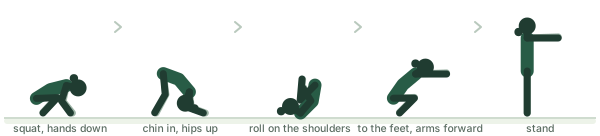
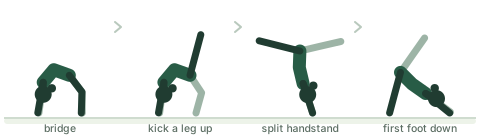
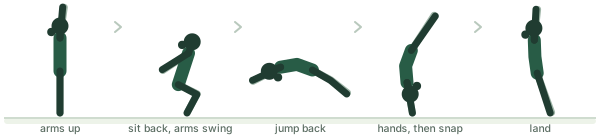
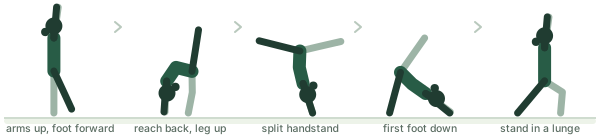
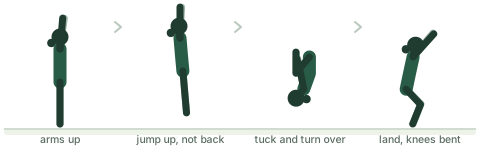
Each card gives the essentials and links to the full guide. The drawings show a skill from that level's routines; you'll find all of them in our gymnastics moves library. For the skills on every event at every level, see our guide to skill requirements for Levels 1–10.
Levels 1–3: the developmental levels
Gymnasts learn short set routines on vault, bars, beam and floor. There's no score to reach: a gymnast passes each routine by meeting three of its four Evaluation Points, the checkpoints USA Gymnastics sets for the skills, and her coach decides when she moves on. To compare one event across Levels 1–5, see our guides to vault, bars, beam and floor.
Development Program · Levels 1–3
Level 1
The first level: short routines built from basic shapes, rolls and balances. A gym can run Level 1 in the gym instead of at a meet.
Youngest age
4th birthday
Routines
Set, on all four events
To move up
Evaluation Points, no score
Key skills: a back hip pullover and back hip circle on bars; a cartwheel, backward roll and candlestick on floor; a stretch jump and arabesque on beam.
The last developmental level, and the first with a handspring vault and a round-off back handspring on floor.
Youngest age
6th birthday
Routines
Set, on all four events
To move up
Evaluation Points; Level 4 needs her 7th birthday
Key skills: a handspring over a raised mat stack; a front hip circle and squat-on on bars; a cross handstand on beam; a round-off back handspring on floor.
Routines are still set, the same for every gymnast, but meet scores now decide when she can move up. Judges score each routine out of 10.0, and the four event scores add up to her all-around score. Our guide to following the floor routines helps families know what to watch.
Development Program · Levels 4–5
Level 4
The first level where meet scores decide moving up. Vault moves to the vault table, and floor adds a back walkover and two back handsprings in a row.
Youngest age
7th birthday
Routines
Set, scored at meets
To move up
34.00 all-around; two 36.00 scores go straight to Level 6
Key skills: a glide kip mount and long hang kip on bars; a cartwheel and cross handstand on beam; a back walkover and front handspring step-out on floor.
From Level 6, the coach builds each routine. Every event has Special Requirements, the elements a routine must include, and the skills she chooses carry set values called Value Parts. Together they decide her Start Value, the highest score the routine can earn before deductions. Our guides explain what changes from compulsory to optional and set out the beam and floor requirements for Levels 6–10.
6
Development Program · optional
Level 6
The first optional level. On bars, for example, she needs a cast at least 45° above horizontal, a bar change with skills on both bars and a salto dismount.
Youngest age
7th birthday
To enter
32.00 all-around at Level 5
To move up
32.00 all-around
Also required: a 180° split leap or jump and a full turn on beam; two tumbling passes with different saltos on floor.
Bars needs a cast to handstand, credited from 45° short of vertical, and floor needs at least two tumbling passes, with a backward, a forward and a stretched salto among them.
Youngest age
7th birthday
To enter
32.00 all-around at Level 5 or 6
To move up
32.00 all-around, or 8.50 on each event she competes
Also required: an acro series plus an acro flight element on beam, which can be part of the series.
Bars needs two bar changes and a flight element, beam needs two flight elements connected in a series, and the bars and beam dismounts must be rated at least B.
Youngest age
8th birthday
To enter
34.00 all-around at Level 8
To move up
34.00 all-around, or 8.50 on each event she competes
Also required: a last tumbling pass on floor with a salto rated at least B.
The top of the Development Program. Each routine on bars, beam and floor needs four event requirements and at least three A, three B and two C Value Parts, from a 9.20 base Start Value.
Youngest age
9th birthday
To enter
34.00 all-around at Level 9
Next
College teams or the elite pathway
Also required: two different flight elements on bars, one rated at least C.
Every Xcel routine is built by the coach within the division's rules, from the first division up. USA Gymnastics describes Xcel as an alternative program, meant to give gymnasts of any age, ability or training commitment a chance to compete. Our Xcel guide covers all six divisions.
B
Xcel · first division
Xcel Bronze
Basic shapes, control and connections. Bars stays on the low bar, floor can include cartwheels, round-offs, handstands and rolls but no saltos or aerials, and vault uses set progressions onto a mat stack.
Vault moves to the vaulting table, and routines open up. A kip on bars or a salto on floor may appear in a Gold routine, though neither is required of every gymnast.
Bars, beam and floor each need a B-rated skill in the mix. Bars includes a kip requirement, floor includes salto tumbling, and vault has its own chart.
A separate national pathway with its own compulsory, optional and meet-entry requirements, leading to national team selection and international competition. USA Gymnastics' TOPs and Hopes programs help prepare younger athletes.
Who
Gymnasts who meet USA Gymnastics' elite qualifying standards
NCAA women's teams compete under Level 10 rules with NCAA modifications, in a 10.0 Start Value system. A gymnast doesn't need to have competed elite to compete in college.
Boys follow USA Gymnastics' men's pathways: introductory classes, the Club Track, the National Track and an elite pathway, with prescribed routines at Levels 3–6 and more choice at Levels 7–10.
Boys' high barSet routines and first giant swings in Levels 3–6
Moving up, skipping a level and switching programs
A qualifying score makes a gymnast eligible for the next level; it doesn't make her ready. USA Gymnastics can't require a gymnast to move up, and her coach decides when she's ready.
From
To
What she needs
Level 3
Level 4
Her 7th birthday; no score
Level 4
Level 5
34.00 all-around at Level 4
Level 4
Level 6, skipping Level 5
36.00 all-around at two Level 4 meets, from the current or previous season
Level 5
Level 6, or Level 7 skipping Level 6
32.00 all-around at Level 5; she can also move back and forth between Levels 5 and 6
Level 6
Level 7
32.00 all-around at Level 6
Level 7
Level 8
32.00 all-around, or 8.50 on each event if she competes only some events
Level 8
Level 9
34.00 all-around, or 8.50 on each event she competes
Level 9
Level 10
34.00 all-around, or 8.50 on each event she competes
Xcel
Development Program
She enters at Level 4 or below
Development Program
Xcel
USA Gymnastics' entry chart sets her division, after at least one all-around meet at her Development Program level
USA Gymnastics sets a youngest age for every level and division, and she must reach it before her first sanctioned meet at that level, qualifiers included. Pick the age she'll be at her first meet.
Age is only the first check. Level 5 and up, and Xcel Platinum and up, also need a qualifying score from the level below, and her coach decides when she's ready.
Common questions
How many levels are there in gymnastics?
USA Gymnastics' women's Development Program has 10 levels, and Xcel has six divisions, Bronze to Sapphire. Elite and college sit beyond them. Our guide to gymnastics levels explains how the programs fit together.
What age can a gymnast start each level?
Level 1 needs her 4th birthday, Level 4 her 7th and Level 10 her 9th. Xcel runs from age 5 for Bronze to 12 for Sapphire. She must reach the age before her first sanctioned meet, and the chart above lists every level.
Is Xcel Gold the same as Level 4?
No. USA Gymnastics doesn't publish a chart that converts Xcel divisions into levels. Its entry chart only sets which Xcel division a Development Program gymnast can enter; our guide to Xcel vs. the Development Program explains it.
Can a gymnast skip a level?
Yes, in two places. Two 36.00 all-around scores at Level 4 let her go straight to Level 6, and a 32.00 at Level 5 lets her skip Level 6. Levels 1–3 have no scores, so her coach decides when she moves on.
What comes after Level 10?
Level 10 is the top of the Development Program. From there, gymnasts can aim for college teams or, by meeting the elite qualifying standards, the separate elite pathway. Our guide to the highest gymnastics level compares them.
Do boys use the same levels?
No. Men's gymnastics has its own pathways and levels, on six events instead of four. Our guide to men's gymnastics levels explains them.
Final Takeaway
Start with the program. The Development Program climbs one level at a time from Level 1 to Level 10, while Xcel gives every division coach-built routines. In both, age opens the door and a score from a live meet makes the next step possible, but her coach decides when she's ready.