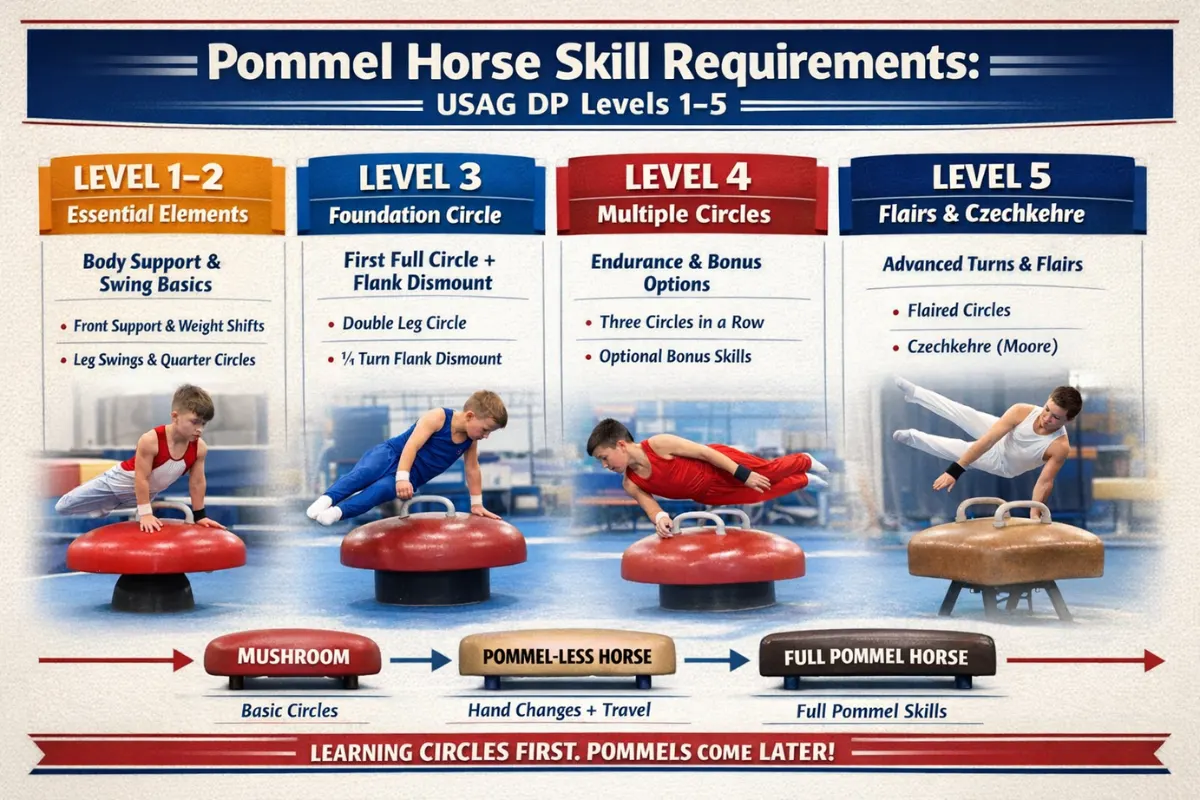
Pommel horse at a boys’ meet can look nothing like the event on TV. In USA Gymnastics’ early competitive levels, boys do their pommel routines on a mushroom: a round, padded trainer with no handles. The full horse with its two pommels comes later.
In the U.S. men’s program, the compulsory levels are Levels 3 to 6. Every boy at a level performs the same set routine, written in USA Gymnastics’ 2025–2028 Men’s Development Program Competition Manual. From Level 7, routines are built for each gymnast.
This guide explains where pommel horse sits in those levels, how it is set up and judged for young boys, and what it turns into at the optional levels and in elite gymnastics. It doesn’t reproduce the routines. They are in the manual, a paid e-book, and they were rewritten for the 2025–2028 cycle, so routine lists from earlier years no longer apply.
Where Pommel Horse Fits in the Boys’ Levels
USA Gymnastics’ Men’s Program Rules & Policies (version 10.27.25) leave levels, ages, equipment and routines to the competition manual (p. 31). The program’s public pages give the outline:
| Stage | Levels | Ages | What happens on pommel horse |
|---|---|---|---|
| Essential Elements | 1, 2 and 3 | Designed mainly for boys 4–10 | Pre-competitive basics; no meet routine |
| National Track, compulsory | 3–6 | From the calendar year a boy turns 6 | The same set routine for everyone at the level, on the mushroom through Level 5 |
| National Track, optional | 7–10 | At least 12 (Levels 7–8), 14 (Level 9) or 16 (Level 10), turned in the calendar year | Each gymnast’s own routine |
| Club Track | Its own levels | Boys 5 and older | A more recreational route with a “modified optional” format |
Two labels cause confusion. Essential Elements is called “Level 1–2–3”, but its Level 3 is not the same thing as competitive Level 3. And Levels 1 and 2 in the men’s program aren’t competition levels at all.
Boys usually stay at one level for the season, although USA Gymnastics’ compulsory-track page says they can switch levels during the season “up to a point”. The move to optional isn’t strictly one level at a time either: according to the optional-track page, a boy who spent several years in the compulsory track can go straight to Level 8 or 9, depending on his age. A separate Junior Elite route starts at Level 6 with a Future Stars division for boys aged about 10 to 12 (Rules & Policies, p. 38), which adds the technical sequences set out in a second USA Gymnastics manual. For the bigger picture across all six events, see how the men’s gymnastics levels fit together.
How Pommel Horse Is Set Up for Young Boys
At Levels 3, 4 and 5 the competition apparatus is the mushroom. USA Gymnastics’ committee clarifications for those three levels describe the flank dismount with the feet reaching the height of the top of the mushroom (Men’s Development Program Newsletter #4, February 2025).
The mushroom suits beginners because there are no pommels to grip or move between. A boy can keep circling on one rounded surface and learn the part of the event everything else depends on: supporting his body on his hands while his legs swing around without stopping. The competition horse adds handles and length. Under the Apparatus Norms of World Gymnastics (formerly FIG), it stands 115 cm high with pommels 12 cm tall (2026 edition, p. 29), and elite routines use every part of it.
The public documents don’t say which apparatus Level 6 uses, and they don’t publish equipment heights for any compulsory level. Those details sit in the manual’s equipment rules, so the meet information or your son’s coach is the place to check.
One rule is specific to this event: coaches can’t stand by as spotters. USA Gymnastics treats a spotter on the pommel horse or floor area as non-permitted, which costs 0.3 at the compulsory levels (Newsletter #2, December 2024).
How Judges Score a Compulsory Pommel Horse Routine
Because everyone at a level performs the same routine, the score is mostly about how well each part is done. The manual breaks each routine into numbered parts, which the program calls boxes, and each box has performance criteria the judges check.
Every compulsory level has two divisions (National Track compulsory page):
- Division 1 gymnasts can add Specified Bonus (SB) skills to the base routine to raise their score.
- Division 2 gymnasts perform the base routine only. Adding bonus skills is penalized, apart from a few listed exceptions (Newsletter #3, February 2025).
The newsletters set out a few more principles for Levels 3–6. Bonus can still be awarded when the bonus skill has several small or medium errors, or one large error, but not after a fall, and not if part of the bonus box is missing (Newsletter #3; Newsletter #5, January 2026). Under what the program calls the “50% rule”, a clearly attempted skill that gets far enough can still earn credit, while a skill that isn’t attempted at all can’t. Neutral deductions, such as the spotter penalty, come off the final score without changing the start value.
On pommel horse, the judges are watching for swing that never stops. USA Gymnastics’ description of the men’s events says judges deduct when the hips aren’t high enough, when scissors lack leg separation and when handstands aren’t completed. On the mushroom the focus is the circles. In elite judging, bent hips, a lack of body extension and legs drifting apart in circles all cost execution points (FIG men’s Code of Points 2025–2028, p. 46). Those are the standards a young gymnast’s circles are heading toward.
The routines grow from there. By Level 5, flairs (circles with the legs straddled) and spindles (circles combined with a turn of the body) appear, at least among the bonus options (Newsletter #3). If those terms are new, our guide to artistic gymnastics moves by event shows what each men’s apparatus involves.
What Comes Next: Optional Levels and Elite Pommel Horse
From Level 7, coaches build each routine around the gymnast’s strengths (National Track optional page). Skills are valued mostly on FIG’s letter scale, and a routine earns credit for covering the event’s element groups. The value a skill needs for full element-group credit climbs through the optional levels, from an A at Levels 7 and 8 to a C at Level 9 and a D at Level 10 (Newsletter #2). At the top, Level 10 Junior Elite gymnasts compete under FIG rules (2026 Championship Season Directives, p. 9).
FIG describes elite pommel horse in its men’s Code of Points as circles and flairs, single-leg swings and scissors, and swings through handstand, using all parts of the horse. Every element has to be swung without interruption, and strength or hold elements aren’t allowed (Section 11.1, p. 40). That makes it the opposite of still rings, where holds are the point. The skills fall into four element groups (p. 41):
| Element group | What it covers |
|---|---|
| I | Single-leg swings and scissors |
| II | Circles and flairs, including versions with spindles or handstands, plus Kehrswings, Russian wendeswings and flops |
| III | Travels along the horse |
| IV | Dismounts |
Named skills give a sense of the scale. The Magyar and Sivado travels, which cross the whole horse forward and backward, are both D-value elements (p. 55). The difficulty score counts the dismount plus the seven best other elements, along with credit for each element group covered (Art. 6.1, p. 14). Pommel horse dismounts don’t earn the stick bonus available on other men’s events (Art. 7.2). For the full calculation, see how the FIG D-Score is calculated.
Execution still decides a lot. In the pommel horse final at the 2025 World Championships in Jakarta, Hong Yanming of China won with a 5.600 D-score and a 9.000 E-score (14.600). Patrick Hoopes of the United States had the joint-highest difficulty in the final, 6.000, and took bronze on 14.566.
Common Questions
Do boys compete pommel horse on a mushroom?
Yes, through Level 5. USA Gymnastics’ 2025 clarifications for Levels 3–5 describe the dismount in relation to the top of the mushroom. What Level 6 uses is set in the competition manual.
Why does pommel horse take boys so long to learn?
It is a support event with continuous swing and no pauses allowed. USA Gymnastics’ event guide notes that mastering the basics on this apparatus often takes twice as long as on the other events.
Where can I see the current Level 3–6 pommel horse routines?
In the 2025–2028 Men’s Development Program Competition Manual, sold as an e-book on Google Play (USA Gymnastics course page), with corrections published in the program’s newsletters. Your son’s coach should have it. Routine lists marked 2021–2024 describe the previous cycle.
What’s the difference between Division 1 and Division 2?
Both perform the same base routine. Division 1 gymnasts can add Specified Bonus skills; Division 2 gymnasts can’t.
Do the other men’s events work the same way?
The levels, divisions and judging principles are shared, but the equipment and skills differ from event to event. Rings, for example, is built around held positions instead of nonstop swing: see what boys do on still rings in the compulsory levels.
The Short Version
Boys’ pommel horse in USA Gymnastics starts on the mushroom. Levels 3–6 are compulsory, with one set routine per level, a bonus route for Division 1 and judging that rewards continuous, clean circles. From Level 7, gymnasts build their own routines, heading toward the elite event: circles, flairs, scissors and travels across the whole horse, without a single stop. For the exact current routines, the 2025–2028 manual is the only official source.