USAG Women’s Floor Requirements: Levels 6–10
USAG women’s Development Program Levels 6–10 use optional floor routines. Gymnasts and coaches choose the routine’s elements and choreography within the level’s rules, rather than performing one universal compulsory routine.
Contents
- Levels 6–8: how the floor requirements progress
- Levels 9 and 10: more difficulty, not just more tumbling
- Three separate tumbling checks at Levels 8–10
- What counts in the dance passage?
- Value parts and special requirements answer different questions
- Start value and final score are different
- Allow enough time for the whole performance
- Final Takeaway
- Main Sources
This overview uses the 2026–2030 optional rules. It highlights how requirements change across the levels; it is not a substitute for the full Code, element tables and subsequent technical updates.
Levels 6–8: how the floor requirements progress
The 2026–2030 Levels 6–8 scoresheet lists the special requirements and value-part counts.
| Level | Acrobatic requirements in brief | Dance and turn requirements |
|---|---|---|
| 6 | One pass with two directly connected flight elements, including a salto; a second pass with a different salto, using two directly connected flight elements or an isolated B salto. | A passage of two different Group 1 elements, including a leap requiring a 180° cross or side split; at least a full turn on one foot. |
| 7 | Two passes: one with a backward salto and two directly connected flight elements, and one with a forward salto. At least one forward or backward salto must be stretched without twist and land on two feet. | The same dance-passage and full-turn requirements as Level 6. |
| 8 | A pass containing two saltos; three different saltos in the routine; at least an A salto in the last acrobatic pass initiated. | A passage of two different Group 1 elements, including a leap requiring a 180° cross or side split. |
“Salto” means a somersault without hand support. An aerial is not counted as one of the three different saltos specified for Level 8. The permitted ways of connecting elements and the exact skill recognition rules still matter.
The first distinction is between a flight element and a salto. A handspring has flight as well as hand support; a salto has an unsupported somersault. Level 6’s two-flight-element pass can therefore include a handspring and a salto. That does not make it a two-salto pass.
For example, a Level 6 routine cannot meet the requirement for a different salto in the second pass simply by repeating the identical salto with different choreography around it. Likewise, describing a Level 7 salto as a layout is incomplete unless its no-twist and two-foot landing conditions are also considered.
Levels 9 and 10: more difficulty, not just more tumbling
Under the 2026–2030 Levels 9–10 scoresheet, both levels require a pass with two saltos, three different saltos overall, and a dance passage with two different Group 1 elements including the specified 180° leap.
The last acrobatic pass initiated must contain at least a B salto at Level 9 or a C salto at Level 10. That last-pass wording is important when evaluating a routine’s construction.
| Level | Required value parts | Base start value |
|---|---|---|
| 6 | 4 A, 2 B | 10.0 |
| 7 | 4 A, 3 B | 10.0 |
| 8 | 4 A, 4 B | 9.8 |
| 9 | 3 A, 4 B, 1 C | 9.5 |
| 10 | 3 A, 3 B, 2 C | 9.2 |
The base values assume the underlying requirements are met. Level 8 adds up to 0.20 in composition credit; Level 9 up to 0.20 plus 0.30 in regular bonus; Level 10 up to 0.30 plus 0.50 in regular bonus. These routes can build the start value to 10.0. A separate Level 10 extra-bonus provision has additional conditions.
Three separate tumbling checks at Levels 8–10
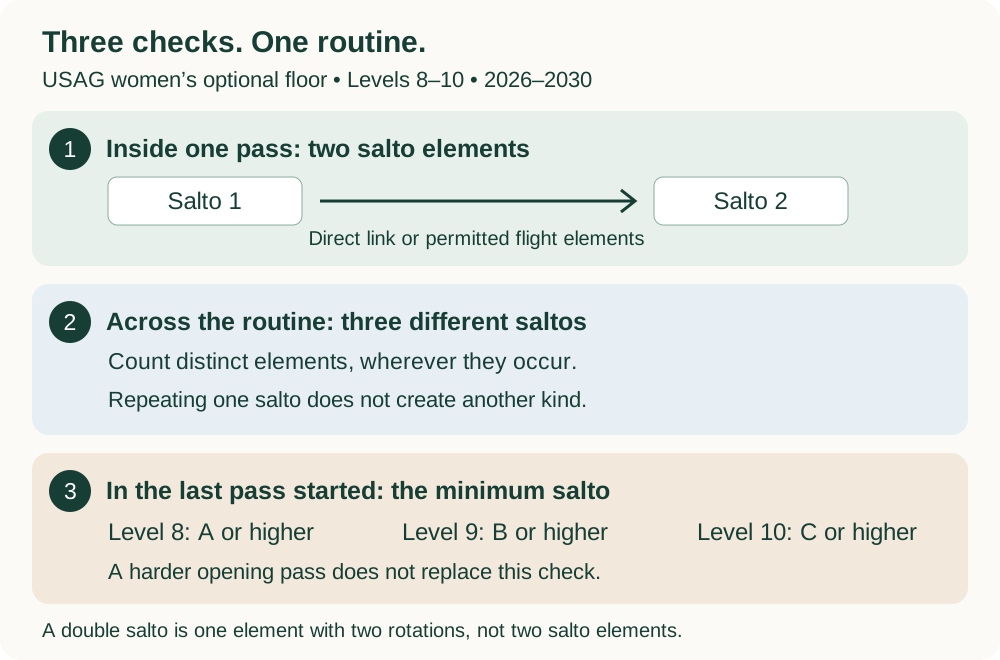
First, count the elements in one pass. Two salto elements may be the same or different. They can connect directly, or indirectly through the permitted flight elements. A double salto is one element containing two somersaults; by itself it does not satisfy the two-salto-element pass requirement. Stops, extra steps or dance inside an intended indirect acro connection can break that pass.
Then count the different saltos across the routine. Repeating a salto does not make it a new kind. Nor does adding a step-out landing turn the same salto into a different element for this requirement. A routine could include a two-salto pass yet still lack three different saltos overall.
Finally, check the last acro pass started. Its credited salto must be at least A at Level 8, B at Level 9 or C at Level 10. A difficult opening pass cannot replace the required content in that last pass. This is why the order of planned passes matters as well as the list of skills.
What counts in the dance passage?
Group 1 is the Code’s family of leaps, jumps and hops. The passage needs at least two different credited Group 1 elements, and at least one must be a leap whose description requires a 180° cross or side split. A split jump cannot take the place of that required leap.
A direct link joins the dance elements without intervening steps. An indirect link may include running steps, small hops, chassés, assemblés or turns while the movement continues. A pause or stop breaks the passage, as does inserting an acrobatic element between the dance elements.
| Sequence considered by itself | Why it falls short |
|---|---|
| A straddle jump linked to a wolf jump | Two Group 1 elements do not replace the required 180° split leap. |
| A split leap linked only to a full turn on one foot | The turn is not the second Group 1 element. |
| Two otherwise qualifying dance elements separated by a back handspring | The acro element breaks the dance passage. |
The written 180° requirement and a deduction-free performance are separate questions. For the required split leap, the Code specifies at least 135° of leg separation for Value Part and passage credit; a short split can still receive execution deductions. The leap’s front-leg position and full element description also matter. Credit should not be judged from an oblique photograph alone.
Value parts and special requirements answer different questions
Value parts count the recognized skills in difficulty categories such as A and B. Special requirements describe particular content the routine must show, such as a dance passage or a kind of acrobatic pass. Having enough total skills does not automatically satisfy every special requirement.
Imagine a routine with enough recognized elements to meet its value-part count but without the required dance passage. Counting the elements again would not solve the missing passage. Conversely, a routine might show the broad kinds of content required while still falling short of its value-part needs. Coaches check both.
Difficulty restrictions add another layer. A more difficult skill is not automatically an acceptable replacement for an easier one in every level. The current optional event rules identify allowed and restricted content alongside the requirements. This prevents a routine-planning shortcut such as “harder always covers easier.”
Start value and final score are different
A routine can contain the required skills and still lose points for how they are performed. Missing requirements, restricted elements and unsuccessful connections also have consequences under the relevant rules. A list of skill names alone cannot establish the final score.
The bonus guide explains bonus concepts separately. For earlier compulsory routines, use the Levels 1–5 floor guide rather than carrying optional requirements backward into a different program.
For a simplified Level 8 example, a routine meeting the underlying requirements starts from 9.80 and earns 0.20 in composition credit, giving a 10.00 start value. If it then receives 0.65 in performance deductions and no separate penalties, the arithmetic produces 9.35. This is an illustration, not a recorded competition result or a complete judging exercise.
Allow enough time for the whole performance
The current optional chart gives Levels 6 and 7 a maximum floor time of 80 seconds, and Levels 8–10 a maximum of 90 seconds. Those are routine limits, not instructions to fill every available second. The chosen music and choreography must support the requirements as well as the time limit.
The floor-timing comparison explains why a file’s displayed audio duration and the officially timed routine are not identical measurements. That distinction becomes useful when the coach adjusts an introduction, transition or ending.
Final Takeaway
Compare the required passes, salto variety, dance passage and difficulty separately. At Levels 8–10, two saltos in one pass, three different saltos overall and the final-pass requirement are distinct checks. A routine change may solve one of those problems without making every part harder.
When a coach changes a sequence, ask which requirement or performance issue the change addresses. For the rest of the four-event routine plan, use the Level Comparison; this page stays focused on floor.
Main Sources
- USA Gymnastics 2026–2030 optional event rules charts: floor requirements, difficulty allowances, Value Parts and routine times.
- Levels 6–8 scoresheet and Levels 9–10 scoresheet: requirement and scoring summaries.
- 2026–2030 Optional Code of Points, Floor 15–21 and Floor 39: acro passes, different saltos, dance-passage recognition and scoring distinctions.