Parallel Bars for Boys: How the USA Gymnastics Compulsory Levels Work
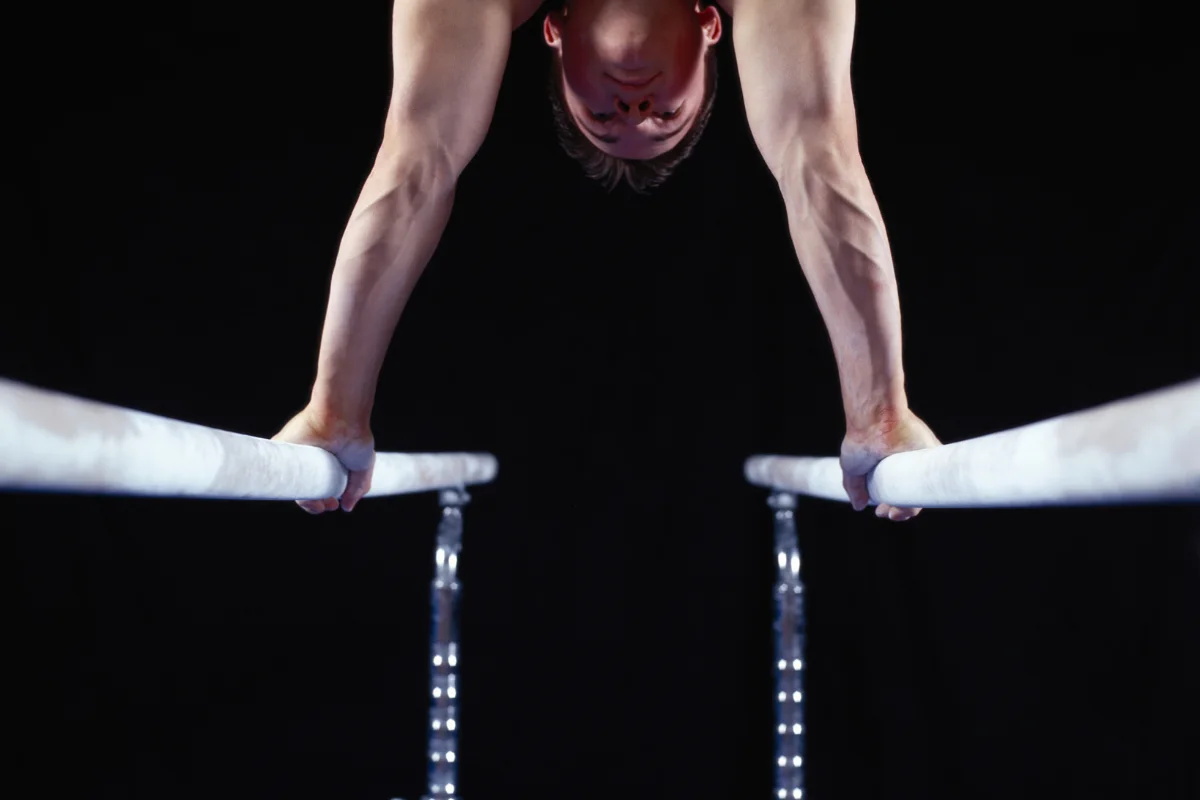
Parallel bars puts a gymnast on two rails at the same height and asks him to swing in three ways: in support above the rails on straight arms, resting on his upper arms, and hanging below. USA Gymnastics’ guide to the men’s events describes the event as mostly swing and flight, performed from support, hang and upper-arm positions with as few pauses as possible.
Contents
In the U.S. men’s program, boys first compete on parallel bars in the compulsory levels, Levels 3 to 6. At each level everyone performs the same set routine from USA Gymnastics’ 2025–2028 Men’s Development Program Competition Manual, and from Level 7 gymnasts build their own.
This guide explains where parallel bars fits in the boys’ levels, what USA Gymnastics has published about setting it up and judging it, and where the event leads. It doesn’t list the routines, which are in the paid manual. Copies of the 2021–2024 manual still turn up online, but those routines have been replaced.
Parallel Bars in the Boys’ Levels
USA Gymnastics’ Men’s Program Rules & Policies (version 10.27.25) say that levels, age requirements, equipment specifications and routine requirements are all in the competition manual (p. 31). The public overview looks like this:
| Track | Levels | Starting age | Routines |
|---|---|---|---|
| Essential Elements | 1–2–3 | Designed mainly for boys 4–10 | Pre-competitive; no meet routines |
| National Track, compulsory | 3–6 | The calendar year a boy turns 6 | One set routine per level, in Division 1 or 2 |
| National Track, optional | 7–10 | 12 for Levels 7–8, 14 for Level 9, 16 for Level 10, turned in the calendar year | The gymnast’s own routine |
| Club Track | Its own levels | 5 and older | “Modified optional” routines on a more recreational route |
The compulsory track runs until a boy’s senior year of high school. Within Level 6 there is also a Junior Elite division, Future Stars, for boys of about 10 to 12, which adds technical sequences (Rules & Policies, p. 38). Levels 1 and 2 aren’t competition levels in the men’s program: they sit inside Essential Elements, whose “Level 3” is a different thing from competitive Level 3.
The public rules describe the levels mainly by minimum age. Boys normally stay at one level for a season, with a switch allowed during the season “up to a point”, and a boy leaving the compulsory track after several years may go straight to Level 8 or 9, depending on his age. Our guide to the men’s gymnastics levels walks through the whole pathway.
How Parallel Bars Is Set Up for Young Gymnasts
Bar heights for young gymnasts aren’t published outside the manual, which holds the equipment specifications for each level. The meet information or your son’s coach will know the setup. For comparison, World Gymnastics (formerly FIG) sets elite rails 200 cm above the floor (Apparatus Norms, 2026 edition, p. 39).
The spotting rules are public. On parallel bars a spotter is allowed but not required (Men’s Development Program Newsletter #2, December 2024). If a spotter is used, leaving the apparatus during the routine costs a 0.2 neutral deduction at the compulsory levels, and physically helping the gymnast with a skill costs 0.5.
How Judges Score a Compulsory Parallel Bars Routine
The manual sets out each routine as numbered boxes, each with performance criteria for the judges. Every level has two divisions (National Track compulsory page). Division 1 gymnasts may add Specified Bonus (SB) skills; Division 2 gymnasts perform the base routine only and are penalized for adding bonus skills, apart from a few listed exceptions (Newsletter #3, February 2025).
The newsletters also explain how bonus and credit work across Levels 3–6. Bonus survives small or medium errors, or one large error, but not a fall or a missing part of the bonus box (Newsletter #3; Newsletter #5). A clearly attempted skill that gets far enough can still be credited under the program’s “50% rule”, while one that isn’t attempted can’t. Neutral deductions, like the spotter penalties above, come off the final score and leave the start value alone.
Two things stand out on this event: how high the swings go and how long the holds last. Public clarifications give clear examples:
- Handstands before the dismount. At Levels 4 and 5, the swing to handstand before the dismount is judged by height. If it stays below horizontal the deduction is 1.0; between horizontal and 45° from vertical it is 0.5; closer to vertical, the FIG handstand deductions apply. Level 5 also requires a 2-second hold in that handstand before the dismount (Newsletter #6, March 2026).
- Timed holds in bonus. In one Level 4 bonus, a hold under 1 second earns no bonus, a hold of 1–2 seconds earns the bonus with a 0.2 hold deduction, and a 2-second hold earns it in full (Newsletter #3).
- Form on bonus skills. At Level 6, a straight-leg Moy in the Division 1 bonus gets no bonus if the knees bend more than 90° (Newsletter #6).
What Comes Next: Optional Levels and Elite Parallel Bars
From Level 7, coaches put routines together to suit the gymnast (National Track optional page). Skills are valued mostly on FIG’s letter scale, and a routine earns credit for each element group it covers. The minimum value for full credit rises from an A at Levels 7 and 8 to a C at Level 9 and a D at Level 10 (Newsletter #2). The handstand also changes: at Levels 7–10, as in the FIG Code, a handstand needs no set hold to count (Newsletter #5, January 2026). Level 10 Junior Elite gymnasts compete under FIG rules (2026 Championship Season Directives, p. 9).
FIG groups parallel bars skills by the position they start from or pass through (men’s Code of Points 2025–2028, p. 94):
| Element group | What it covers |
|---|---|
| I | Elements starting in an upper-arm position |
| II | Elements in support, or through support, on both rails |
| III | Long swings in hang on one or both rails, and underswings |
| IV | Dismounts |
Some familiar names and their 2025–2028 values: the Diamidov and the Healy, both one-arm turning elements in support, are C (pp. 100, 102); the Bhavsar, a flight element that regrasps the rails, is an E (p. 104). The Moy from the Level 6 bonus leads into elite skills too: the Code lists the Tippelt as a piked Moy with a straddle to handstand, valued D (p. 104).
One-rail work adds a twist of its own. A skill that finishes in a handstand on one rail is worth the same as the two-rail version, but when it is connected to a Healy-type turn, it and the Healy each go up one value, as long as the Healy has no large error. Straddled elements to one rail, such as the Tippelt, can’t be upgraded this way (Art. 14.2.2, point 2, p. 94).
As on the other swinging apparatus, the difficulty score counts the dismount plus the seven best other elements (Art. 6.1, p. 14), along with element-group credit. Our explainer on how the FIG D-Score is calculated shows the full sum.
Clean swing still wins. In the parallel bars final at the 2025 World Championships, Zou Jingyuan of China scored 6.000 for difficulty and 9.300 for execution (15.300) to take gold by 0.800. Angel Barajas of Colombia had the highest difficulty in the final, 6.100, and finished fourth on 14.366.
Common Questions
Are spotters allowed on parallel bars at boys’ meets?
Yes. USA Gymnastics allows a spotter on parallel bars but doesn’t require one. A spotter who leaves during the routine, or who physically helps with a skill, triggers a neutral deduction.
Do boys have to hold handstands on parallel bars?
It depends on the level and the part of the routine. Level 5, for example, requires a 2-second handstand hold before the dismount. From Level 7, following the FIG Code, the handstand itself has no required hold.
Where can I find the current Level 3–6 parallel bars routines?
In the 2025–2028 Men’s Development Program Competition Manual, sold as an e-book on Google Play (USA Gymnastics course page), with corrections in the program’s newsletters. Copies of the 2021–2024 manual found online describe the previous routines.
Is parallel bars scored the same way as the other men’s events?
The levels, divisions and judging principles are shared, but each event sets its own skills and standards. Still rings, for instance, judges held strength positions on moving rings: see boys’ still rings in the compulsory levels. High bar takes the swing from hang much further: see what boys do on high bar.
Wrapping Up
Boys compete parallel bars in set routines from Level 3 to Level 6, in Division 1 with bonus or Division 2 without. Judges look closely at swing height, handstands and how long holds last, and a spotter is allowed, though one who leaves mid-routine or helps with a skill costs a deduction. From Level 7, routines are the gymnast’s own and head toward the elite event of upper-arm swings, handstands, Healy turns and long swings below the rails. For the exact current routines, check the 2025–2028 manual.