A, B, C, D and E Value Parts in USAG Gymnastics Explained
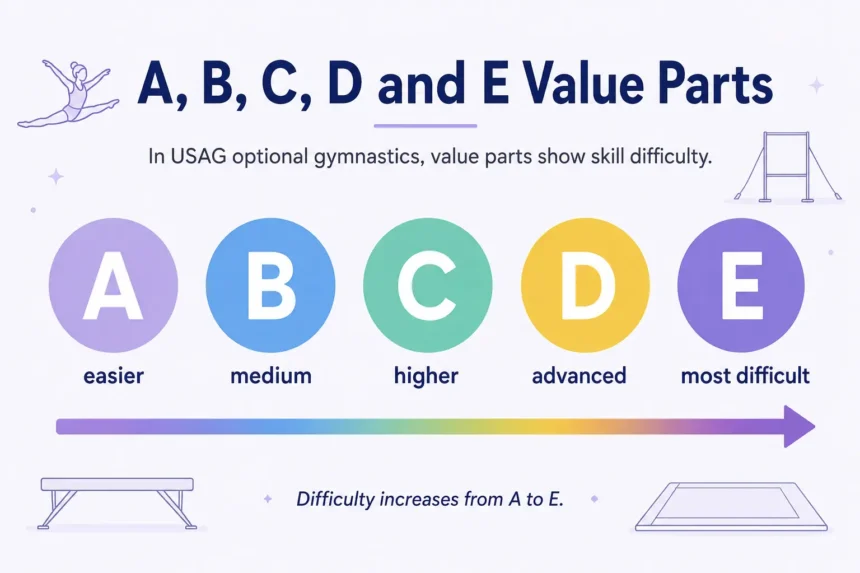
A coach might say a routine needs “another B” or that a gymnast is learning “a D skill.” Those letters describe the difficulty of individual skills, and they help judges decide how much a routine is worth before deductions.
Contents
- What Do A, B, C, D and E Mean in Gymnastics?
- How Many Value Parts Does Each Level Need?
- How Much Is a Value Part Worth?
- Which Harder Skills Are Allowed at Each Level?
- How D and E Skills Earn Bonus
- What Happens If Judges Do Not Credit a Skill?
- Are USAG Value Parts the Same as FIG Difficulty Values?
- Frequently Asked Questions
In the USA Gymnastics Women’s Development Program, this difficulty classification is called a Value Part, usually shortened to VP. The scale progresses from A through E, with later letters representing greater difficulty.
Each optional level requires a particular number and mix of Value Parts. Harder allowed skills can fill places assigned to easier skills, while some advanced elements can also earn bonus.
This guide covers Levels 6–10 on Uneven Bars, Balance Beam and Floor Exercise under the 2026–2030 Development Program Optional Code of Points. Vault uses its own value charts.
What Do A, B, C, D and E Mean in Gymnastics?
The letter tells judges where a recognized skill sits on the Development Program difficulty scale.
| Value Part | Place on the difficulty scale | Main role in optional routines |
|---|---|---|
| A | The starting category | Helps meet the basic skill count |
| B | More difficult than A | Becomes a larger part of the required mix as levels progress |
| C | More difficult than B | Appears in the required mix at Levels 9 and 10 |
| D | Advanced difficulty | Can replace lower required Value Parts and earn bonus where allowed |
| E | The highest letter category in this DP system | Can replace lower required Value Parts and earn bonus where allowed |
An A skill is not necessarily easy for a beginner. It is simply at the lower end of this competitive scale. Likewise, the letter does not describe how well the gymnast performs the skill or how difficult it feels to that individual gymnast.
USA Gymnastics lists skills by apparatus and technical description. Details such as the body position, amount of turning and way the skill is performed help determine its classification. A similar-looking movement on Beam and Floor should not automatically be assumed to have the same value.
Value Parts help determine a routine’s Start Value: its starting score before performance deductions. They are one part of that calculation, alongside the other requirements for the gymnast’s level.
How Many Value Parts Does Each Level Need?
The current requirements on Bars, Beam and Floor are:
| Level | A Value Parts | B Value Parts | C Value Parts | Total required VP count |
|---|---|---|---|---|
| 6 | 4 | 2 | 0 | 6 |
| 7 | 4 | 3 | 0 | 7 |
| 8 | 4 | 4 | 0 | 8 |
| 9 | 3 | 4 | 1 | 8 |
| 10 | 3 | 3 | 2 | 8 |
These counts come from USA Gymnastics’ current Levels 6–8 rules chart and Levels 9–10 rules chart.
The table describes the required difficulty mix, rather than every movement in the routine. A gymnast may perform additional skills and choreography beyond these counts.
Also, “3 A” does not mean a Level 10 gymnast must perform three actual A-rated skills. Higher allowed Value Parts can fill those places.
Can a Harder Skill Replace an Easier One?
Yes. A higher Value Part can replace a lower required Value Part, provided the skill is allowed and receives credit. A lower Value Part cannot replace a higher one.
For example, a Level 10 routine needs:
3 A + 3 B + 2 C
Suppose judges recognize:
3 A + 3 B + 1 C + 1 D
The D fills the place of the second required C. All eight required Value Parts are covered. The D may also earn difficulty bonus if it meets the separate bonus conditions.
Replacement works one-for-one. One D can fill one lower required place; it cannot replace several A skills at once.
What If the Routine Has Fewer A Skills?
A second hypothetical Level 10 routine contains:
2 A + 4 B + 2 C
Three B skills cover the three required B places. The extra B fills the missing A place, so this routine also meets the basic Value Part requirement.
The useful question is whether all the required places can be filled by the skills judges count. Matching the letters in the table exactly is unnecessary.
How Much Is a Value Part Worth?
The familiar numbers A = 0.10, B = 0.30 and C = 0.50 belong to the Development Program’s Start Value calculation.
For a beginner, the clearest way to use them is to understand the loss when a required Value Part remains missing after allowed replacements:
| Missing required Value Part | Reduction from Start Value |
|---|---|
| One A | 0.10 |
| One B | 0.30 |
| One C | 0.50 |
The current Level 10 judging reference lists the A, B and C amounts as 0.10, 0.30 and 0.50 respectively. NAWGJ’s 2026–2030 Level 10 reference.
These are not execution deductions for a poorly performed skill. They reduce the routine’s starting score because part of its required difficulty is missing.
Example: One B Receives No Credit
Suppose a Level 8 routine is planned with exactly 4 A + 4 B. One B receives no Value Part credit, leaving 4 A + 3 B, with no other skill available to fill the missing place.
The missing B reduces the Start Value by 0.30. If everything else still supports a 10.00 Start Value, the calculation is:
10.00 − 0.30 = 9.70 Start Value
Execution deductions are then taken from 9.70. In an actual routine, the same mistake could affect another requirement as well; this example isolates the missing Value Part.
Why Judges Do Not Simply Add Every Skill’s Value
The routine must contain the required number and mix of skills. Performing extra A skills does not make up for a missing B, even if their numerical amounts seem to add up.
For example, three A skills do not replace one required B. The requirement calls for B difficulty or an allowed higher replacement.
D and E bonus amounts also belong to a separate calculation. Putting A, B, C, D and E into one continuous numerical table would mix required Value Part credit with bonus.
Which Harder Skills Are Allowed at Each Level?
A skill’s listed letter and the credit it receives at a particular level are not always identical. The level’s restrictions must be applied as well.
Levels 6–8: Allowed C Skills Receive B Credit
Levels 6–8 do not require C Value Parts. Certain C skills are allowed under the event rules, but those allowable C skills receive B credit for the Value Part count. The official Levels 6–8 chart states this adjustment.
A permitted C can therefore help fill a required B place. It does not create a separate C requirement or automatically earn difficulty bonus.
The permission matters: the rule does not allow every C skill at these levels. A restricted element can cost 0.50 from Start Value and receive no Value Part, Special Requirement or Composition Credit.
Level 9: Allowed D and E Skills Receive C Credit
At Level 9, allowable D and E elements receive C credit for the required Value Part count. The program also permits a single +0.10 Difficulty Value Bonus for the first qualifying D or E element: on Bars, an eligible D or E; on Beam and Floor, an eligible acrobatic D or E. USA Gymnastics’ Levels 9–10 chart.
Level 9 still has event-specific limits on advanced skills. A D or E letter alone does not establish whether the element is allowed, whether it earns bonus or whether an additional advanced element would be restricted.
Level 10: D and E Skills Have a Larger Role
Level 10 has no general difficulty restriction on Bars, Beam and Floor. However, skills must still meet the rules for recognition, repetition and bonus.
There is no fixed D or E count in the basic 3 A + 3 B + 2 C requirement. Harder skills become important through the additional composition and bonus rules used to reach the full Start Value.
How D and E Skills Earn Bonus
At Level 10, a qualifying D or E skill can earn Difficulty Value Bonus, often shortened to DV Bonus:
| Level 10 element | Individual difficulty bonus |
|---|---|
| D | +0.10 |
| E | +0.20 |
The element must meet the bonus conditions, including being performed without a fall or spotting assistance. The same D or E does not earn fresh DV Bonus each time it is repeated. NAWGJ’s current Level 10 bonus reference.
For example, a qualifying Level 10 D skill can fill a required C place and earn +0.10 DV Bonus. Those are two different jobs performed by the same skill.
Connections can earn bonus too. Judges award Connection Value (CV) for combinations that satisfy the event’s linking rules. The allowed combinations and bonus limits are covered in the guide to difficulty and connection bonus.
Why Enough Value Parts Still May Not Produce a 10.0 Start Value
Value Parts check the routine’s amount and mix of difficulty. Special Requirements check for particular types of skills or combinations, such as an acrobatic series or an appropriate dismount.
At Levels 8–10, Composition Credit also rewards specified features of the routine’s difficulty. Levels 9 and 10 use bonus as well. A routine can therefore have enough Value Parts and still be short of the credit needed for a 10.0 Start Value.
One skill may contribute to several of these categories when the relevant rules allow it. Filling a required C place does not automatically use up that skill’s ability to earn other credit.
What Happens If Judges Do Not Credit a Skill?
Judges award the value supported by the gymnast’s actual performance. A skill must meet its technical requirements to receive the intended Value Part.
Some errors lead only to execution deductions. Others can cause a skill to receive a lower value or no Value Part credit.
The effect on Start Value depends on the rest of the routine. Another counted skill might fill the gap. If no replacement is available, the gymnast loses the amount associated with the missing required Value Part.
A lost skill can also affect a Special Requirement, Composition Credit or bonus if those points depended on it. This is why one mistake can sometimes cost more than the visible execution deduction suggests.
Does a Fall Always Remove the Value Part?
No. A fall does not automatically erase all credit for the skill. Depending on how it was completed, the gymnast may retain the Value Part while losing the associated bonus.
For example, current Level 10 judging study material includes cases where a release skill on Bars receives Value Part credit despite a subsequent fall. Whether it counts depends on satisfying the recognition rules for the element. NAWGJ’s Level 10 practice questions and answer explanations.
Credit for performing the skill and credit for earning bonus should therefore be checked separately.
Are USAG Value Parts the Same as FIG Difficulty Values?
No. International elite gymnastics also uses letter ratings, but its scoring system assigns them different numerical values and uses them differently.
For example, a FIG B element contributes 0.20 when it counts toward the difficulty total. In the Development Program, a missing required B Value Part costs 0.30 from Start Value.
FIG builds a separate D-Score, or difficulty score, by adding the elements and other difficulty points that count. Development Program routines work within their level’s Start Value rules.
The letter assigned to a particular skill can differ between programs as well. A skill’s FIG rating should not be substituted for its USAG rating. The guide to FIG’s lettered difficulty values explains the elite system separately.
Frequently Asked Questions
Does Every Movement in a Routine Count as a Value Part?
No. A routine also contains preparation, transitions and choreography that may not have a separate Value Part. Judges count movements that qualify as recognized elements under the applicable rules.
Can the Same Skill Receive Value Part Credit More Than Once?
Sometimes. Repetition rules depend on the event and how the skill is used. A repeated skill can receive Value Part credit in circumstances allowed by the Code, but repetition does not automatically earn another Value Part or another difficulty bonus.
Are E Skills Always Better for a Gymnast’s Score?
No. An E skill can help earn difficulty credit, but it can also produce execution deductions. Once a routine earns the available Start Value credit, adding more difficulty does not simply keep raising that Start Value.
Coaches consider whether an upgrade earns useful additional credit and whether the gymnast can perform it consistently and cleanly.
Does Vault Use the Same A, B and C Requirements?
No. Vault has level-specific charts with predetermined Start Values. A gymnast does not build the Vault Start Value by collecting the required Value Parts shown in the Bars, Beam and Floor table.