Still Rings for Boys: What USA Gymnastics Compulsory Levels Ask For
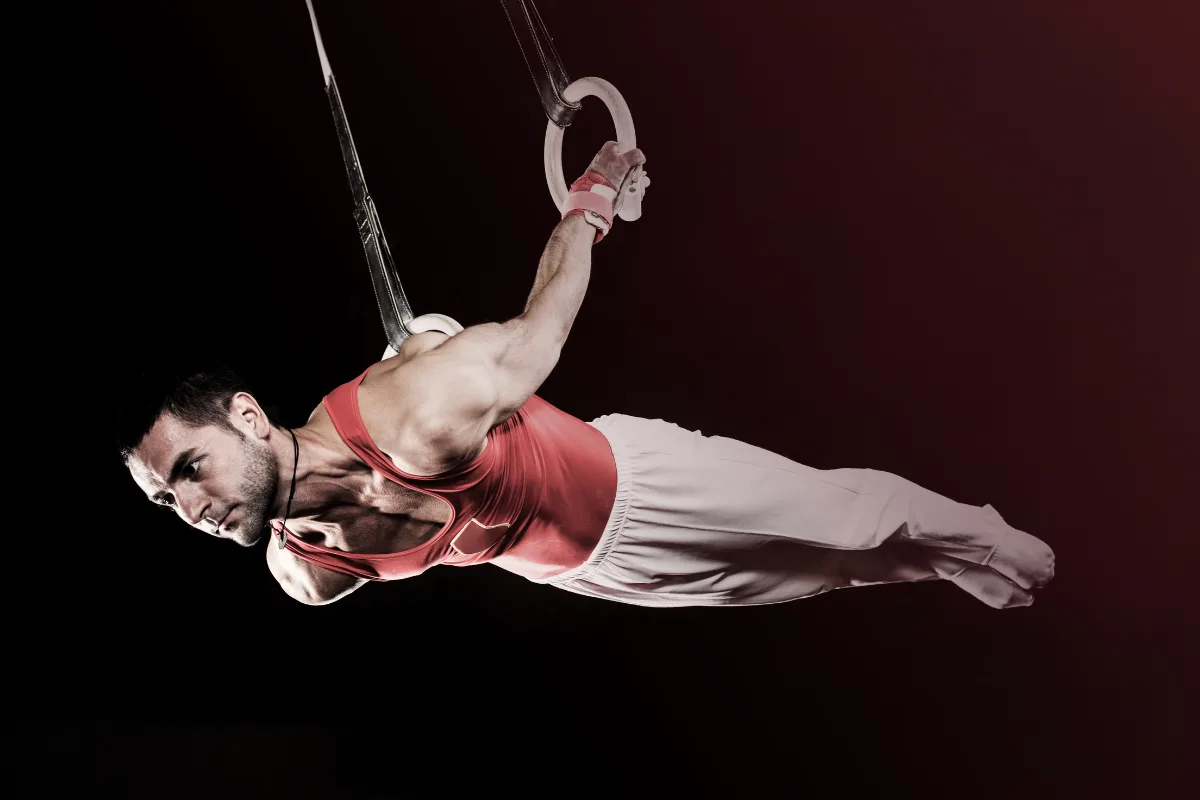
Still rings is the men’s event built on control. The rings hang free on straps, so they move whenever the gymnast moves, and judges want them quiet at the end of every skill. In USA Gymnastics, boys first compete on rings at Level 3, the start of the four compulsory levels (Levels 3–6).
Contents
At a compulsory level, every boy performs the same set routine from USA Gymnastics’ 2025–2028 Men’s Development Program Competition Manual. The routines combine swings with held positions and presses, and they ask for more strength and control at each level.
This guide covers where rings sits in the boys’ levels, what USA Gymnastics has published about how the event is run and judged, and how it grows into the elite event of crosses and swings to handstand. It doesn’t list the routines. Those are in the paid manual, and the 2021–2024 versions that still circulate online are out of date.
Rings in the Boys’ Level System
The Men’s Program Rules & Policies (version 10.27.25) put levels, age rules, equipment and routine requirements in the competition manual (p. 31). USA Gymnastics’ public pathway pages give the outline:
| Levels | Program | Routines | Ages |
|---|---|---|---|
| 1–2–3 | Essential Elements | Pre-competitive; no meet routines | Designed mainly for boys 4–10 |
| 3–6 | National Track, compulsory | One set routine per level, in Division 1 or Division 2 | From the year a boy turns 6 until his senior year of high school |
| 6 | Future Stars (a Junior Elite division) | Adds technical sequences | About 10–12 |
| 7–10 | National Track, optional | Each gymnast’s own routine | At least 12 (Levels 7–8), 14 (Level 9), 16 (Level 10), turned in the calendar year |
| Its own levels | Club Track | “Modified optional” routines | 5 and older |
Levels 1 and 2 belong to Essential Elements, a pre-competitive program, and its “Level 3” is not the same as competitive Level 3. The Future Stars ages come from the Rules & Policies (p. 38).
Boys normally compete one level for the whole season, though the compulsory-track page allows a switch during the season “up to a point”. Moving to optional can skip levels: the optional-track page says a boy with several compulsory years behind him may start at Level 8 or 9, depending on his age. Our overview of men’s gymnastics levels covers the whole pathway across all six events.
How Rings Works for Young Gymnasts
Rings asks for two different abilities in one routine. The gymnast swings, and he also has to stop and hold positions while the rings try to keep moving. The compulsory routines build both, and by Level 6 they include presses.
USA Gymnastics’ public clarifications give a sense of where the compulsory routines end up. At Level 6 the routine includes a press to a held shoulder stand, which must be done in a pike, and Division 1 bonus adds a press to handstand (Men’s Development Program Newsletter #5, January 2026; Newsletter #3, February 2025). The full Level 3–6 routines are in the manual.
The public documents don’t give ring heights for young gymnasts. Equipment specifications for each level are part of the manual, so the meet information or your son’s coach will know the setup. For comparison, the Apparatus Norms of World Gymnastics (formerly FIG) put the lower edge of elite rings 290 cm (about 9½ feet) above the floor (2026 edition, p. 31).
How Judges Score a Compulsory Rings Routine
Each compulsory routine is written as a series of numbered boxes, and each box carries performance criteria that the judges check. With everyone at a level doing the same routine, execution is what separates scores.
The divisions shape what a boy can earn (National Track compulsory page). Division 1 gymnasts may add Specified Bonus (SB) skills; Division 2 gymnasts do the base routine only, and adding bonus skills there is penalized, apart from a few listed exceptions (Newsletter #3).
A few general rules from the newsletters apply across Levels 3–6:
- Bonus can still be awarded if the bonus skill has small or medium errors, or a single large error. A fall, or a missing part of the bonus box, means no bonus (Newsletter #3; Newsletter #5).
- Under the program’s “50% rule”, a clearly attempted skill that gets far enough can still be credited; a skill that isn’t attempted can’t (Newsletter #5).
- Neutral deductions are taken from the final score and don’t change the start value (Newsletter #2, December 2024).
For rings in particular, USA Gymnastics’ guide to the men’s events says the rings should be still and under control at the end of each skill, with the body straight and not arched. Held positions are judged too: in the Level 6 press-to-handstand bonus, for example, judges can deduct for a lack of hold (Newsletter #3).
The compulsory rules are also deliberately kinder than elite rules in places. In Level 6 Division 1 there is no deduction for excessive swinging of the cables or for bent arms in front swings, and bent arms are allowed on the bonus press to handstand, with that press’s execution deduction capped at 0.3 (Newsletter #3). In elite gymnastics, excessive swinging of the cables costs 0.10 on every element (FIG men’s Code of Points 2025–2028, p. 62).
Where Rings Leads: Optional Levels and Elite
Optional routines start at Level 7, where coaches choose skills to suit the gymnast (National Track optional page). Skills are valued mostly on FIG’s letter scale, and routines earn credit for each element group they cover. The value needed for full credit rises from an A at Levels 7 and 8 to a C at Level 9 and a D at Level 10 (Newsletter #2). Junior Elite gymnasts at Level 10 are scored under FIG rules (2026 Championship Season Directives, p. 9).
FIG sorts rings skills into four element groups in its men’s Code of Points (p. 60):
| Element group | What it covers |
|---|---|
| I | Kips and swing elements, including swings through or to handstand |
| II | Strength and hold elements |
| III | Swings that finish in a strength hold |
| IV | Dismounts |
The values show how far the event climbs. The L-sit, back lever and front lever are A elements, the planche and the cross are C, and the inverted cross and the Maltese (also called the swallow) are D (p. 67). Among the swing elements, the Yamawaki is a B and the Jonasson a C (p. 64).
Holds are where elite rings gets strict. A hold must last 2 seconds from a complete stop: a shorter hold costs 0.30, and with no stop at all the deduction is 0.50 and the element gets no difficulty credit (Art. 9.2.15, p. 19). Every routine also needs one swing to handstand held for 2 seconds, or 0.30 comes off (p. 62). And no more than three strength or hold elements may follow each other directly before a swing element breaks them up (p. 61), so the event never turns into a pure strength display.
On rings, as on pommel horse, parallel bars and high bar, the difficulty score counts the dismount plus the seven best other elements (Art. 6.1, p. 14). To see what those letters add up to, read what the A-to-J difficulty values are worth.
At the 2025 World Championships in Jakarta, Donnell Whittenburg of the United States won the rings title with the highest difficulty in the final, 6.000, and an 8.700 E-score for 14.700.
Common Questions
When do boys start competing on rings?
At Level 3, the first compulsory level. USA Gymnastics’ compulsory track is open from the calendar year a boy turns 6. Before that, the pre-competitive Essential Elements program teaches the basics without meet routines.
Do boys do the iron cross in the compulsory levels?
Nothing in USA Gymnastics’ public clarifications for Levels 3–6 mentions a cross. The strength skills that appear there are presses to shoulder stand and to handstand, and a straddled L hold. In the FIG Code, a cross is a C-value element.
How long does a hold have to last on rings?
In elite gymnastics, 2 seconds from a complete stop. The compulsory routines set their own hold requirements box by box in the manual, so check the current manual or ask the coach.
Where can I find the current rings routines?
In the 2025–2028 Men’s Development Program Competition Manual, sold as an e-book on Google Play (USA Gymnastics course page), with corrections in the program’s newsletters. Lists dated 2021–2024 describe the old routines.
Do the other events follow the same levels?
Yes. The levels, divisions and judging principles are shared; the apparatus and skills are not. Compare boys’ pommel horse in the compulsory levels, which bans holds altogether, and boys’ parallel bars, which mixes swing and holds on two rails.
What to Remember
Boys start competing on still rings at Level 3. Levels 3–6 use one set routine per level, with a bonus route in Division 1, and the judging rewards still rings, straight bodies and positions that are clearly held. At Level 6, the rules on swinging cables and bent arms are kinder than elite rules. From Level 7 the routines open up and head toward the elite event, with 2-second holds, a required swing to handstand and strength skills such as the cross. The current routines themselves are only in the 2025–2028 manual.