USAG Floor Routines: How to Follow Levels 1–5
Women’s USA Gymnastics (USAG) Levels 1–5 use compulsory floor routines: prescribed exercises with set skills, connecting movements and music. A routine is more than its tumbling passes. Balances, dance steps, arm positions and transitions connect those skills into one performance.
Contents
This guide helps families follow the 2021–2029 compulsory cycle and choose the right learning resources. For a comparison of skill requirements, split angles and holds, use the separate Levels 1–5 floor requirements chart.
How to follow a USAG floor routine
On a first viewing, follow the broad movement types rather than trying to memorize every arm position. Notice where the gymnast tumbles, where she balances or turns, and where she travels through dance. On a second viewing, watch how those sections join.
A familiar skill name is an anchor, not the whole exercise. A list that says “handstand, leap, back handspring” leaves out the prescribed entries, finishes, directions and connections. Adding a harder element is not automatically an acceptable improvement.
| Look for | What it helps you understand |
|---|---|
| The opening position and first major skill | Where the routine begins and which side the gymnast is using |
| Changes between tumbling and dance | How the exercise moves across the floor instead of stopping after every skill |
| Balances, holds and turns | Control and recognition beyond the most dramatic tumbling |
| The final pass and finishing position | Which connected skills are prescribed, and where the routine actually ends |
These observations help a parent understand the performance. They do not replace a judge’s assessment or the coach’s instruction.
What to watch at each level
Level 1: connect familiar movement types
The routine combines a cartwheel, tucked rolls, a candlestick, balance and dance work, a stretch jump and a three-quarter handstand. Watch the changes between being supported on the floor and returning to standing.
A candlestick is supported through the upper back with the legs raised. A chassé is a traveling dance step. Knowing those names makes the exercise easier to follow without reproducing its choreography.
Level 2: recognize more specific positions
Level 2 includes a full handstand, split-shaped dance elements and bridge-and-kick-over work. The backward roll has a push-up finish. Its prescribed endpoint is part of the skill, so an apparent “upgrade” to handstand is not automatically correct.
The July 2026 update reduced the specific Level 2 backward-roll-to-handstand substitution deduction from 0.60 to 0.30. That change applies to this Level 2 element; it is not a new penalty for every backward roll in the program.
Level 3: follow the closing connection
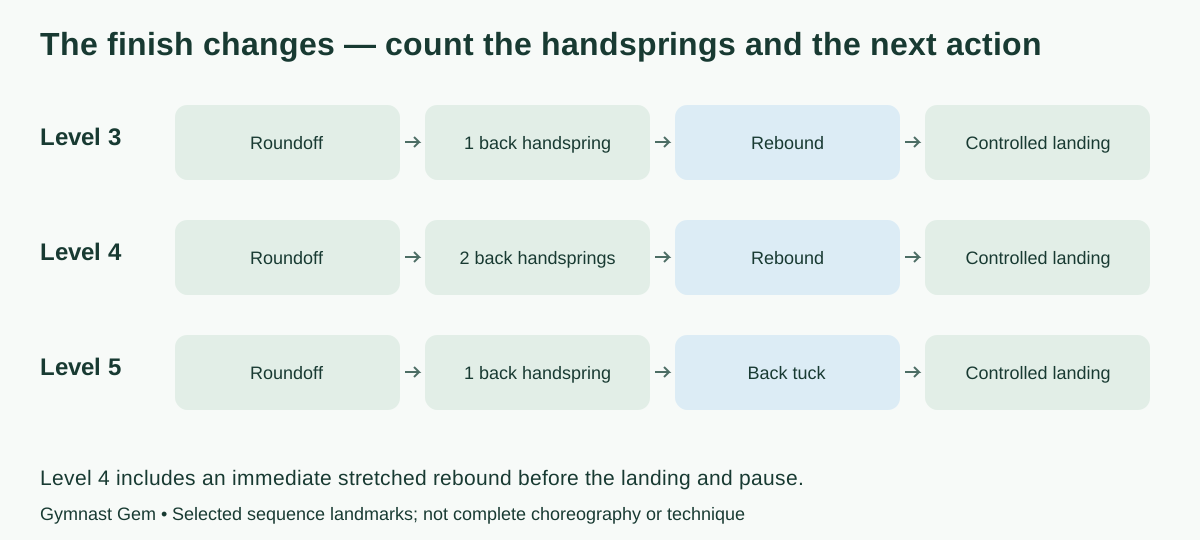
The closing tumbling pass connects a roundoff to one back handspring and a rebound. USAG also uses the term flic-flac for a back handspring. The rebound is the immediate stretched jump after the handspring, followed by the controlled landing.
Elsewhere, watch the handstand forward roll and the handstand-to-bridge and kick-over work. These are recognizable sections of the routine, not spare time before the final pass.
Level 4: two handsprings, then the rebound
The closing pass contains a roundoff, two connected back handsprings, an immediate stretched rebound, then a controlled landing and pause. Leaving out the rebound gives an incomplete description. “Stick the finish” refers to controlling the landing after that rebound.
The opening acrobatics and dance also change, including a back walkover, front handspring step-out and a full turn on one foot. A step-out lands one foot and then the other; it is more specific than saying “a front handspring.”
Level 5: permitted choices and a different final pass
The opening acrobatic element allows a front tuck, an aerial cartwheel or an aerial forward walkover. These are approved alternatives in that position. A different opening among two Level 5 gymnasts therefore need not mean one has the wrong routine.
The closing pass connects a roundoff, one back handspring and a back tuck, followed by a controlled landing. Level 5 does not simply append a back tuck to Level 4’s two-handspring pass.
Watch two routines from start to finish
The National Association of Women’s Gymnastics Judges (NAWGJ) publishes practice films so that judges can rehearse scoring. They are competition recordings, not the official demonstrations described in the next section, and they include faults. They are still a useful public way to see a compulsory routine as one continuous performance. The notes use the four landmarks from the table above.
A Level 1 routine
- Opening. The gymnast holds the starting pose at 0:09 and the first major skill, the cartwheel, comes at 0:11.
- Changes between tumbling and dance. The backward roll and the candlestick keep the gymnast on the floor until about 0:16. The balance and the traveling step are done standing, and the forward roll at 0:27 goes back down to the floor.
- Balance. The passé balance, with one knee lifted in front, is at 0:19.
- Finish. The last skill is the ¾ handstand at 0:30, and the routine ends in a pose at 0:32.
A Level 4 routine
- Opening. The routine opens with poses from about 0:11, and the first major skill, the back walkover, comes at about 0:18.
- Changes between tumbling and dance. Three acrobatic skills arrive close together: the front handspring step-out at 0:29, the cartwheel at 0:30 and the backward roll to handstand at 0:32. From about 0:34 the routine turns to dance, with poses, jumps and a leap.
- Holds. The forward split on the floor is reached at about 0:56.
- Final pass and finish. The round-off is at 1:10, followed by two back handsprings and the rebound at 1:12. The routine does not end there: the kneeling final pose comes at about 1:17.
A slide after the Level 4 routine shows how a group of judges scored it in practice. Their totals are not all the same, which is worth remembering for the section on scores below.
Music and official demonstrations
USA Gymnastics provides official floor music for Levels 1–5. Its W316 compulsory materials include the complete book content, floor music and official demonstrations for each event and level. The videos are accessed through the registered user’s account; they are not public videos we can assume are available to embed here.
The official compulsory page also identifies music sources. Confirm the level and cycle with the coach before choosing a recording. A video titled “Level 4 floor” could belong to an older cycle or another organization.
A competition recording is useful for seeing the exercise as a continuous performance. It is not a rule reference: it may contain an error, an omitted movement or a finish that should not be copied. For exact details, use the current written exercise and its amendments alongside the official demonstration.
Our floor-music guide owns the wider comparison of compulsory, optional and elite music. This page focuses on following the compulsory routine rather than choosing or editing a custom track.
Use the video to support the lesson
Ask the coach which version and side of the routine to review. The official text permits reversing the entire compulsory routine, while individual reversals are allowed only where specified. Simply mirroring every unfamiliar movement is not a reliable way to learn it.
For a short review, choose one section and identify its start and finish. Listen for where the music changes, then watch how the gymnast moves into the next section. If a connection looks different from the instruction given in class, note the question rather than changing the routine from an online example.
Watching and naming the sections can be useful outside practice. New tumbling, inversions and assisted drills belong with qualified coaching and appropriate equipment. A parent does not need to reproduce the gym setup to help a child remember the order.
Why the same routine earns different scores
Compulsory gymnastics evaluates the prescribed content and how it is performed. Completing the recognizable major skills does not account for all the execution, connection and movement details that judges assess.
Two routines can therefore look similar to a new viewer while differing in holds, body position, rhythm and landing control. The compulsory scoring guide explains the scoring system; this viewing guide does not attempt to assign deductions from a casual recording.
Final Takeaway
Use the major skills as landmarks, then follow how the routine connects them. Keep Level 4’s rebound in the closing sequence and distinguish Level 5’s one-handspring-to-back-tuck finish. The official text, current amendments and demonstrations supply the choreography that a summary cannot.
Main Sources
- USA Gymnastics compulsory program and updates — 2021–2029 exercises and current amendments; selected Level 4–5 passages checked in the owner’s licensed ebook.
- USA Gymnastics W316 — official book content, floor music and demonstration access.
- July 2026 compulsory replacement pages — Level 2 backward-roll substitution.
- July 2023 replacement pages — selected routine and penalty descriptions, read with later amendments.
- National Association of Women’s Gymnastics Judges: about the association — the judges’ association whose practice films are embedded above.