What Are the Special Requirements for USAG Levels 6–10?
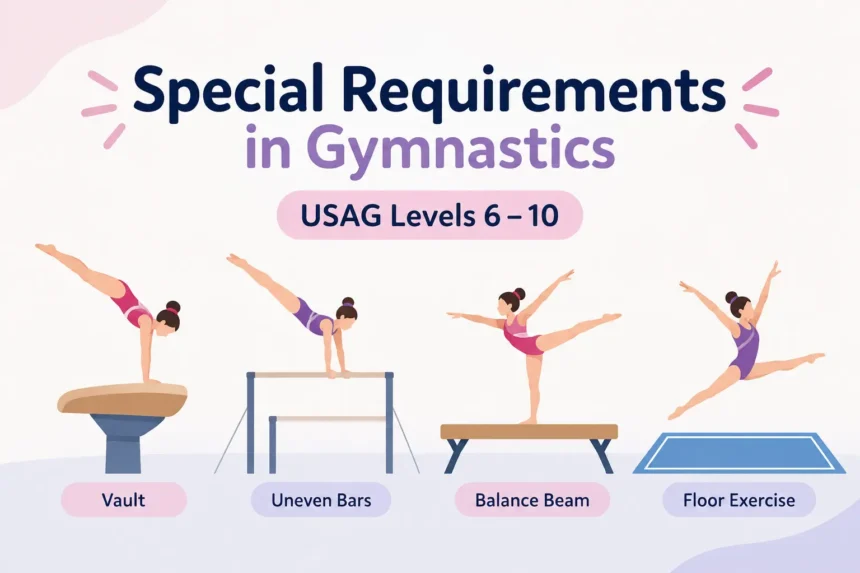
In USA Gymnastics optional competition, routines must include specific types of skills known as Special Requirements (SR). For Levels 6–10, there are four on uneven bars, balance beam and floor exercise. Each is worth 0.50.
Contents
- Special Requirements Introduction
- USAG Special Requirements by Level: Quick Comparison
- Special Requirements by Level and Event
- What Happens If a Gymnast Misses a Special Requirement?
- Can One Skill Fulfill More Than One Special Requirement?
- Special Requirements vs. FIG Composition Requirements
- Special Requirements vs. Value Parts, Composition Credit and Bonus
- Does Vault Have Special Requirements?
Missing one reduces the gymnast’s Start Value by 0.50 before normal execution deductions are applied.
This article covers the current 2026–2030 USA Gymnastics Women’s Development Program rules for Levels 6–10. See more details for: Levels 6–8 rules, Levels 9–10 rules.
Special Requirements Introduction
Special Requirements describe the content that must appear in a routine. All four together account for 4 × 0.50 = 2.00 of its Start Value.
| Special Requirements Met | SR Credit Lost |
|---|---|
| 4 of 4 | 0.00 |
| 3 of 4 | 0.50 |
| 2 of 4 | 1.00 |
| 1 of 4 | 1.50 |
| 0 of 4 | 2.00 |
For example, if a gymnast misses one required Beam SR, the routine loses 0.50 from the Start Value before normal execution deductions are applied.
Vault also works differently and does not use the same four-SR structure.
USAG Special Requirements by Level: Quick Comparison
The required content becomes progressively more difficult from Level 6 through Level 10.
| Level | Bars Focus | Beam Focus | Floor Focus |
|---|---|---|---|
| 6 | Cast, bar change, clear circle, A dismount | Basic acro, split, turn, A dismount | Two acro passes, dance passage, turn |
| 7 | Cast to handstand, clear circles, A dismount | Acro series + flight, split, turn | Forward/backward tumbling, dance, turn |
| 8 | Handstand cast, B flight/turn and clear circle | Acro series containing flight | Multiple saltos, dance passage, A final salto |
| 9 | Bar changes, flight/turn, B dismount | Two-flight acro series, B dismount | Multiple saltos, B final salto |
| 10 | C-level flight/turn content, C dismount | Higher-level flight series, C-level dismount requirement | Multiple saltos, C final salto |
The details matter, especially at the higher levels, so each event is broken down below.
Special Requirements by Level and Event
The tables summarize the 2026–2030 requirements. A salto is a flip without hand support; flight means there is a moment with no support on the apparatus or floor. A long-axis turn rotates around the length of the body. Letter ratings such as A, B and C refer to the skill’s value in the applicable USAG rules.
Level 6 Special Requirements
Level 6 is the first optional level in the Development Program.
Level 6 Uneven Bars
| # | Special Requirement |
|---|---|
| 1 | One cast reaching at least 45° above horizontal |
| 2 | At least one bar change |
| 3 | One 360° clear circling element from Groups 3, 6 or 7 |
| 4 | Salto dismount, minimum A |
For the cast requirement, the current chart notes that a cast above horizontal can still fulfill the SR, although the full amplitude requirement is higher and angle deductions may apply.
The clear circling element must be performed without the hips contacting the bar.
Level 6 Balance Beam
| # | Special Requirement |
|---|---|
| 1 | A non-flight acro series OR one acro flight element, isolated or connected; mounts and dismounts do not count |
| 2 | One leap or jump requiring a 180° cross or side split |
| 3 | At least a 360° turn on one foot |
| 4 | Aerial or salto dismount, minimum A |
The first requirement gives Level 6 gymnasts two options: a connected non-flight acro series or a recognized acro element with flight.
Level 6 Floor Exercise
| # | Special Requirement |
|---|---|
| 1 | One acro pass with at least two directly connected flight elements, including a salto |
| 2 | A second pass with at least two directly connected flight elements, including a different salto; OR an isolated B salto |
| 3 | Dance passage with at least two different Group 1 elements, connected directly or indirectly, including a leap requiring a 180° cross or side split |
| 4 | At least a 360° turn on one foot |
The second tumbling requirement can normally be met with another pass containing directly connected flight elements and a different salto. An isolated B salto is also an allowed option.
Level 7 Special Requirements
Level 7 increases the expected acrobatic and circling difficulty while keeping the same four-SR structure.
Level 7 Uneven Bars
| # | Special Requirement |
|---|---|
| 1 | One cast to handstand; a cast reaching 45° above horizontal fulfills the SR, although execution deductions may apply |
| 2–3 | Two 360° clear circling elements, same or different; one must be B and one must come from Groups 3, 6 or 7 |
| 4 | Salto dismount, minimum A |
A notable difference from Level 6 is that Level 7 does not have a separate bar-change SR.
Instead, greater emphasis is placed on cast and circling work.
Level 7 Balance Beam
| # | Special Requirement |
|---|---|
| 1 | An acro series, with or without flight, plus one acro flight element that may be in the series or separate; mounts and dismounts do not count |
| 2 | One leap or jump requiring a 180° split |
| 3 | At least a 360° turn on one foot |
| 4 | Aerial or salto dismount, minimum A |
The acro series may contain flight or non-flight elements. The required flight element can be part of that series or performed separately; it does not have to be an additional skill outside a qualifying flight series.
Level 7 Floor Exercise
The first two SRs together require at least two acro passes:
| # | Special Requirement |
|---|---|
| 1 | An acro pass containing a backward salto, with at least two directly connected flight elements |
| 2 | An acro pass containing a forward salto |
| 3 | Dance passage with at least two different Group 1 elements, connected directly or indirectly, including a leap requiring a 180° cross or side split |
| 4 | At least a 360° turn on one foot |
One of the forward or backward saltos used for these requirements must also be performed in a stretched position under the current rule.
Level 8 Special Requirements
At Level 8, the SRs remain four requirements worth 0.50 each, but routine construction becomes more demanding.
Level 8 also begins using Composition Credit, which is separate from Special Requirements.
Level 8 Uneven Bars
| # | Special Requirement |
|---|---|
| 1 | One cast to handstand |
| 2–3 | Two B elements, same or different: one with flight (not a dismount) OR a long-axis turn (not a mount or dismount), AND one B 360° clear circle from Groups 3, 6 or 7 (not a dismount) |
| 4 | Salto dismount, minimum A |
The two middle requirements introduce B-level flight, turning and clear-circling difficulty.
Level 8 Balance Beam
| # | Special Requirement |
|---|---|
| 1 | An acro series of at least two elements, with at least one flight element; mounts and dismounts do not count |
| 2 | One leap or jump requiring a 180° split |
| 3 | At least a 360° turn on one foot |
| 4 | Aerial or salto dismount, minimum A |
The important progression from Level 7 is that the acro series itself must contain flight.
Level 8 Floor Exercise
| # | Special Requirement |
|---|---|
| 1 | One acro pass containing at least two saltos |
| 2 | At least three different saltos in the routine |
| 3 | Dance passage with at least two different Group 1 elements, connected directly or indirectly, including a leap requiring a 180° cross or side split |
| 4 | The last acro pass initiated must contain at least an A salto |
For the first requirement, the two saltos may be the same or different and can be connected directly or indirectly through flight elements.
Aerials do not count toward the three-different-saltos requirement.
Level 9 Special Requirements
Level 9 requires more flight and increases the minimum dismount difficulty.
Level 9 Uneven Bars
| # | Special Requirement |
|---|---|
| 1 | At least two bar changes |
| 2 | One flight element worth at least B, excluding the dismount |
| 3 | A second, different flight element worth at least C, OR a B element with a long-axis turn; the long-axis turn may not be in a mount or dismount |
| 4 | Salto dismount, minimum B |
The third requirement gives the gymnast two possible routes: another higher-level flight element or a qualifying turning element.
Level 9 Balance Beam
| # | Special Requirement |
|---|---|
| 1 | An acro series containing two directly connected flight elements |
| 2 | One leap or jump requiring a 180° split |
| 3 | At least a 360° turn |
| 4 | Aerial or salto dismount, minimum B |
Compared with Level 8, both directly connected skills in the required acro series must now have flight.
Level 9 Floor Exercise
| # | Special Requirement |
|---|---|
| 1 | One acro pass containing at least two saltos |
| 2 | At least three different saltos |
| 3 | Dance passage with at least two different Group 1 elements, connected directly or indirectly, including a leap requiring a 180° cross or side split |
| 4 | The last acro pass initiated must contain at least a B salto |
The structure is similar to Level 8, but the minimum difficulty of the final tumbling increases:
Level 8 → A
Level 9 → B
Level 10 Special Requirements
Level 10 is the highest level in the Women’s Development Program.
The four SRs remain worth 0.50 each, but the required content is considerably more difficult.
Level 10 Uneven Bars
| # | Special Requirement |
|---|---|
| 1 | At least one C flight element, excluding the dismount |
| 2 | A second, different flight element, minimum B |
| 3 | At least one C element with a long-axis turn, excluding mount and dismount |
| 4 | Salto dismount, minimum C |
Level 10 Bars therefore requires both flight variety and higher-level turning content.
Level 10 Balance Beam
| # | Special Requirement |
|---|---|
| 1 | An acro series of two directly connected flight elements with at least one C, OR a directly connected E flight + A non-flight series; mounts and dismounts do not count |
| 2 | One leap or jump requiring a 180° split |
| 3 | At least a 360° turn |
| 4 | Aerial/salto dismount minimum C, or an eligible B dismount connected to qualifying C-level difficulty |
The standard acro-series option requires two directly connected flight elements with at least one C.
The current rules also allow the specific alternative of:
E flight + A non-flight
for the first requirement.
For the dismount SR, a C aerial or salto is the straightforward option. A B dismount can qualify when connected to an acro series containing a C flight element, or when connected to a C acrobatic or dance element. A B dismount on its own does not fulfill this SR. These alternatives appear in the official Levels 9–10 summary linked below.
Level 10 Floor Exercise
| # | Special Requirement |
|---|---|
| 1 | One acro pass containing at least two saltos |
| 2 | At least three different saltos |
| 3 | Dance passage with at least two different Group 1 elements, connected directly or indirectly, including a leap requiring a 180° cross or side split |
| 4 | The last acro pass initiated must contain at least a C salto |
The final-pass progression from Levels 8–10 is especially easy to remember:
| Level | Minimum Salto in Last Acro Pass |
|---|---|
| 8 | A |
| 9 | B |
| 10 | C |
What Happens If a Gymnast Misses a Special Requirement?
Each missing Special Requirement reduces the Start Value by:
0.50
Suppose a Level 8 Beam gymnast fulfills three SRs but does not perform the required acro series containing flight.
The routine loses:
0.50 from the Start Value
This is not an ordinary execution deduction.
The gymnast simply does not receive the Start Value credit associated with that Special Requirement.
A skill can also fail to receive SR credit if it is not recognized or if a restricted element is used. Under the current rules, restricted elements can create additional Start Value consequences.
Can One Skill Fulfill More Than One Special Requirement?
Sometimes.
The answer depends on the event and the exact requirement.
On Uneven Bars, for example, the Code allows one element to fulfill more than one SR unless otherwise specified.
However, requirements that call for different elements, separate passes or specific connections still have to be fulfilled exactly as written.
This is why routine construction depends on more than simply counting the number of skills performed.
Special Requirements vs. FIG Composition Requirements
The terminology can be confusing because FIG uses a similar concept with a different name.
| USAG Special Requirements | FIG WAG Composition Requirements | |
|---|---|---|
| Abbreviation | SR | CR |
| Used in | USAG Development Program / Xcel | FIG WAG |
| Main purpose | Required routine content | Required routine content |
| Affects | Start Value | D-Score |
| Value | 0.50 each | 0.50 each |
The important distinction is:
USAG DP / Xcel → Special Requirements
FIG WAG → Composition Requirements
Although they serve a similar general purpose, they are different rule systems and should not be used interchangeably.
For the elite system, see WAG Composition Requirements and the D-Score.
Special Requirements vs. Value Parts, Composition Credit and Bonus
Special Requirements are only one part of an optional routine’s Start Value.
| Component | What It Means |
|---|---|
| Value Parts | Required mix of recognized skills at specific difficulty levels |
| Special Requirements | Required types of skills or combinations |
| Composition Credit | Additional composition credit at Levels 8–10 |
| Difficulty and Connection Bonus | Additional credit used at Levels 9–10 |
Levels 6 and 7 can reach a full 10.0 Start Value by meeting their required Value Parts and Special Requirements.
At Levels 8–10, Composition Credit becomes another part of the calculation. Levels 9 and 10 also use difficulty and connection bonus to help build the routine to 10.0.
Does Vault Have Special Requirements?
Not in the same way.
Vault does not use four 0.50 Special Requirements.
Instead, each allowable vault has a predetermined Start Value or is governed by the applicable level-specific Vault rules.