How Start Value Is Calculated in USAG Gymnastics (Levels 6–10)
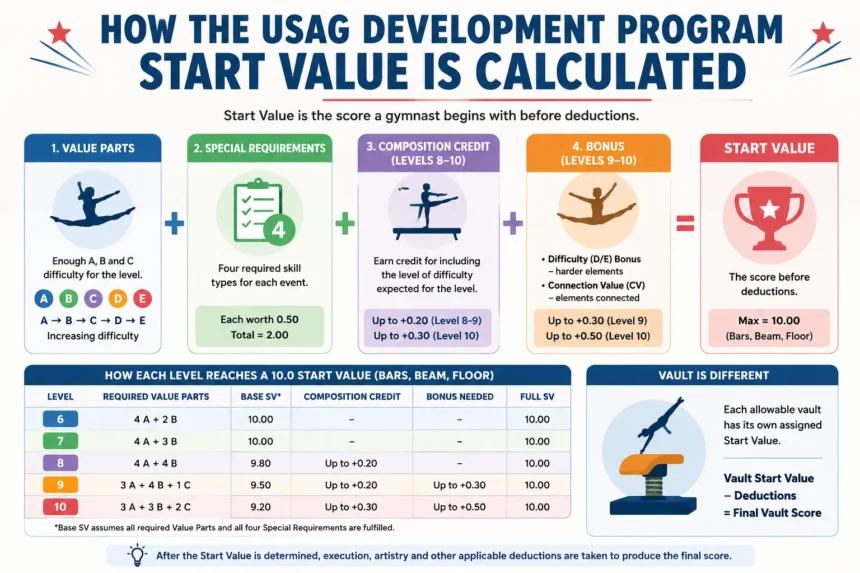
A gymnast can finish a routine without falling and still begin below a 10.0. Before judges deduct for bent knees, landing steps or other mistakes, they check whether the routine contains the skills and combinations required for its level.
Contents
That starting score is called the Start Value (SV). At Levels 6 and 7, meeting the basic skill requirements can produce a 10.0 Start Value. At Levels 8–10, gymnasts also need additional credit for how the routine is built.
This guide explains the USA Gymnastics Women’s Development Program, often shortened to USAG DP, under the 2026–2030 Optional Code of Points. The calculations below apply to uneven bars, balance beam and floor exercise. Vault uses a separate system of assigned values.
New to the term? Our beginner’s guide to Start Value covers the basics across USAG, Xcel and NCAA.
Start Value by Level: A Quick Guide
The optional levels allow gymnasts to perform individually constructed routines within their level’s rules. Each routine must contain enough skills at the required difficulty and the required types of movements.
Once those basic requirements are met, the calculation looks like this:
| Level | Required Value Parts | Base Start Value* | Composition Credit available | Bonus available toward 10.0 | Maximum Start Value |
|---|---|---|---|---|---|
| 6 | 4 A + 2 B | 10.00 | — | — | 10.00 |
| 7 | 4 A + 3 B | 10.00 | — | — | 10.00 |
| 8 | 4 A + 4 B | 9.80 | 0.20 | — | 10.00 |
| 9 | 3 A + 4 B + 1 C | 9.50 | 0.20 | 0.30 | 10.00 |
| 10 | 3 A + 3 B + 2 C | 9.20 | 0.30 | 0.50 | 10.00 |
The base assumes that all required Value Parts and all four Special Requirements receive credit. Missing requirements can lower it. The current level summaries are published by USA Gymnastics for Levels 6–8 and Levels 9–10.
The lower base at Level 10 does not mean a Level 10 routine is easier. More of its starting score must be earned through harder skills and valuable combinations.
For example, a complete Level 10 calculation can be:
9.20 base + 0.30 Composition Credit + 0.50 bonus = 10.00 Start Value
The required skills and Special Requirements are already included in the 9.20 base. Adding their points again would count them twice.
The Four Parts of the Calculation
The four parts answer different questions: Does the routine have enough difficulty? Does it include the required types of skills? Does it earn additional composition credit? And, at the highest optional levels, does it earn enough bonus?
1. Check the Required Value Parts
USAG assigns competitive skills difficulty letters, progressing from A through E. These classifications are called Value Parts (VP).
An A is generally easier than a B, while a C requires more difficulty than a B. Each level requires a particular combination of these letters, as shown in the table above.
For example, Level 7 requires four A Value Parts and three B Value Parts. Performing seven movements is not enough on its own: judges must recognize enough skills at the required difficulty.
Allowed higher-value skills can replace lower required Value Parts under the program’s replacement rules. A gymnast therefore does not have to avoid harder skills simply because a requirement calls for an A or B. However, replacement is one skill for one required Value Part; a single harder skill does not fill several missing positions in the count.
The letter credited also depends on the level’s restrictions. Certain C skills are allowed at Levels 6–8 but receive B credit for the required Value Part count.
2. Check the Four Special Requirements
A routine also needs particular types of skills or combinations. These are called Special Requirements (SR).
Bars, beam and floor each have four Special Requirements at every optional level. Each requirement is worth 0.50, so missing one lowers Start Value by half a point.
The exact requirements depend on the event and level. They can involve a bar change, an acrobatic series, a leap or jump with a specified split, or a sufficiently difficult dismount—the skill used to finish the routine.
A gymnast can have enough Value Parts but still miss a Special Requirement. For example, having several difficult beam skills does not necessarily fulfill a requirement for an acrobatic series if the necessary skills are not connected.
One skill can also serve more than one purpose. A qualifying dismount can count as a Value Part and fulfill the dismount Special Requirement. The gymnast does not need a separate skill for every line of the scoring calculation.
The Special Requirements for Levels 6–10 give the event-by-event detail.
3. Add the Composition Credit Earned
At Levels 8–10, including the minimum skills and Special Requirements does not complete the Start Value. The routine must also meet additional difficulty goals to earn Composition Credit (CC).
These goals are specific. Judges are checking for prescribed skills or combinations, rather than deciding generally whether a routine “looks hard enough.”
Level 8 provides a useful example. On beam, the gymnast can earn 0.10 for a qualifying directly connected B + B acrobatic series in which both skills have flight. Another 0.10 is available for qualifying dismount content, such as a B-rated dismount. “Flight” means the gymnast becomes airborne during the skill. These conditions appear in the official Level 8 beam summary.
Assuming the routine meets its other requirements, earning both tenths raises the base from 9.80 to 10.00. Earning only one produces a 9.90 Start Value.
Composition Credit is separate from artistry deductions. A routine may earn its full CC and still lose points for posture, rhythm or other performance errors. Equally, a polished routine can miss CC because it does not contain the specified difficulty.
For the complete apparatus breakdown, see how Composition Credit is earned.
4. Add Eligible Difficulty and Connection Bonus
Levels 9 and 10 use bonus to complete their Start Values. There are two main sources:
| Bonus type | What earns it |
|---|---|
| Difficulty bonus, also called D/E bonus | Eligible higher-difficulty skills |
| Connection Value (CV) | Eligible combinations of skills linked in the way the rules require |
A difficult skill and a valuable connection are different ways of earning points. A routine may earn both when the skill and combination meet their respective rules.
Level 9 can use up to 0.30 bonus toward its Start Value. Level 10 can use up to 0.50, with both difficulty and connection bonus needed to earn the full amount. The bonus types have their own eligibility rules and limits; judges do not simply add unlimited points for every difficult skill.
Connections also work differently across the events. On floor, some tumbling bonus comes from indirect connections: qualifying flips can be linked through other flight skills, such as a round-off and back handspring. The flips do not always have to follow each other immediately. USA Gymnastics lists separate direct and indirect floor formulas in its Levels 9–10 connection table.
The difficulty and connection bonus rules explain which combinations count and how the two bonus types work together.
Worked Examples: From Start Value to Final Score
The following examples are hypothetical. Each assumes the stated credit has been awarded and there are no additional score adjustments beyond those shown.
Levels 6–7: Meeting the Basic Requirements
Suppose a Level 7 gymnast receives all her required Value Parts and all four Special Requirements, with no other Start Value losses. Her Start Value is 10.00.
If her performance deductions total 0.75:
10.00 − 0.75 = 9.25 final score
Try this example in the USAG score calculator: choose USAG Development Program and Women, then enter 10.00 as the starting score and 0.75 as total deductions.
Now consider a routine missing one Special Requirement, while everything else in the calculation remains the same:
| Calculation | All requirements met | One Special Requirement missing |
|---|---|---|
| Start Value before the missing requirement | 10.00 | 10.00 |
| Missing Special Requirement | 0.00 | −0.50 |
| Awarded Start Value | 10.00 | 9.50 |
| Performance deductions | −0.75 | −0.75 |
| Final score | 9.25 | 8.75 |
Both routines lose the same amount for performance. The difference in the final score comes from the missing requirement.
Levels 8–10: Adding Composition Credit and Bonus
At the higher levels, a routine can meet all its basic Value Parts and Special Requirements and still begin below 10.0.
These examples show how that happens:
| Example routine | Base | CC earned | Bonus counting toward SV | Awarded SV |
|---|---|---|---|---|
| Level 8 with one of two available CC tenths | 9.80 | +0.10 | — | 9.90 |
| Level 9 with full CC but only 0.20 bonus | 9.50 | +0.20 | +0.20 | 9.90 |
| Level 10 with full CC but only 0.40 bonus | 9.20 | +0.30 | +0.40 | 9.90 |
The same 9.90 Start Value can therefore result from different missing credit. A coach looking to raise it needs to identify which part of the calculation is incomplete.
If any of these routines then loses 0.65 in performance deductions, its final score is 9.25.
Why Extra Bonus Cannot Replace Missing Composition Credit
Suppose a Level 10 routine earns 0.60 in eligible difficulty and connection bonus but only 0.20 of the available 0.30 Composition Credit. It fulfills all its Value Parts and Special Requirements.
Only 0.50 of that bonus can count toward the normal Start Value:
9.20 + 0.20 CC + 0.50 bonus = 9.90 Start Value
The extra bonus tenth cannot fill the missing CC tenth. Each part of the calculation has its own limit. Current NAWGJ judging practice examples illustrate this distinction between total bonus performed and bonus used in the Start Value.
This is why “the routine has plenty of difficulty” does not necessarily explain whether it starts from 10.0.
The Extra Level 10 Bonus: Why It Is Outside Start Value
Level 10 has a separate additional 0.10 bonus on bars, beam and floor. USA Gymnastics explicitly identifies it as not part of Start Value.
To qualify, the routine needs a 10.00 Start Value, at least 0.60 total eligible difficulty and connection bonus, and the required difficult element for the apparatus:
| Event | Qualifying element for the additional bonus |
|---|---|
| Uneven bars | A D-rated single-bar release or any E-rated release |
| Balance beam | An E-rated acrobatic element |
| Floor exercise | An E-rated acrobatic element, excluding the front double twist listed as element #6.501 |
The qualifying element must satisfy the bonus rules, including the conditions concerning a fall or assistance from a coach. The apparatus conditions are shown in the official Level 10 scoring summary.
The 0.60 requirement refers to difficulty and connection bonus. Composition Credit is not included in that total.
For an eligible routine with 0.80 in performance deductions, the calculation is:
10.00 Start Value − 0.80 deductions + 0.10 additional bonus = 9.30
The Start Value remains 10.00. Describing it as a 10.10 Start Value would combine two separate parts of the scoring system.
Why the Awarded Start Value Can Change
A coach may construct a routine to start from 10.0, but judges calculate the value of the routine actually performed. A planned skill or connection must receive the necessary credit during the competition.
Unrecognized Skills and Broken Connections
If a skill does not meet its technical requirements, judges may credit a different skill or withhold credit. That can leave the routine short of a Value Part, Special Requirement, Composition Credit or bonus.
A broken connection can also affect more than one part of the calculation. For example, an interruption may prevent a beam combination from fulfilling its intended series requirement as well as earning connection bonus.
Those losses depend on what else the gymnast performs. Another skill or series may already meet the requirement, so a mistake does not produce the same Start Value loss in every routine.
Falls and Start Value Are Separate Questions
A fall receives a 0.50 performance deduction in the Women’s Development Program. It does not automatically reduce Start Value by another 0.50.
Judges also check whether the skill still receives credit and whether any planned connection or bonus survives. Some skills can retain Value Part and Special Requirement credit despite a fall. Composition Credit may also remain when its conditions are fulfilled; a fall does not automatically erase all the routine’s difficulty credit.
The calculation can therefore involve a fall deduction alone, or a fall deduction together with lost Start Value credit. The official scoring summaries distinguish performance deductions from situations in which skill credit is withheld.
Skills Outside the Level’s Rules
Levels 6–9 limit which difficult elements may be performed and how they receive credit. Some harder skills are permitted, but adding difficulty without checking those restrictions can lower the score.
Level 10 has no general difficulty restrictions of the same kind. Its routines still have to follow the rules for recognizing skills, repetitions, connections and bonus.
Does Vault Use the Same Calculation?
Vault has an assigned Start Value for the allowable vault performed. Judges do not build it by adding the bars, beam and floor components from this guide.
The relevant vault chart and rules depend on the gymnast’s level. The special vault progressions used at Levels 6 and 7 also need to be distinguished from the vaults performed at higher optional levels.
A 9.20 Level 10 base from the opening table therefore should not be applied to vault. That number belongs to the construction of a bars, beam or floor routine.
Frequently Asked Questions
Does every optional routine start from 10.0?
No. Each routine must earn its Start Value. Missing requirements or insufficient Composition Credit or bonus can leave it below 10.0 before execution deductions begin.
Can a gymnast earn a good score with a lower Start Value?
Yes. A 9.90 Start Value with 0.30 deductions produces 9.60. A 10.00 Start Value with 0.60 deductions produces 9.40. In this hypothetical comparison, with no additional adjustments, the cleaner routine scores higher.
Does performing more skills always increase Start Value?
No. Additional skills help only when they provide needed credit under the level’s rules. Once the routine has earned its maximum Start Value, extra difficulty does not keep raising that value. It can still introduce more opportunities for execution deductions.
Is USAG Start Value the same as an elite D-Score?
No. The Development Program builds toward a 10.0 Start Value and takes deductions from it. FIG elite gymnastics calculates difficulty separately as a D-Score, then adds an execution score. The two calculations should not be mixed.
Do these formulas also apply to Xcel or NCAA women?
No. Those programs also use Start Values, but their requirements and available credit differ. A Level 10 formula should not be transferred to an Xcel or NCAA routine without checking that program’s rules.
What You Should Know
To calculate a Development Program Start Value, begin with the gymnast’s level, check the required skills and Special Requirements, and add the Composition Credit and bonus the routine earns. Keep each component within its own limit.
Then apply the performance deductions. Separating those two stages explains why a routine can look clean yet start below 10.0—and why the most difficult routine does not always receive the highest final score.