Balance Beam Requirements: USAG Women’s Levels 6–10
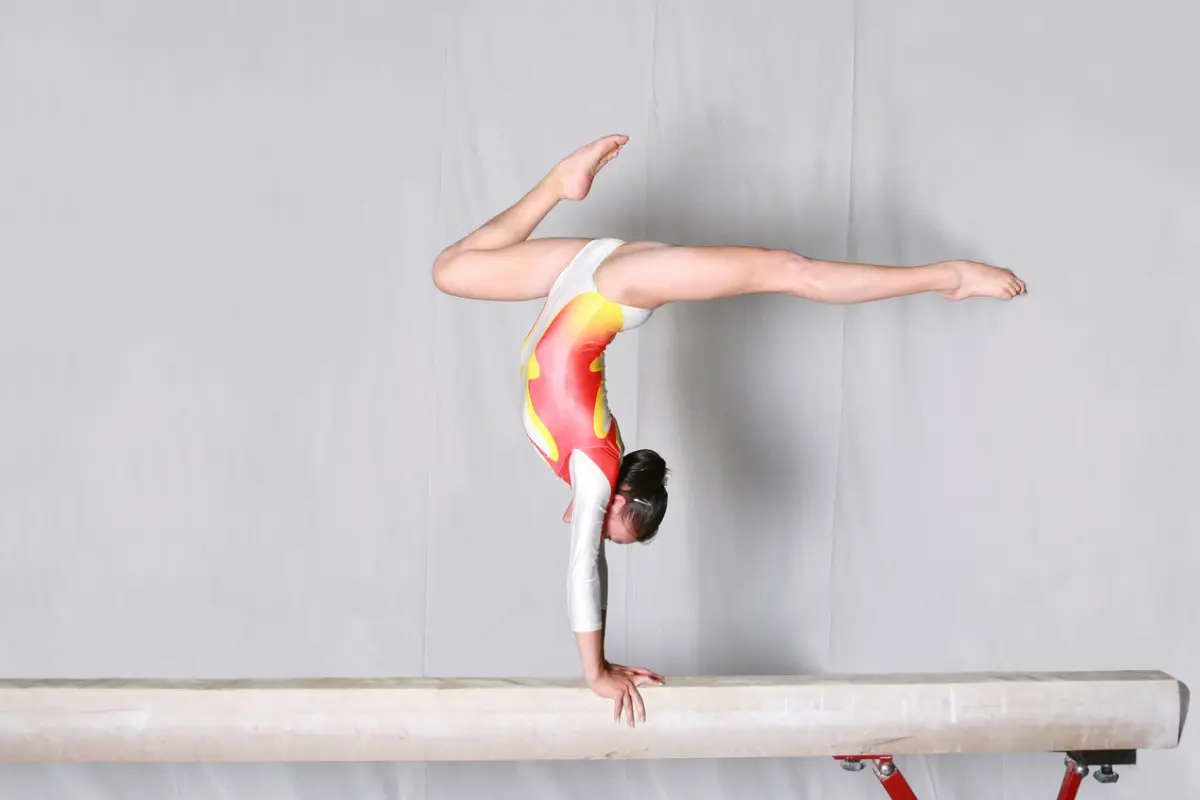
What does a gymnast need in an optional balance beam routine? From Level 6 through Level 10, the answer includes acrobatics, a split leap or jump, a full turn and a dismount. As the levels increase, the required connections and difficulty become more demanding.
Contents
Coaches choose the skills and choreography, so two gymnasts at the same level can perform different routines. Both must still satisfy the rules for that level.
This guide covers the 2026–2030 USA Gymnastics Women’s Development Program. It explains the main beam requirements, allowed difficulty, time limits and starting scores. Xcel and elite gymnastics have separate rules.
Beam Requirements at a Glance
All five levels require a leap or jump whose defined position includes a 180-degree cross or side split, plus a turn of at least 360 degrees on one foot from Group 3, the Code’s turn category. The main changes are in the acrobatics and dismount.
| Level | Acrobatics on the beam | Minimum aerial or salto dismount | Maximum routine time |
|---|---|---|---|
| 6 | A connected non-flight acro series or one acro flight skill | A | 1 minute 20 seconds |
| 7 | An acro series and a flight skill; the flight can be inside the series | A | 1 minute 20 seconds |
| 8 | At least two connected acro skills, including one with flight | A | 1 minute 30 seconds |
| 9 | At least two directly connected flight skills | B | 1 minute 30 seconds |
| 10 | At least two directly connected flight skills, including one rated C or higher; a specific non-flight/E-flight alternative also exists | C, or an approved connection into a B dismount | 1 minute 30 seconds |
The mount and dismount do not count toward the required on-beam acro series. The Level 10 alternatives are explained below. These are the current requirements in USAG’s event rules chart, beam page.
What the terms mean
Acrobatics, often shortened to acro, includes skills such as cartwheels, walkovers, handsprings and somersaults. A series connects skills without an interruption that breaks the connection under the judging rules.
A flight skill has an airborne phase without support from the beam. A back handspring has flight even though the gymnast also places her hands on the beam. An aerial or salto—a somersault—has no hand support during the airborne rotation. A dance jump does not satisfy an acro flight requirement.
The letters A, B and C describe a skill’s difficulty classification, called its Value Part. The routine needs both an appropriate mix of these skills and the four required types of content, called Special Requirements.
Missing a Special Requirement costs 0.50 from the Start Value, the routine’s starting maximum before execution deductions. Having enough skills overall does not automatically satisfy every requirement.
How the Acro Requirement Changes by Level
Level 6: A series or a flight skill
Level 6 offers two routes. A gymnast can connect non-flight acro skills, or she can perform one acro flight skill, either alone or in a connection.
For example, a recognized walkover series can satisfy the non-flight route. A recognized back handspring can satisfy the flight route. These are examples of the acro requirement, not complete routines or instructions to learn the skills.
A Level 6 gymnast therefore does not have to perform a back handspring to meet this particular requirement. She still needs the required Value Parts, split element, turn and dismount elsewhere in the routine.
Level 7: A series and a flight skill
At Level 7, the gymnast needs both an acro series and an acro flight skill. The flight skill can be part of the series; it does not have to appear separately.
One possible structure is a non-flight series plus an isolated back handspring. Another is an eligible series that already includes a flight skill.
The difference from Level 6 is the connection requirement. An isolated flight skill alone can satisfy Level 6’s acro condition, but it does not supply the series needed at Level 7.
Level 8: Flight must be inside the series
The Level 8 acro series must contain at least two skills, including at least one with flight.
This is where a Level 7 routine may need restructuring. A non-flight series followed much later by an isolated flight skill does not meet Level 8’s series requirement. The flight has to be part of the connection.
A series with one flight skill can meet the basic requirement. More demanding eligible connections can also earn Composition Credit, which helps build the Start Value.
Level 9: Two connected flight skills
Level 9 requires at least two directly connected acro flight skills. A series consisting of a walkover and one handspring is no longer enough for this requirement because only the handspring has flight.
The rule does not automatically require a somersault in the series: flight skills with hand support can qualify. However, the full routine must also meet Level 9’s difficulty requirements, and particular skill choices affect additional credit.
Judges evaluate the connection as well as the individual elements. Landing both skills does not guarantee series credit if the gymnast stops between them.
Level 10: Higher difficulty within the connection
The usual Level 10 route requires at least two directly connected flight skills, with at least one rated C or higher. The C flight skill may have hand support or be performed without it.
The event chart also lists an alternative: an A non-flight acro skill from Group 7 directly connected to an E acro flight skill. This is a specific exception, not a general rule that any difficult isolated element can replace the series.
Coaches using that alternative should check the exact proposed connection in the full Code. It is especially important to distinguish the allowed connection from simply including an A and an E somewhere in the routine.
Leaps, Turns and Dismounts
The split element is a skill requirement
The required leap or jump must be an element that calls for a 180-degree cross or side split. The gymnast cannot satisfy it by holding a split pose on the beam or adding together the positions of two smaller jumps.
The split element may be performed on its own or within a series. At Levels 8–10, the separate expectation for a dance series also needs attention; a single split jump does not automatically cover both tasks.
A short split can receive execution deductions without automatically losing all skill credit. Larger faults can change which element judges recognize. For example, USAG’s current dance appendix says that a split jump below 135 degrees is evaluated as the element actually performed, if one can be credited. The intended skill name alone does not establish its value. USAG dance technique appendix
A full turn means a complete rotation
Every level in this guide requires a Group 3 turn on one foot of at least 360 degrees. Half turns used to change direction in the choreography do not add together to replace the required full turn.
The turn must meet its recognition conditions. Judges also evaluate how it is performed, including balance, posture and the raised-heel position.
The dismount minimum rises at Levels 9 and 10
Levels 6–8 require at least an A aerial or salto dismount. Level 9 raises the minimum to B.
At Level 10, a C-or-harder aerial or salto dismount meets the standard difficulty route. A B dismount can also meet the Special Requirement through an approved direct connection:
- Connected to an acro series containing a qualifying C flight skill.
- Directly connected to at least a C acro flight skill or C dance skill.
An isolated B dismount does not meet the Level 10 dismount requirement simply because the rest of the routine contains difficult skills. Meeting this Special Requirement and earning extra dismount Composition Credit are also separate checks.
Which Difficulty Is Allowed?
Optional routines allow individual choices, but Levels 6–9 still limit which skills can receive credit. The restrictions are different for acrobatics and dance.
| Level | Allowed difficulty on beam |
|---|---|
| 6 | A and B skills, plus one C dance skill. C, D and E acro skills are restricted. |
| 7 | A and B skills, plus C dance skills. C, D and E acro skills and D/E dance skills are restricted. |
| 8 | A and B skills, C dance skills, and one C acro skill, including a mount or dismount. Additional C acro skills and D/E skills are restricted. |
| 9 | A, B and C skills, D/E dance skills, and one D/E acro skill, including a mount or dismount. Additional D/E acro skills are restricted. |
| 10 | No general difficulty restrictions in the beam event chart. |
Where a single higher-rated skill is allowed, USAG considers the relevant skills in the order they are performed. Coaches cannot simply choose a later skill to use the allowance after an earlier one has already used it.
Allowed C skills at Levels 6–8 receive B Value Part credit. Allowed D/E skills at Level 9 receive C Value Part credit, with separate rules governing bonus. A higher letter therefore does not automatically produce a larger starting score.
A restricted element can cost 0.50 from Start Value and receive no Value Part or Special Requirement credit. The limited exceptions in the table should not be read as permission to perform any one prohibited skill without consequence. The full beam event chart sets out those allowances.
How Beam Start Value Works
Meeting the four Special Requirements is one part of the calculation. Judges also check the routine’s Value Parts and, at the higher levels, its eligible Composition Credit and bonus.
| Level | Required Value Parts | Base with required content present | Maximum Composition Credit | Bonus available toward 10.00 |
|---|---|---|---|---|
| 6 | 4 A + 2 B | 10.00 | None | None |
| 7 | 4 A + 3 B | 10.00 | None | None |
| 8 | 4 A + 4 B | 9.80 | 0.20 | None |
| 9 | 3 A + 4 B + 1 C | 9.50 | 0.20 | Up to 0.30 |
| 10 | 3 A + 3 B + 2 C | 9.20 | 0.30 | Up to 0.50 |
These are base figures before losses for missing content or restrictions. The current structure comes from USAG’s Levels 6–8 and Levels 9–10 summaries.
Composition Credit rewards specified difficulty and dismount choices. On Level 8 beam, a directly connected B + B acro series with flight in both elements earns 0.10. An eligible B-or-harder dismount is one route to the other 0.10. The separate Composition Credit guide explains the choices for Levels 8–10.
Bonus at Levels 9 and 10 has its own rules. Level 9 can use up to 0.30 connection bonus, or 0.20 connection bonus plus 0.10 eligible D/E acro bonus. Level 10’s 0.50 bonus allocation requires at least 0.10 from connections and at least 0.10 from difficulty. Extra bonus cannot simply replace missing Composition Credit.
The USAG Start Value explanation covers those calculations across bars, beam and floor. Level 10 also has a separate exceptional-routine bonus under additional conditions; it is not included in the base or the 10.00 Start Value shown here.
A Level 8 scoring example
Suppose a Level 8 gymnast receives credit for all required Value Parts and all four Special Requirements. Her routine also earns both available Composition Credits:
| Step | Amount |
|---|---|
| Base with required content present | 9.80 |
| Qualifying B + B flight acro series | +0.10 |
| Qualifying B dismount | +0.10 |
| Start Value | 10.00 |
| Total execution deductions in this example | −0.60 |
| Score, assuming no other deductions | 9.40 |
This is an illustrative calculation, not a competition result. The letters and credits are assumed to have been confirmed by judges. A 10.00 Start Value establishes the starting maximum; it does not guarantee a perfect performance.
The gymnastics score calculator can reproduce the arithmetic using a 10.00 Start Value and 0.60 in deductions. It does not decide whether a beam skill or connection should receive credit.
Connections, Timing and Other Common Deductions
Four requirements do not cover every construction rule
Levels 8–10 have additional beam composition expectations. For example, lacking a dance series of at least two eligible elements from Groups 1, 2 or 3 carries a 0.20 deduction. That is separate from the Special Requirement for a split leap or jump.
Acrobatic direction also matters. The charts list a 0.10 deduction for missing backward and forward/sideward acro variety, reduced to 0.05 when the only different direction is in the dismount. These are construction checks, rather than deductions for bent knees or a landing step.
A broken series can affect more than execution
A pause or balance adjustment can break a planned connection. The gymnast may still receive credit for each individual skill while losing the series requirement or the extra credit expected from the connection.
The outcome depends on the level and the rest of the routine. A broken connection in Level 6 does not necessarily remove the acro requirement if a recognized flight element already satisfies its alternative route. At Level 8, an isolated flight skill cannot by itself supply the required flight series.
Routine time and falls
The maximum routine time is 80 seconds at Levels 6–7 and 90 seconds at Levels 8–10. Timing starts when the gymnast’s feet or hands leave the board or mat to mount and ends when she lands the dismount. The routine clock stops during a fall from the beam.
Overtime costs 0.10. Routines under 30 seconds can also receive a short-exercise deduction: normally 2.00, with a specific Level 6 beam exception of 0.50 when the routine has a 10.00 Start Value.
A fall itself costs 0.50 in this USAG system. A failed skill can also affect difficulty or requirement credit, depending on what judges recognize. The routine’s full scoring loss can therefore be more than the fall deduction alone.
Frequently Asked Questions
Does Level 7 require a back handspring outside the acro series?
No. Level 7 requires an acro series and a flight skill, but the flight can be part of the series. A back handspring is one possible flight skill; the requirement is not a demand for that exact skill in a separate location.
Does Level 9 require a salto in the acro series?
The basic series requirement is two directly connected flight elements. It does not specify that one must be a salto. The gymnast still needs the required difficulty mix and must consider additional credit and composition.
Can a gymnast use the same routine after moving up?
Some skills may carry over, but the whole routine needs checking against the new level. A series that satisfies Level 7 may fail Level 8’s flight-in-the-series condition, and a dismount that meets Level 8’s minimum may be too simple for Level 9.
Do these rules apply to Xcel beam?
No. Xcel has its own division requirements and scoring rules. These numbered levels belong to the Women’s Development Program. The gymnastics requirements directory provides the wider event and level context.
What You Should Know
The clearest progression is in the acrobatics: Level 6 offers a choice, Level 7 needs a series and flight, Level 8 puts flight inside the series, and Levels 9–10 demand stronger flight connections. The dismount minimum also rises at the top two levels.
A complete routine needs more than a list of skills. Judges check the difficulty mix, required content, connections and performance. The best routine plan is one the gymnast can perform consistently while meeting the rules for her own level.