USAG Vault Skill Requirements (Levels 1–5)
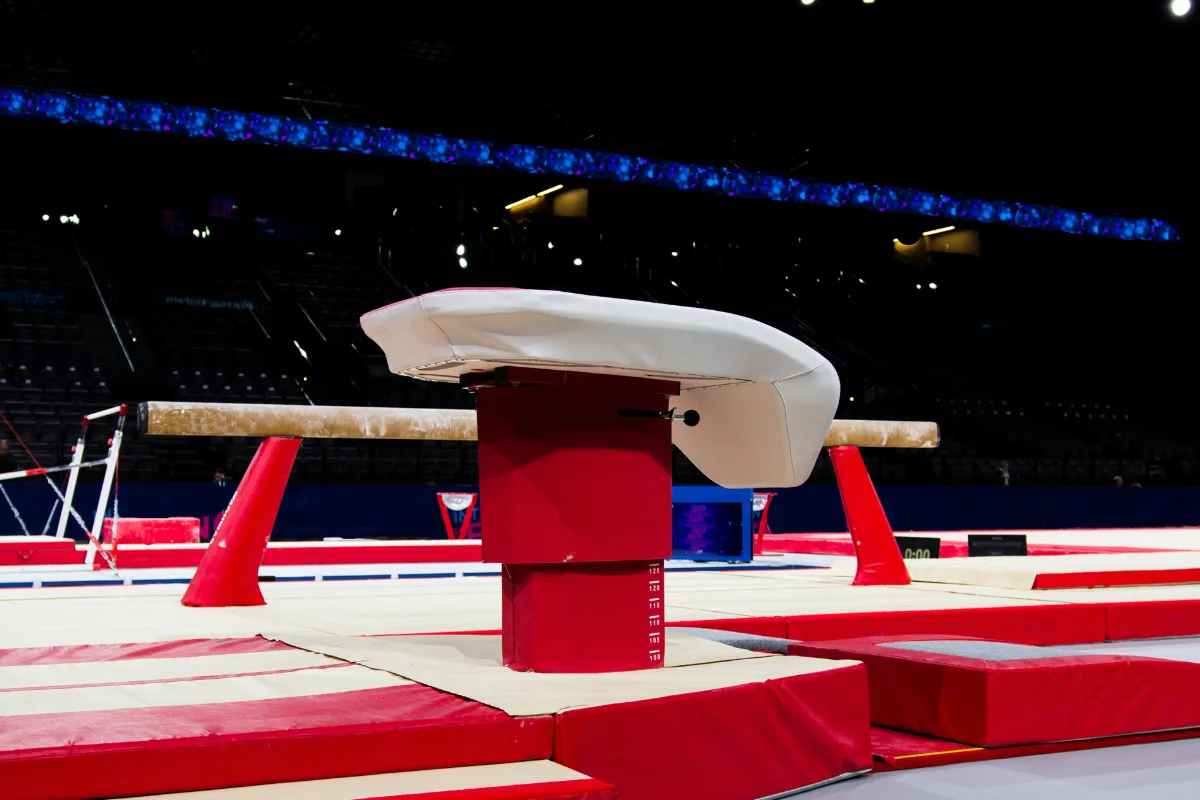
The early vault levels teach different parts of a handspring vault before the gymnast performs the complete skill over a table. The progression moves from a jump and handstand sequence to a handspring over mats, then to the vault table.
Contents
This guide covers the USA Gymnastics Women’s Development Program compulsory Levels 1–5, using the 2021–2029 compulsory material and the 2026–27 apparatus rules. It is a requirements reference, rather than a step-by-step training lesson.
For a particular level, open the vault requirements in the Explorer, select the level and choose Get info. For example, women’s USAG DP → Level 1 → Vault shows the jump and the separate handstand-to-back sequence. The result summarizes the prescribed vault; it does not provide the full equipment or judging rules.
Check the review date and sources shown with each result. Get info retrieves the site’s latest reviewed record; it does not automatically check USAG for rule changes.
The Required Vault at Each Level
| Level | Required movement | Main apparatus |
|---|---|---|
| 1 | Stretch jump onto the mats, followed by the handstand-to-straight-back sequence | Mat stack |
| 2 | Jump to handstand on the mats, then continue to a straight-lying position on the back | Mat stack placed lengthwise |
| 3 | Handspring over the raised mats, landing on the feet | Mat stack placed sideways |
| 4 | Handspring over the vault table | Vault table |
| 5 | Handspring over the vault table | Vault table |
The finishes are an important distinction. Level 2 ends on the back. Level 3 travels over the mats to a landing on the feet. Levels 4 and 5 use the same basic handspring vault over the table.
The Levels 1–10 skill requirements directory shows how this event fits into the rest of the program.
Levels 1 and 2: The Jump and Handstand Foundations
Level 1 includes more than the stretch jump
The first part of Level 1 is a stretch jump onto the raised mats. The gymnast then performs the handstand and straight-body fall to the back described in the compulsory exercise.
Both parts belong to the exercise. The official evaluation points address the jump, the vertical handstand and the straight body position during the finish on the back.
Judges assess the jump’s shape and control, along with the required positions in the rest of the exercise. The handstand should show an inverted body line; the finish should preserve the intended straight shape.
Level 2 connects the board directly to the handstand
At Level 2, the gymnast jumps from the board into hand support on the mat stack, passes through the required inverted position and finishes lying straight on her back.
There is no preliminary stretch jump to a standing position on the mats as in the Level 1 sequence. The movement joins the approach, board action and handstand more directly.
A forward roll is not equivalent to the intended handstand action. Bent arms, an incomplete inverted position and loss of body shape can affect the score. The official table also distinguishes an execution fault from performing an incorrect vault.
Level 3: A Handspring Over the Mats
Level 3 changes the landing task. The gymnast performs a handspring over a raised mat surface and lands on her feet beyond it.
The vault has an approach, board takeoff, flight toward the hand support, a push away from the support and a landing. The push away is often called the block or repulsion phase.
Passing through an inverted position is still important, but the gymnast now needs to continue over the apparatus to a controlled landing. Describing this as another flat-back vault misses that change.
The mat stack is placed sideways and uses the approved height choices. A higher mat stack by itself does not turn a Level 2 vault into a Level 3 vault; the prescribed movement and finish are different.
For a fuller explanation of these stages, see how vault skills are grouped.
Levels 4 and 5: The Handspring Over the Table
Both levels perform a handspring over the vault table. Level 5 does not require a different vault family simply because it is the next compulsory level.
The gymnast runs to the board, takes off toward the table, supports briefly on the hands and pushes away into the flight toward the landing. Judges assess the quality throughout, including body alignment, arm and leg form, direction, repulsion and landing control.
There are level-specific rule differences, including assistance during the vault. In the compulsory table, coach assistance during the first flight, support or second flight costs 2.00 at Level 4 and makes the vault void at Level 5.
That should not be shortened to “any contact anywhere is void at Level 5.” Assistance on landing is a separate situation with its own treatment. The phase in which the assistance occurs matters.
“Higher standards” is also too vague to explain the difference. The precise compulsory deductions apply; judges do not invent an extra penalty simply because they expect an older or more advanced gymnast to look stronger.
Current Apparatus Requirements
The 2026–27 Women’s Rules & Policies specifies these main height arrangements:
| Level | Setup | Allowed height choices or range |
|---|---|---|
| 1–2 | Lengthwise mat stack | 16, 24, 32, 40 or 48 inches, with the stated measurement allowance |
| 3 | Sideways mat stack | 32, 40 or 48 inches, including base matting, with the stated allowance |
| 4–5 | Vault table | Any manufactured setting within the maximum of 135 cm, subject to the stated allowance |
Level 2 therefore does not have a blanket minimum of 32 inches. Its permitted stack begins at 16 inches. Level 3 begins at 32 inches.
The Rules & Policies also specifies the mats’ dimensions, markings, additional landing protection and permitted top surfaces. The current top-layer wording is a minimum of a throw mat in thickness; a universal “4-inch skill cushion on top” statement does not accurately describe the current rule.
For Levels 1–5, the required runway provision is 60–80 feet. This is the available runway length, not a requirement for every gymnast to run the full distance.
Approved alternative springboards are permitted for Levels 1–3 vault. They are not permitted for Levels 4–5. An ordinary trampoline or improvised device is not automatically an approved alternative board.
Equipment setup is the responsibility of the qualified coaches and meet personnel. This summary does not replace the full apparatus specifications.
What Judges Assess
A vault can lose points even if the gymnast reaches the intended landing. Common areas include a loss of speed at the board, bent or separated legs, bent arms during support, an arched or piked body where a stretched shape is required, and an uncontrolled finish.
Some deductions can apply in more than one phase. A gymnast who bends her legs on the way to support and again after pushing away may be evaluated for both occurrences.
Other problems are not ordinary form deductions. Performing the wrong vault or failing particular basic conditions can produce a void vault. Coach assistance also has specific treatment: at Level 2, assistance from the board to the mat stack makes the vault void, while assistance after hand support is established carries the specified 2.00 deduction.
These examples explain why “the coach helped” is not enough information to calculate the score. The level, phase and exact action all matter.
Elite vault values and penalties should not be applied to these compulsory exercises. The competition program must be identified before comparing scores.
Following the Progression at a Meet
The easiest way to identify the early vaults is to look at three things: whether the gymnast first stands on the mats, whether she finishes on her back or her feet, and whether the hand support is on mats or on the table.
That makes the progression easier to recognize without treating it as a timetable. The Development Program guide explains why gymnasts can progress at different rates across their competitive careers.
Reviewed September 28, 2026. An overview of the prescribed vaults and selected apparatus rules, not a complete judging or equipment checklist.