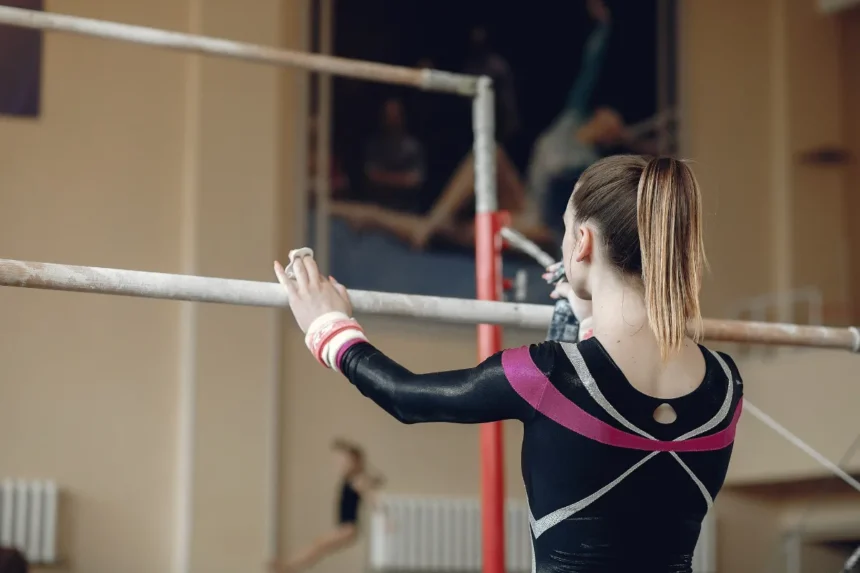
Uneven bars at the early Development Program (DP) levels is all about building safe shapes and clean timing. In Levels 1–3, gymnasts learn how to control front support, casts, and circle actions on the low bar, plus a simple, consistent dismount.
By Levels 4–5, bars starts to look more like “real compulsory bars,” with glide kips, long-hang skills, higher casts, and a dismount that requires better swing rhythm and air awareness.
Quick progression map (Levels 1–5)
| Level | The “big idea” on bars | Main building blocks you’ll see |
|---|---|---|
| 1 | First front-support control | Pullover → cast → back hip circle → low-bar dismount option |
| 2 | Add glide swing + cleaner shapes | Glide swing & return + pullover → cast → back hip circle → underswing dismount |
| 3 | Link skills with rhythm (mount option introduced) | Glide swing & return + pullover or glide kip mount + circles + squat-on jump dismount |
| 4 | First true compulsory kip/swing feel | Glide kip mount + cast to horizontal + long-hang kip + tap-swing sequence + ½-turn dismount |
| 5 | Bigger casting + clear hip + flyaway | Glide kip + cast above horizontal + clear hip + long-hang swing sequence + flyaway dismount |
Start-value note (Level 5):
USAG allows a Level 5 routine option using the Level 4 dismount for a 9.5 start value, or the routine as written (with flyaway) for a 10.0 start value.
Level 1 Uneven Bars (Developmental)
Level 1 bars is about front-support body tension. Judges want to see a gymnast who can hold shape, move around the bar, and finish skills without collapsing at the shoulders or piking at the hips. Every cast, kip, and swing later on depends on this foundation.
Major elements you’ll see
- Mount: Back hip pullover to front support
- Cast
- Back hip circle
- Cast to straddle-on / squat-on
- Dismount option: Sole circle or underswing
Common make-or-break details
- Pullover: Not finishing in a fully extended front support, extra hops before the mount, or using the chin/neck on the bar.
- Back hip circle: Bent arms, piking, or losing contact/timing around the bar.
- Dismount: Low amplitude, poor distance from the bar, or obvious shape breaks in flight or landing.
Nothing here is flashy but small form errors add up fast. Clean shapes and calm control are what separate strong Level 1 routines from average ones.
Level 2 Uneven Bars (Developmental)
Level 2 introduces one of the most important bar concepts a gymnast will ever learn: glide mechanics. The gymnast must create swing from the feet, stay long through the body, and return to the bar under control. The challenge is generating motion without turning the glide into a run-out or drifting into a long-hang swing.
Major elements you’ll see
- Glide swing & return
- Mount: Back hip pullover
- Cast
- Back hip circle
- Underswing dismount
Common deductions to watch
- Glide swing: Run-out glides, bent knees, insufficient extension, or failing to lead clearly with the feet.
- Cast / back hip circle: Bent arms, soft body, or loss of control returning to front support.
- Underswing dismount: Excessive bar contact, low amplitude, or loose body in flight and landing.
At Level 2, judges are watching for the beginning of real swing awareness. Clean glide shape and controlled returns set up everything that comes next.
Level 3 Uneven Bars (Developmental → bridge toward compulsory rhythm)
Level 3 is where bars starts to feel like connecting ideas instead of isolated skills. Gymnasts are expected to keep moving, reduce pauses, and show consistent body shape across multiple elements. This level quietly prepares gymnasts for true compulsory bars in Levels 4 and 5.
Major elements you’ll see
- Glide swing & return
- Mount option: Back hip pullover or glide kip mount
- Cast
- Back hip circles with improved continuity
- Front hip circle → small cast → return to front support
- Cast, squat-on, stretch jump dismount
Common deductions to watch
- Routine setup: There is a specific penalty for starting incorrectly relative to the low bar—details matter.
- Back hip circles: Pauses between circles, broken rhythm, or shape changes that interrupt flow.
- Front hip circle section: Missing the small cast immediately after the circle or failing to return to a clear front support.
At Level 3, routines that look busy but connected tend to score better than routines with clean skills separated by long stops. Rhythm starts to matter almost as much as form.
Level 4 Uneven Bars (Compulsory)
Level 4 is where classic compulsory bars truly begins. Glide kips must work, casts must reach horizontal, and swing rhythm finally matters. This level often separates gymnasts who are “getting through bars” from those building real optional-level foundations.
Major elements you’ll see
- Mount: Straddle or pike glide kip
- Cast to horizontal & return
- Cast → squat-on / pike-on or backward sole circle option
- Long-hang kip
- Cast to horizontal
- Tap swing + counterswing sequence
- Dismount: Tap swing forward with ½ turn
What judges care about most
- Kip efficiency: Long glide, feet leading, smooth leg closure
- Cast angle: Horizontal is a real benchmark—short casts are heavily deducted
- Swing mechanics: Clear hollow-to-arch tap timing, not just passive swinging
Level 4 judging is less forgiving. Clean kips, true horizontal casts, and disciplined swing rhythm make a visible difference.
Level 5 Uneven Bars (Compulsory)
Level 5 is the biggest visual jump in the compulsory system. Bars routines get faster, higher, and more dynamic because gymnasts must show above-horizontal casts, a true clear hip, and a flyaway dismount. This level exposes weaknesses quickly.
Major elements you’ll see
- Mount: Straddle or pike glide kip
- Cast above horizontal
- Clear hip circle (to required height)
- Additional compulsory swing content (long-hang pullover, underswing + counterswing units)
- Dismount: Tap swing to flyaway
Start-value option:
10.0 SV with flyaway, or 9.5 SV using the Level 4 dismount.
What Level 5 is really testing
- Amplitude control: Height and shape matter, just “getting around” isn’t enough
- Clear hip identity: If the hips brush the bar and it looks like a back hip circle, judges treat it as a major error
- Flyaway readiness: Correct tap timing, lift away from the bar, and a controlled landing
Strong Level 5 bars routines show confidence, height, and clarity. These are the routines that translate cleanly into Level 6 and optional bars.
The deductions that wreck bars scores at Levels 1–5
These show up constantly in judging and are usually the difference between a solid score and a frustrating one.
Extra swing or extra cast
An intermediate extra swing or cast is 0.30 by itself. Multiple extras can stack quickly, especially in Levels 3–5.
Bent arms or bent legs in support
Significant bends in front support, casts, or circles can be deducted up to 0.30 per element. Small errors add up fast.
Hesitation on high-bar transfer or jump
Any pause or reset during the transition is a specific deduction category. Judges want continuous motion.
Change of prescribed text or missing major element
Compulsory routines are built around required elements. Changing or omitting them results in full-value, half-value, or double-value deductions, depending on the mistake.
Amplitude and tightness issues
Judges evaluate both:
- External amplitude: how high casts and swings rise
- Internal tightness: straight body, hollow shape, leg extension
Low casts and soft shapes quietly bleed tenths throughout the routine.
Bottom line
If you’re building or auditing a Level 1–5 bars program, the winning formula is simple:
- Own the support positions (front support and squat-on should look quiet)
- Eliminate extra swings and casts
- Make casts and taps actually rise
- Keep body shapes consistent (tight legs, pointed toes)
- Treat dismount landings like a skill, not an exit
This is exactly what sets gymnasts up for success in Level 6 and optional bars.