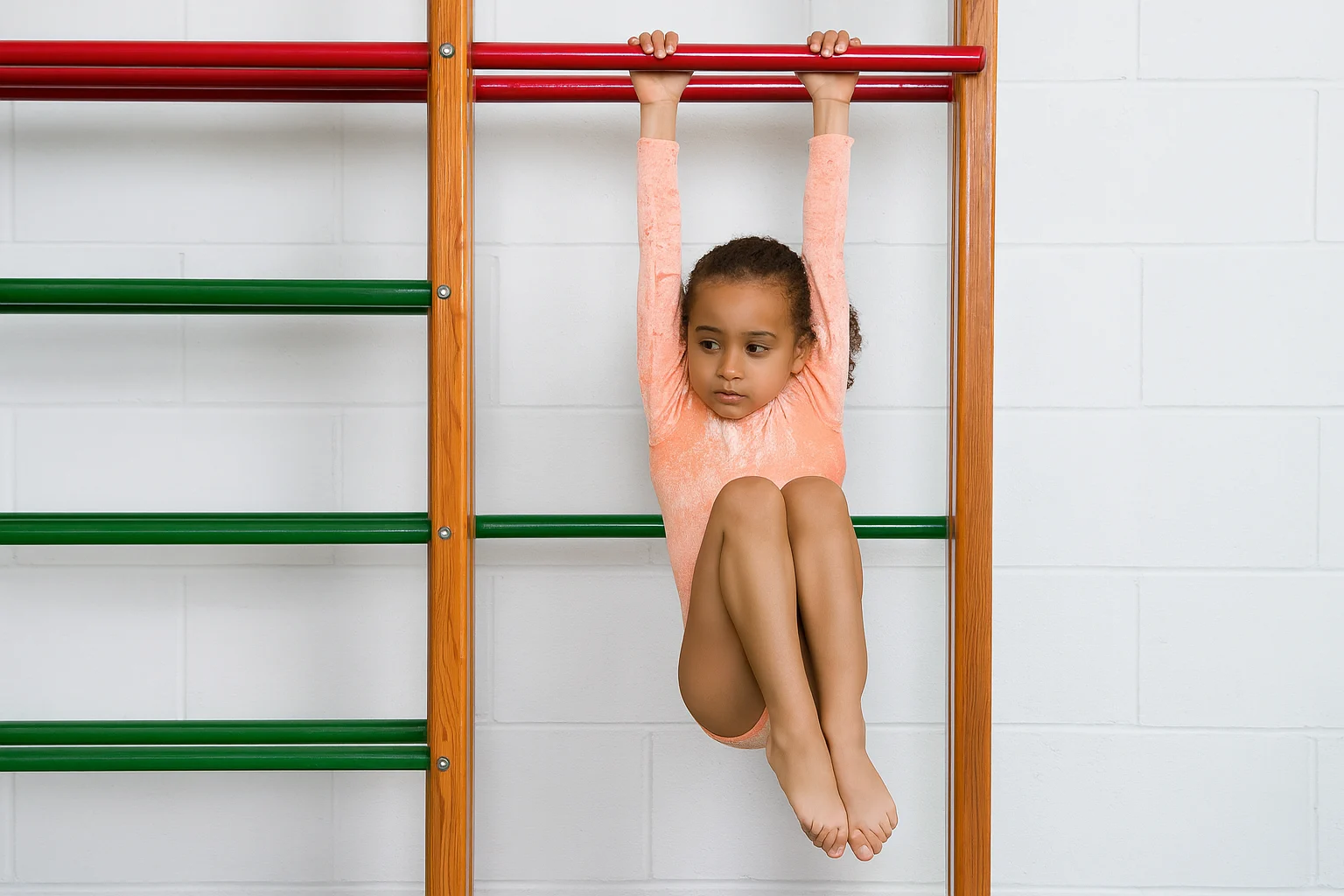
Beginner bar lessons help children learn to hang, support their weight, swing and move around a rail with control. Progress often appears in small details: a more secure grip, a clearer body shape or a smoother finish. A new named skill is only one sign that learning is happening.
- 1. Hanging and Making Simple Body Shapes
- 2. Front Support Above the Bar
- 3. A Small Cast and Controlled Return
- 4. Learning the Pullover
- 5. Introducing a Back Hip Circle and a Short Sequence
- Playful Does Not Mean Unplanned
- Why Inverted Games Need Particular Care
- Recognizing Progress Without Rushing the Next Skill
These five movement areas explain what families may see in an artistic gymnastics class. They are not a checklist every preschooler should complete, and they are not instructions for spotting a child at home. The instructor chooses the apparatus, assistance and task for the individual gymnast.
1. Hanging and Making Simple Body Shapes
In a hang, the gymnast holds the rail with the body below it. A coach may introduce a tuck shape with bent knees, a pike shape with straight legs lifted forward, or another task appropriate to the child. The activity can combine grip, body awareness and learning to follow a clear start-and-finish instruction.
Watch the whole task rather than only the height of the feet. Can the child get into position with the planned help? Do they understand when to begin and how to finish? Are they still following the coach’s instruction as the activity continues? Those observations are more useful than comparing how long two children can hang.
Hold times should not automatically equal the child’s age. Four years old does not establish that a four-second hold is the right challenge. The shape, assistance, grip, fatigue and the child’s experience all affect what the instructor chooses.
2. Front Support Above the Bar
Front support places the gymnast above the rail, with the hands supporting the body and the bar near the hips. It introduces a different task from hanging below the rail. The child learns how the body is arranged over the hands and how to remain controlled before the next movement.
The route into support depends on the lesson and equipment. A coach may provide assistance or use a suitable setup. Being placed in support is not the same achievement as getting there independently, but it can still be a purposeful learning step.
A support should have an agreed exit. Parents may focus on the impressive moment above the bar and miss this equally important part of the lesson. Ask what the child is learning about returning to the mat as well as what they are learning about holding the position.
3. A Small Cast and Controlled Return
A cast moves the body away from front support before returning to the bar or continuing to a later skill. A beginner’s cast may be small. That does not make it meaningless: it introduces a change from a supported position into a moving one and back again.
A higher cast is not automatically a better task for that session. The instructor may be working on the shape, timing or controlled return. From the viewing area, look for the goal the coach has identified rather than measuring every attempt against a handstand seen in elite competition.
It is also helpful to separate a cast from a circle. A cast does not itself mean the gymnast has rotated all the way around the bar. If the lesson combines them later, recognizing the individual parts makes the sequence easier to understand.
4. Learning the Pullover
A pullover brings the gymnast around the bar into front support. It combines bringing the lower body upward with coordinated movement around the rail. It can look straightforward once learned, but a child may need support with several different parts.
Assisted pullovers and independent pullovers are different practice conditions. If a child succeeds with assistance, that is useful progress without being proof that the same skill should now be attempted alone. A coach can explain what the assistance is helping and which part the child is controlling.
Nor is a pullover required in every compulsory level. Bar routines change as gymnasts progress, and skills such as the kip have their own role. The kip learning guide explains why getting above the bar can involve a different movement pattern.
5. Introducing a Back Hip Circle and a Short Sequence
A back hip circle takes the gymnast backward around the rail with contact near the hips, returning to support. It differs from a clear hip circle, in which the hips stay clear of the rail. Similar names should not hide that distinction.
When the separate parts are ready, an instructor may link a pullover, cast and back hip circle into a short sequence. The new challenge is not just performing three actions: it is arriving from one in a position that allows the next to begin.
A child who can perform the pieces separately may still be learning their connection. Pausing between them during a lesson can give the coach a chance to check position or explain the next task. The purpose of that practice should be understood before it is compared with a continuous competition routine.
Playful Does Not Mean Unplanned
A game can give a child a concrete target, an imaginative theme or a reason to repeat a familiar movement. It still needs a clear setup and supervision. USA Gymnastics’ preschool instructor course description combines movement development with appropriate activity selection, equipment use and lesson planning.
For school-aged children, the R103 course similarly emphasizes individual development, progressions and hands-on spotting education. These are descriptions of instructor training, not an endorsement of one universal five-skill lesson.
For example, a coach may turn a familiar body-shape task into a brief game while another station teaches a new movement with direct assistance. The game should support the learning objective, rather than encourage children to hang for as long as possible or imitate an unfamiliar inversion.
Why Inverted Games Need Particular Care
Names such as “skin the cat” or “hot dog” can make a movement sound harmless without explaining its demands. A cheerful name does not establish that a shoulder position, grip or release is appropriate for a particular child.
In her preschool bar teaching notes, instructor Patti Komara specifically cautions about skin-the-cat and unassisted inverted work. The useful message for families is to leave those decisions and spotting to a trained instructor, rather than copying a brief online demonstration.
Recognizing Progress Without Rushing the Next Skill
A useful class update identifies what changed: less assistance during a particular phase, a controlled return after a cast, or remembering a short sequence. “Nearly has the pullover” can mean several different things, so invite the coach to explain it.
If practice at home is suggested, ask for the exact approved activity and setup. The class-selection guide also offers questions about instruction and supervision. A child’s willingness to return, understanding of the task and growing control deserve attention alongside the next skill name.