The 7 Types of Gymnastics: A Complete Beginner’s Guide
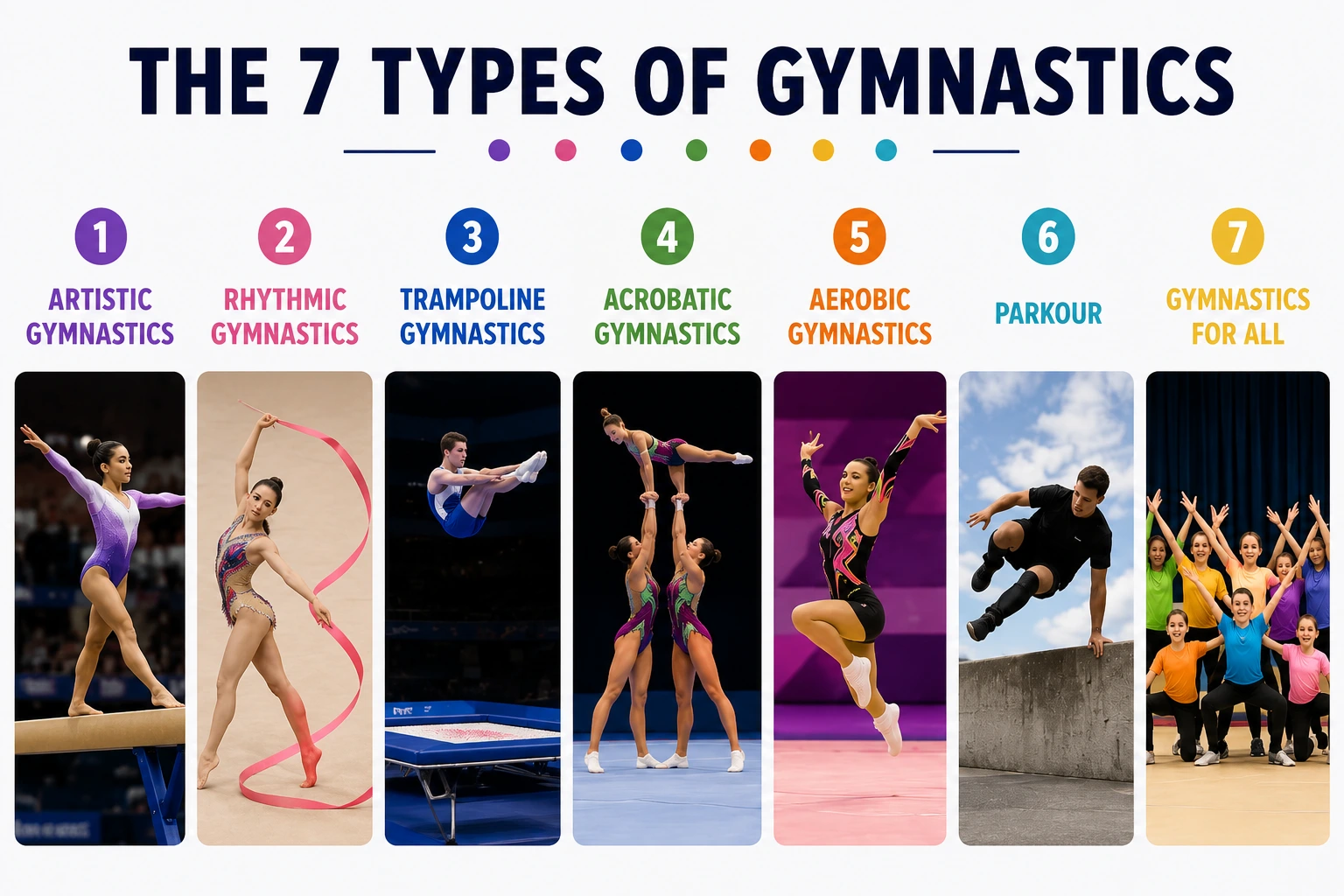
When most people think of gymnastics, they picture athletes flipping on the balance beam or soaring over the vault at the Olympic Games.
Contents
In reality, gymnastics is much broader than artistic gymnastics alone. The sport is usually grouped into seven main types, each with its own equipment, rules, skills, and style of competition. The International Gymnastics Federation (FIG), the sport’s world governing body, lists eight disciplines because it counts men’s and women’s artistic gymnastics separately.
Is Gymnastics a Sport?
Yes. Gymnastics is an Olympic sport with its own world governing body, the International Gymnastics Federation (FIG). Three of its seven types, artistic, rhythmic and trampoline gymnastics, are on the Olympic program.
The 7 Types of Gymnastics at a Glance
| Type | Main Focus | Equipment | Olympic Sport |
|---|---|---|---|
| Artistic Gymnastics | Strength, power, technique | Apparatus | Yes |
| Rhythmic Gymnastics | Dance, flexibility, apparatus handling | Hand-held apparatus | Yes |
| Trampoline Gymnastics | Height, flips, twists | Trampoline | Yes |
| Acrobatic Gymnastics | Partner skills and teamwork | No apparatus | No |
| Aerobic Gymnastics | Endurance and continuous movement | Floor | No |
| Parkour | Speed and obstacle movement | Obstacle course | No |
| Gymnastics for All | Recreation and participation | Various | No |
Artistic Gymnastics (WAG & MAG)
Artistic gymnastics is the best-known discipline and the one most people watch during the Olympic Games. Athletes perform short routines on different apparatus that showcase strength, flexibility, balance, coordination, power, and artistic presentation.
Men and women compete on different apparatus.
Women’s Artistic Gymnastics (WAG)
Women’s artistic gymnastics includes four events.
Vault: Gymnasts sprint down a runway, jump from a springboard, push off the vault table, and perform flips or twists before landing.
Uneven Bars: Athletes swing, transition, release, and regrasp between two bars set at different heights while performing giant swings and flight elements.
Balance Beam: Routines include leaps, jumps, turns, acrobatic skills, and dismounts performed on a beam that is only 10 centimeters (4 inches) wide.
Floor Exercise: Floor routines combine tumbling passes, dance, leaps, and choreography performed to music.
Men’s Artistic Gymnastics (MAG)
Men compete on six apparatus:
- Floor Exercise
- Pommel Horse
- Still Rings
- Vault
- Parallel Bars
- High Bar
These events place a greater emphasis on upper-body strength, swinging skills, and power.
In the United States, many artistic gymnasts begin in the USA Gymnastics Development Program. Gymnasts typically learn compulsory routines in Levels 1–5 before progressing to optional routines from Level 6 onward.
Best for: Children and teens who enjoy learning a wide variety of gymnastics skills while developing strength, flexibility, coordination, and confidence.
Rhythmic Gymnastics
Rhythmic gymnastics combines dance, flexibility, music, and apparatus handling into elegant routines performed on the floor.
Unlike artistic gymnastics, there are no bars, beams, or vaults. Instead, athletes perform balances, turns, leaps, and limited acrobatic elements while manipulating hand-held apparatus.
The five rhythmic apparatus are:
- Ribbon
- Hoop
- Ball
- Clubs
- Rope
Under the FIG’s current rhythmic Code, senior individual gymnasts use hoop, ball, clubs and ribbon. What changes from one Olympic cycle to the next is the combination of apparatus used in group routines, while rope continues to appear in many junior and national-level competitions.
Rhythmic gymnastics includes both individual and group competitions. At the Olympic Games, only women currently compete in rhythmic gymnastics.
In the United States, rhythmic gymnastics follows its own USA Gymnastics athlete development pathway with age-group and level-based competitions.
Best for: Athletes who enjoy dance, music, flexibility, and expressive performances.
Trampoline Gymnastics (TRA)
Trampoline gymnastics focuses on height, body control, and aerial awareness. Athletes perform multiple flips and twists while maintaining precise technique and consistent height.
The discipline includes four competition events.
- Individual Trampoline
Gymnasts perform a routine consisting of 10 consecutive skills, combining somersaults and twists while maintaining control throughout the routine.
- Synchronized Trampoline
Two athletes perform identical routines simultaneously on separate trampolines while staying perfectly synchronized.
- Double Mini-Trampoline
Athletes sprint toward a smaller trampoline, perform a mounting skill and aerial elements, then finish with a controlled landing on a mat.
- Tumbling
Tumbling takes place on a long, sprung tumbling track instead of a trampoline. Athletes perform fast, connected flips and twists in powerful passes down the track.
Only Individual Trampoline is currently an Olympic event.
Best for: Athletes who love jumping, aerial skills, and learning flips safely.
Acrobatic Gymnastics (ACRO)
Acrobatic gymnastics is built around teamwork.
Instead of performing on apparatus, athletes work together in pairs or groups to complete lifts, balances, throws, catches, pyramids, dance, and tumbling.
Competition categories include:
- Women’s Pair
- Men’s Pair
- Mixed Pair
- Women’s Group (3 gymnasts)
- Men’s Group (4 gymnasts)
Routine types:
- Balance – Holding still poses and partner balances.
- Dynamic – Throws, catches, and flight moves.
- Combined – A mix of both.
Success depends on trust, communication, timing, and precision.
Best for: Athletes who enjoy teamwork, partner skills, and strength-based performances.
Aerobic Gymnastics (AER)
Aerobic gymnastics is a fast-paced discipline that combines gymnastics, dance, and high-energy fitness. Routines last about 80 to 90 seconds and feature continuous movement, powerful jumps, flexibility, push-ups, strength skills, and choreography performed to upbeat music.
Competition formats include:
- Individual (men or women)
- Mixed Pair
- Trio
- Group (up to 5 athletes)
- Aerobic Dance (8 athletes)
- Aerobic Step (at selected competitions)
Because there are very few pauses, aerobic gymnasts need excellent endurance and cardiovascular fitness.
Best for: Athletes who enjoy energetic routines, dance, and continuous movement.
Parkour (PK)
Parkour is the newest discipline recognized by the FIG. Instead of performing on traditional gymnastics apparatus, athletes move through obstacle courses by running, climbing, jumping, vaulting, swinging, and balancing.
There are two competition formats.
- Speed Run – Complete the obstacle course in the fastest time possible.
- Freestyle – Create your own flow and impress judges with flips, vaults, and style.
Parkour uses walls, rails, and platforms instead of traditional equipment. It’s about adapting to the environment and expressing movement freely.
Best for: Athletes who enjoy obstacle courses, creative movement, and outdoor-style training.
Gymnastics for All (GFA)
Gymnastics for All is a recreational discipline designed for people of all ages and abilities.
Unlike competitive gymnastics, Gymnastics for All focuses on participation, fitness, fun, and lifelong physical activity rather than scores or medals.
Programs often include:
- Basic gymnastics
- Dance
- Tumbling
- Acrobatics
- Group performances
Many clubs offer classes for toddlers, children, adults, families, and older adults. International festivals also bring together thousands of participants to perform large group routines.
Best for: Beginners, families, recreational athletes, and anyone who wants to enjoy gymnastics without competing.
Which type of gymnastics is best for beginners?
Recreational artistic gymnastics and Gymnastics for All are excellent starting points because they teach fundamental movement skills in a supportive environment.
Can Gymnasts Switch Between Disciplines?
Yes. Many gymnastics skills are transferable, making it possible for athletes to move between disciplines as they grow or discover new interests. Strong balance, flexibility, coordination, and body awareness benefit athletes in every discipline.
Is tumbling its own type of gymnastics?
Not officially. Under the FIG, tumbling is one of the competition events within Trampoline Gymnastics, along with individual trampoline, synchronized trampoline, and double mini-trampoline.
Is rhythmic gymnastics only for girls?
No. While Olympic rhythmic gymnastics currently features women, some countries also have men’s rhythmic gymnastics programs and competitions.
Which gymnastics discipline requires the most strength?
Artistic gymnastics, particularly men’s artistic gymnastics, is widely considered the most strength-intensive because of events such as still rings and pommel horse.
Each discipline offers its own style and benefits, so the best choice depends on your child’s personality and interests. No matter which path they take, gymnastics helps kids grow stronger, more focused, and more confident on and off the mat.