Circles vs. Flairs on Pommel Horse: How to Tell Them Apart and How Gymnasts Learn Them
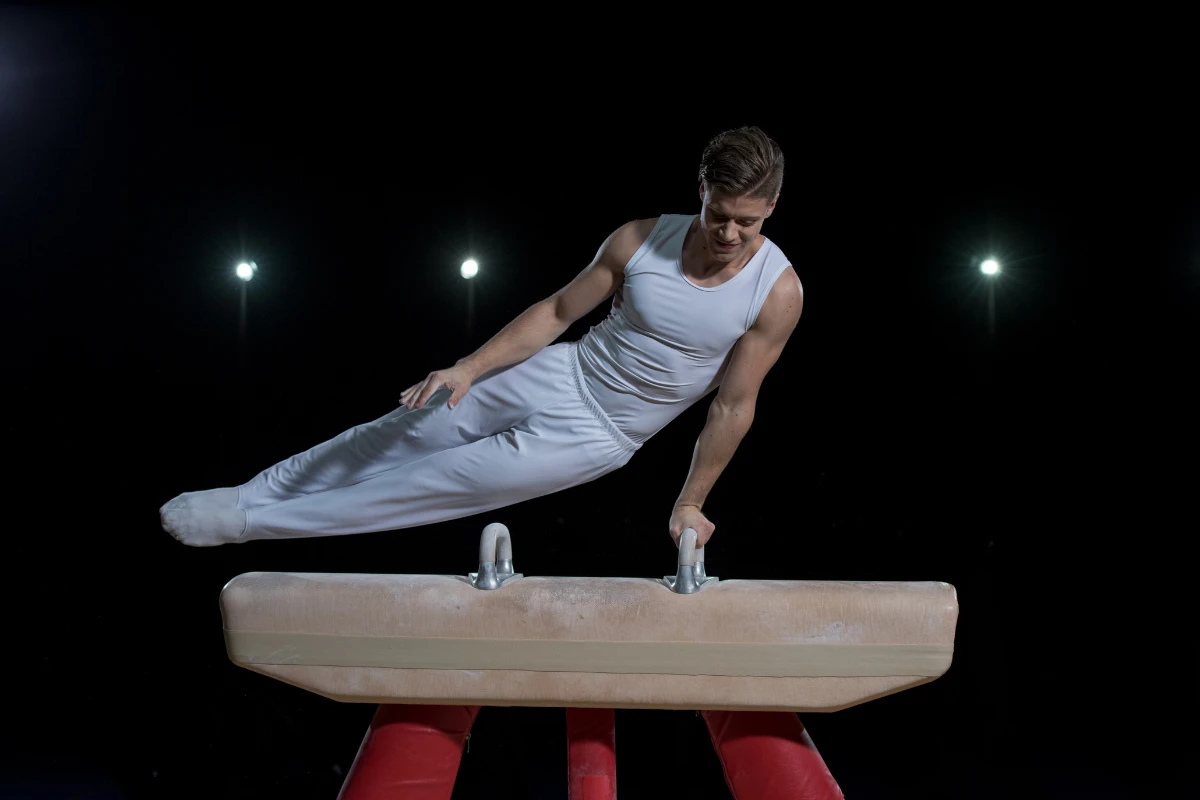
The quickest way to tell circles from flairs on pommel horse is to watch the legs. In a typical double-leg circle, the legs stay together as the gymnast circles around the hand support. In a flair, the legs are straddled and alternate through the circling movement.
Contents
That is only the starting point. The leg pattern does not tell you the complete skill name or its difficulty, and it does not set a timetable for learning. This guide covers both: how to tell the movements apart when you watch, and how gymnasts build from circles to flairs with their coach.
How to Tell Circles and Flairs Apart
Start with the shared circling action
In both circles and flairs, the gymnast repeatedly changes which hand carries the support while the body moves around the apparatus. The movement must remain organised enough for the legs to clear the horse and for the next hand placement to arrive on time.
The pommels are the two raised handles. They are not the only places a gymnast can put their hands: routines also use the padded body of the horse and different combinations of support. This is why two passages with similar leg action can look quite different from the shoulders upward.
What to watch in a double-leg circle
The legs-together shape makes a circle visually compact. Rather than tracking each foot separately, try following the joined legs as one moving line. The body passes around the support, with the hands changing their role as the gymnast moves through the cycle.
Also notice whether the gymnast remains in one place. Circles can form part of a passage that moves along the apparatus, so the same visible leg pattern can appear within a travel rather than a stationary sequence.
What changes with flairs
Flairs have a wider silhouette because the legs separate and move through an alternating pattern. The body still circles around the hand support, but the legs do not remain joined as they do in the typical double-leg circle.
The movement often looks more dramatic because the feet sweep through different parts of the surrounding space. Dramatic appearance is not a reliable difficulty ranking, however. A tightly controlled legs-together passage with demanding hand placements or travel may involve details a new viewer barely notices.
| Viewing clue | Circles | Flairs |
|---|---|---|
| Most obvious leg pattern | The legs remain together through the circling action. | The legs separate and alternate through a straddled circling action. |
| Useful thing to follow | The joined legs as one line, then the hand changes. | The relationship between the two legs, then the hand changes. |
| What the pattern alone cannot tell you | The full element identity, travel, turn, difficulty value or execution quality. | |
| Common viewing mistake | Assuming a compact appearance means a simple element. | Assuming the largest-looking movement must earn the highest value. |
You may hear the expression Thomas flair. The International Gymnastics Hall of Fame’s profile of Kurt Thomas highlights the movement as a signature part of his influence on the sport. That historical association helps explain the name, but it does not identify every variation performed in a modern routine.
Scissors also separate the legs, but they are different
A straddle by itself is not enough to identify a flair. Pommel-horse routines also contain single-leg swings and scissors, where the legs have a different swing-and-exchange relationship.
The FIG men’s Code of Points places single-leg swings and scissors in a different pommel-horse element group from circles and flairs. Its event description also includes travels and movements through handstand. A routine therefore contains several kinds of action, not merely alternating circles and flairs.
Difficulty and Execution Answer Different Questions
There is no safe general rule that every flair is worth more than every circle, or that all circle and flair versions are interchangeable. The relevant apparatus table and the rules of the particular competition program decide the credit. A rule written for a similar-looking floor element should not automatically be applied to pommel horse.
Execution concerns how the movement is performed. Under the FIG horse rules, continuous swinging and good body extension matter. A gymnast can receive difficulty credit while also losing execution marks for faults in the performance.
For example, imagine two athletes performing a passage that receives the same difficulty credit. One maintains a clear shape and rhythm; the other bends the knees or visibly disrupts the movement. The shared difficulty does not require the same final score.
How Gymnasts Learn Circles and Flairs
Circles are an important foundation for pommel-horse training, but there is no universal rule that every gymnast must complete exactly ten or fifteen circles before learning any flair preparation. The useful question is what the gymnast can control, on which apparatus, and what the next exercise is meant to develop.
Why coaches spend time on circles
Circles help establish movement patterns used throughout the event. They can lead into changes of support, travel, turning and work toward handstand. Their value in training comes from those relationships, not from being a compulsory waiting period before the more eye-catching flair.
Consider two hypothetical learners who each complete six circles. One maintains a consistent shape and stops deliberately. The other changes shape increasingly and ends by losing the movement. The same count describes different performances. A coach needs to assess how the circles happen as well as how many are completed.
Repeated work on a familiar skill is not necessarily a sign that the gymnast has stopped progressing. The task may be changing from finishing one circle to linking several, maintaining extension or performing the movement on a different trainer. Ask what quality is being developed that day.
What flair preparation adds
Leg separation, timing and clearance are related. If a learner struggles, it is too simplistic to conclude that the only problem is insufficient flexibility. The coach may instead be adjusting the movement sequence, support timing or task difficulty. An observer cannot reliably diagnose the limiting factor from a short clip.
Preparation can also be partial. Practising a chosen phase under instruction does not mean the gymnast has been cleared to attempt continuous flairs on a full horse. Families should distinguish exposure to a movement from independent mastery of the complete skill.
The apparatus changes the task
A mushroom is a circular training surface without the two pommels of a full horse. A floor horse or another trainer can present a different support area and height. Those differences affect hand placement, clearance and how the gymnast enters and leaves the exercise.
Consequently, “can do circles” is incomplete information. Ask whether the circles are on a mushroom, a trainer or the competition apparatus, and whether assistance or a particular setup is being used. The mushroom-to-pommel-horse guide discusses that equipment progression.
Useful progress questions beyond the circle count
| Question | Why it helps |
|---|---|
| What movement or phase is the current focus? | Separates a preparation drill from the complete skill. |
| What assistance and apparatus are being used? | Makes comparisons between sessions meaningful. |
| Does the quality remain consistent? | Shows whether additional repetitions are preserving the intended action. |
| How does the gymnast finish? | Includes control of the exit, not just continuation. |
| What will the next change be? | Clarifies whether the goal is technique, equipment, sequence length or a new element. |
These are discussion questions, not a substitute assessment form. The coach sees the gymnast’s full practice, including attempts that never appear in a highlight video. Progress decisions should use that broader picture.
When progress seems to stall
Start by identifying the actual change. Has the gymnast lost consistency on a familiar setup, or are they trying a harder task? Are they tired near the end of practice, or having the same difficulty when fresh? Sharing those observations is more helpful than asking for a fixed number of extra circles.
USA Gymnastics’ safety and risk-management curriculum treats apparatus, supervision, preparation and progressions together. That is the appropriate context for learning these skills: a coordinated plan, not clearance based solely on a birthday, a flexibility pose or a personal-best repetition count.
A Simple Way to Watch Your Next Routine
On the first viewing, follow only the leg pattern. Notice where the gymnast uses legs-together circles, flairs or single-leg work. Do not try to count difficulty at the same time.
On a second viewing, follow the hands and location. Does the athlete stay near the centre, use one pommel or move toward an end? Are they changing orientation as they go? This reveals why passages that initially looked repetitive are not necessarily the same element repeated.
Finally, watch how the sections connect. Look for an uninterrupted rhythm and a deliberate transition into the dismount. The handstand you see near the end belongs to the swinging sequence rather than a rings-style strength hold.
Final Takeaway
Circles keep the legs together; flairs separate and alternate them, and scissors are a different single-leg family. None of those patterns alone decides a skill’s difficulty: hand placement, travel, turns and execution matter too.
For learners, circles are the foundation rather than a waiting period, and progress is about control on a given apparatus, not a fixed circle count. The apparatus guide explains how pommel horse fits among the other events.