Balance Beam Skills: What to Watch from Mount to Dismount
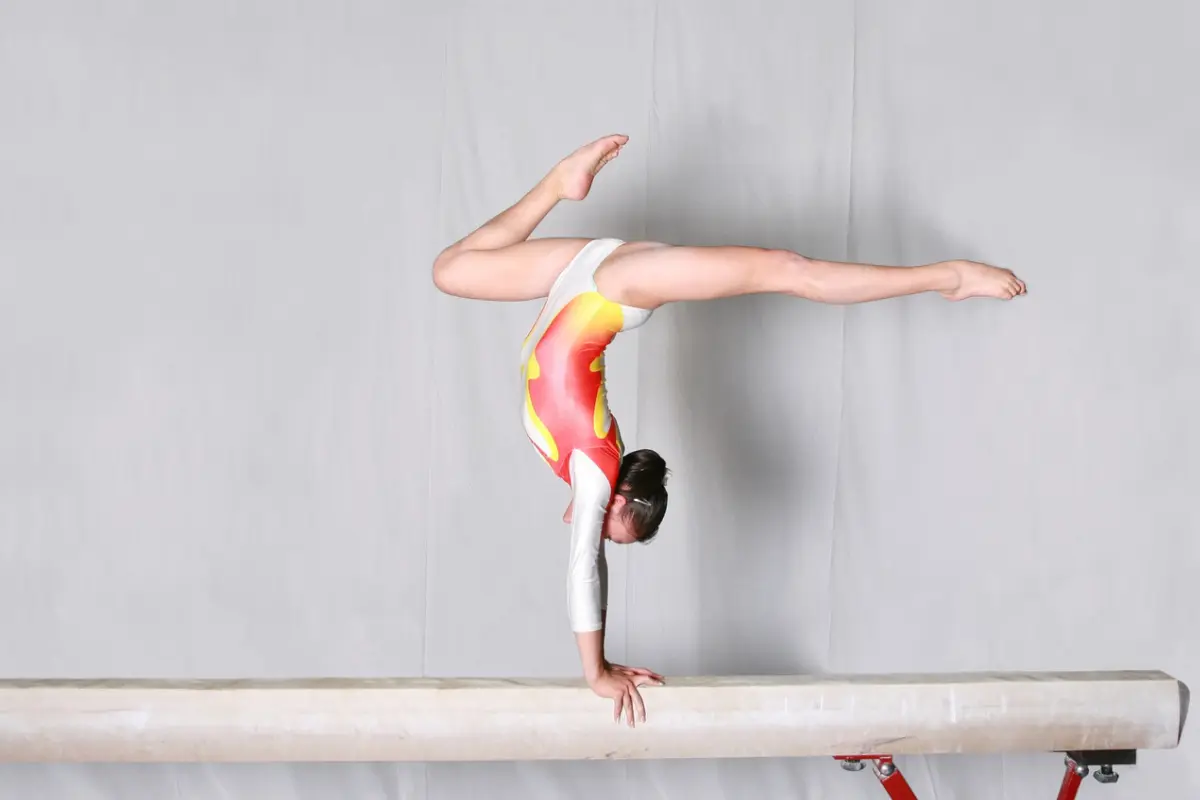
A balance beam routine combines an entry onto the apparatus, movements along it, dance skills, acrobatics and a dismount to the mat. Learning those groups makes the individual skill names easier to recognize.
Contents
The easiest way to follow beam is to notice what each movement does: gets the gymnast onto the apparatus, travels or turns on it, leaves it briefly in flight, or finishes the exercise. The examples below include selected 2025–2028 FIG women’s difficulty values, checked September 28, 2026. Those values describe the exact variations shown; they are not USAG level requirements.
The artistic gymnastics moves guide places beam alongside the other apparatus.
Follow the routine before trying to name every skill
Start with the mount and finish with the dismount. Between them, look for changes of direction, dance movements, acrobatic skills and the steps that join everything together. Dance and acrobatics can alternate; they are not separate chapters that every routine performs in the same order.
For example, a gymnast might connect a back handspring step-out to a layout step-out, then move into choreography before a leap sequence. The two acrobatic skills belong together as a series. The choreography gives that series a place in the larger routine.
At first, it is enough to distinguish a leap from a jump, a skill using the hands from one without hand support, and a landing on one foot from a landing on two. Those visible details will help make sense of the names in the tables.
To look up an unfamiliar movement, use the Gymnastics Skill Explorer and select balance beam. It contains reviewed skill descriptions and selected values; it is not a complete list of everything allowed at every competitive level.
Mounts, Holds and Basic Movement
Mounts: getting onto the beam
A mount is the entry onto the apparatus. It can begin with support from the hands or contain an airborne skill before landing on the beam.
Broad names such as “handstand mount” cover several possibilities. Whether the gymnast holds the handstand, turns in it or lowers into another position can change the value.
| Selected mount | What it looks like | FIG value |
|---|---|---|
| Press-to-handstand mount, held two seconds | Press up to a handstand, hold it for two seconds, then lower to an ending position touching the beam; no turn in this example | B |
| Cartwheel mount | A cartwheel with bent arms through a chest stand onto the beam | A |
| Front-tuck mount from the end | Perform a tucked forward salto from the approach at the end of the beam and land standing on it | D |
| Roundoff–back-handspring mount to stand | Roundoff at the end of the beam, then a back handspring through handstand with one- or two-arm support, finishing standing on the beam | D |
These are the specified versions in the FIG mount table. A momentary jump to handstand and a held press-to-handstand mount should not automatically receive the same label.
Walking and choreography are not automatically A skills
Walking forward or backward, stepping sideways and rising onto the toes help connect the routine. Relevé describes that rise onto the balls of the feet.
Those movements contribute to how the exercise is presented, but an ordinary walking step does not automatically earn an A difficulty value. Listed holds and acrobatic movements have their own descriptions and conditions.
| Selected hold or non-flight acrobatic skill | What it looks like | FIG value |
|---|---|---|
| Kick to handstand, held two seconds | Kick to a cross or side handstand, hold for two seconds, then lower to an ending position touching the beam | A |
| Cartwheel on the beam | Rotate sideways through hand support and return to the feet | A |
| Front walkover | Pass forward through handstand with separated legs and step through to the feet | A |
| Back walkover | Pass backward through hand support with separated legs and step through to the feet | A |
The walkover examples use the ordinary versions with two-hand or alternating-hand support. One-arm and other variations must be checked separately. Source: FIG Women’s Code, beam Groups 1 and 4.
Leaps, Jumps and Turns
Dance skills bring changes of shape, direction and rhythm. Their difficulty depends on the exact takeoff, position and turn, rather than whether the movement looks graceful or travels a long distance.
Leaps and jumps
A split leap takes off from one foot. A split jump takes off from two. A sissonne also takes off from two feet, but lands on one foot with the split shown on a diagonal.
In the table, cross position means facing along the length of the beam. In side position, the gymnast faces across its width. Body orientation and added turns can change the value, so those details are part of the skill description.
| Selected dance skill | Identifying movement | FIG value |
|---|---|---|
| Split leap | Leap forward with 180-degree leg separation | A |
| Split jump from cross position | Jump from two feet with 180-degree leg separation | B |
| Sissonne | Take off from two feet, show a 180-degree diagonal split and land on one foot | A |
| Switch leap | Change legs in flight and show the required split after the change | C |
| Switch half | Perform the switch-leap action with a half-turn and the required split position | D |
| Wolf jump from cross position | Jump with one leg extended forward and the other bent, meeting the Code’s hip-angle and knee-position requirements | A |
| Sheep jump | Jump with upper-back arch and head release, bringing the feet to head height in the closed-ring shape | C |
A split leap and a split jump are therefore not interchangeable labels. In the current FIG beam table, the ordinary split leap is A and the cross-position split jump is B.
The descriptions help identify the skills; judges also check technical details such as leg position and completed rotation. A movement’s intended name does not guarantee that value. The FIG beam dance table and WAG Help Desk (2nd edition, April 2026) explain recognition in more detail.
Turns
A turn’s value depends on the number of rotations and the position held during them. Lifting the free leg for only part of a turn is not the same as maintaining a required leg position throughout it.
| Selected turn | Required variation | FIG value |
|---|---|---|
| Full turn | One complete rotation on one leg, with the free leg in an optional position below horizontal | A |
| Double turn | Two complete rotations on one leg, with the free leg in an optional position below horizontal | D |
| Full turn with the leg held in a vertical split | One rotation with the free leg held upward in a 180-degree split throughout | C |
| Full illusion turn | One complete illusion turn through a standing split with 180-degree leg separation | D |
| Double wolf turn | Two rotations in a low tuck stand on one leg, keeping the free leg straight throughout | D |
In an illusion turn, the gymnast tips the torso downward while the free leg sweeps overhead through the standing-split position. A half illusion and a full illusion are different skills.
In a wolf turn, the supporting leg stays deeply bent while the free leg extends. FIG awards difficulty for only the first turn in tuck stand on one leg in chronological order; listing several wolf-turn variations does not mean a routine can collect difficulty for all of them.
Acrobatic Flight Skills
An acrobatic skill has flight when the gymnast is briefly unsupported in the air. A back handspring has flight even though the hands contact the beam during the movement.
A salto is a flip without hand support. An aerial is also performed without the hands, such as an aerial cartwheel or aerial walkover. Those terms help distinguish a side aerial from a tucked side somersault.
| Selected acrobatic skill | Identifying movement | FIG value |
|---|---|---|
| Front handspring | Forward flight through hand support, landing on one or both feet | B |
| Back handspring step-out | Backward flight through hand support, landing one foot and then the other | B |
| Roundoff | A turning acrobatic movement through hand support that finishes with the feet together | B |
| Onodi | Start with a backward jump, make a half-turn, then pass through handstand into a forward walkover | D |
| Front aerial | A forward aerial walkover without hand support, landing on one or both feet | D |
| Side aerial | An aerial cartwheel without hand support; the ordinary cross-position version | D |
| Back tuck | A tucked backward salto returning to the beam | C |
| Back pike | A backward salto with straight legs and a fold at the hips, returning to the beam | C |
| Back layout step-out | A stretched backward salto landing one foot and then the other | C |
| Back layout with legs together | A stretched backward salto performed with the legs together | E |
| Tucked side somersault | A tucked sideways salto taking off from one leg and landing in side stand | D |
| Arabian tuck | Take off backward, make a half-turn, then perform a tucked forward salto onto the beam | F |
The layout step-out is C, while the legs-together layout is E. A general “back layout: D” label misses both exact descriptions.
An Onodi and an Arabian both begin with a backward takeoff and a half-turn, but the Onodi then uses hand support. The Arabian continues into a salto without putting the hands on the beam.
The performed shape must also meet the recognition rules. FIG publishes video and photo examples for recognizing a stretched backward salto on beam. These help explain why the intended skill name and the skill credited by the judges can differ.
Tuck, pike and layout describe body shape rather than the direction of travel. A tuck bends the knees and hips; a pike bends at the hips with straight legs; a layout is stretched. Source for the table: FIG Women’s Code, beam Group 5.
Dismounts: Leaving the Beam
A dismount finishes the exercise by taking the gymnast from the beam to the landing mat. Its value comes from the dismount element itself, rather than treating its preparatory roundoff and salto as one newly named skill.
| Selected dismount | Movement after leaving the beam | FIG value |
|---|---|---|
| Back tuck | One backward salto in a tuck | A |
| Full-twisting back layout | One stretched backward salto with one twist | B |
| Double back tuck | Two backward saltos in a tuck | D |
| Double back pike | Two backward saltos in a pike | E |
| Biles dismount | Two backward saltos in a tuck with two twists | H |
A back tuck performed onto the beam is C in the acrobatic-flight table. A back tuck performed off the beam as a dismount is A. The landing location and element category change the value.
Likewise, a roundoff before a back-tuck dismount does not turn the dismount into a C element. The roundoff and dismount are identified separately. Source: FIG Women’s Code, beam Group 6, especially printed pages 144–145.
What the Difficulty Letters Mean
FIG gives recognized elements a letter representing their difficulty contribution: A is 0.10, B is 0.20, C is 0.30, continuing upward by 0.10 per letter. Judges count eligible elements under the routine rules to build the difficulty score, or D-Score.
For example, a C skill contributes 0.30 to the difficulty total when it is one of the elements that counts. It does not mean the gymnast receives a final score of 0.30 for performing it.
| Letter used in this guide | Difficulty contribution |
|---|---|
| A | 0.10 |
| B | 0.20 |
| C | 0.30 |
| D | 0.40 |
| E | 0.50 |
| F | 0.60 |
| G | 0.70 |
| H | 0.80 |
The letter belongs to a particular movement. “Back layout” is not precise enough to assign one value: a layout step-out onto the beam and a layout landing with the legs together are different entries in the Code.
Difficulty also differs from execution. A skill can receive its difficulty value while still losing points for a balance check or poor body position. If the movement does not meet the recognition rules, judges may count a different element or award no difficulty for it. Source: FIG Women’s Code, Sections 7–8.
How the Skills Fit into a Routine
A routine needs more than a collection of the highest letters. Under FIG rules, judges count up to eight difficulty elements including the dismount, with at least three dance and three acrobatic elements among the counting skills. Composition requirements and eligible connections and bonuses contribute separately.
For a simple example, a back handspring step-out is B and a layout step-out is C. If both count, their individual difficulty contributions total 0.20 + 0.30 = 0.50. That addition does not, by itself, award connection value or establish the routine’s full D-Score.
An acro series links acrobatic elements. It does not automatically earn extra points merely because two skills appear together. Connection Value requires a connection that meets the applicable formula and performance conditions. The connection-value guide explains that separate part of scoring.
Execution still matters throughout the exercise, including on lower-value skills and transitions. Receiving difficulty credit and avoiding deductions are separate questions.
USAG Development Program, Xcel and NCAA use their own rules for values, permitted difficulty and routine construction. Families looking for a specific optional DP level should use the Levels 6–10 beam requirements rather than treating this FIG list as a level checklist.
Frequently Asked Questions
Do ordinary beam walks count as A skills?
Not automatically. Walking and choreography help connect and present the routine. Difficulty credit comes from recognized elements under the applicable rules.
Is a split leap the same as a split jump?
No. Their takeoffs differ. The ordinary FIG beam split leap is A, while the cross-position split jump is B.
Is every back layout worth the same value?
No. A layout step-out on beam is C; the legs-together layout is E. A layout used as a dismount has its own entry again.
Does connecting two skills always earn a bonus?
No. The skills and connection must meet the program’s particular requirements. A smooth connection can still earn no connection bonus.
What to Remember
A beam routine becomes easier to follow when the reader can recognize its movement families before memorizing skill names. Watch the takeoff, body shape, hand contact and landing; those details distinguish similar-looking skills and explain why a small change can produce a different difficulty value.