Men’s Floor Exercise Explained: Tumbling, Transitions and the 2025–2028 Rules

Men’s floor exercise combines tumbling with strength, balance, flexibility and choreography. It is performed without music, but rhythm and the way skills flow together still matter.
Contents
This guide covers senior international men’s artistic gymnastics under the 2025–2028 FIG Code, including updates in force by September 2026. USA Gymnastics developmental and NCAA routines can use different rules.
How the Routine Uses the Floor
The performance area measures 12 by 12 meters. A routine may last up to 70 seconds, with no minimum duration. The gymnast moves between corners using tumbling and choreographed transitions, rather than simply walking to the next starting position.
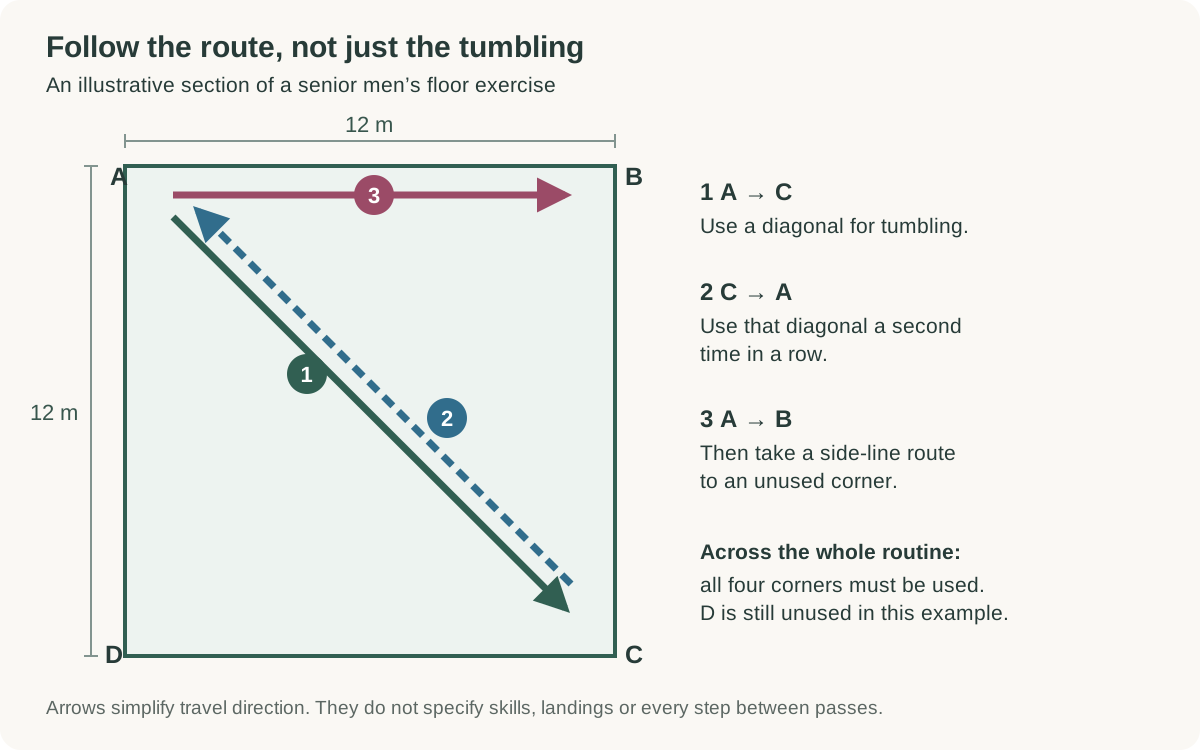
All corners must be used as defined in the Code. The same diagonal cannot be used more than twice consecutively; after two uses in a row, a side-line route to an unused corner is required. This does not mean that a diagonal may be used only twice in the entire routine.
The current routine must begin with an acrobatic tumbling pass. The final acrobatic skill acts as the dismount, even though the gymnast finishes on the same floor rather than leaving a raised apparatus.
Read the Exercise in Three Layers
For a first viewing, separate the tumbling, the non-acrobatic work and the routes between them. A long diagonal with a double salto is visually different from a supported hold, but both belong to the exercise. The transitions explain how the gymnast gets from one part to the next without losing the routine’s rhythm.
On a second viewing, follow the corners. A gymnast who finishes one pass near a corner may turn, leap or move through a supported position before the next approach. Watch the movement actually performed, rather than assuming that every pause at the edge is identical. This makes the purpose of the current transition rules easier to understand.
Four Element Groups Organize the Content
The Code groups floor elements into non-acrobatic skills, forward acrobatics, backward acrobatics, and single forward or backward saltos with at least one full twist. These groups help ensure variety within the routine.
Non-acrobatic content can include handstands, strength work and other recognized movements. The acrobatic groups cover different kinds of tumbling. A single salto with several twists is different from a double salto: the first contains one head-over-heels rotation, while the second contains two.
The men’s element-group guide explains the categories across all six events. Their credit should not be confused with the separately named composition-credit system used in USA Gymnastics women’s optional levels.
A run, a preparatory roundoff and a major salto can appear in one tumbling sequence while serving different purposes. Counting every visible movement will not reproduce the difficulty score. For the event’s selection rules and worked scoring explanation, see how men’s floor exercise is scored.
Which Eight Elements Count?
For senior floor difficulty, the dismount is counted first, followed by the seven highest eligible remaining elements, subject to the routine’s restrictions. This dismount-first rule took effect in January 2026, following FIG Men’s Technical Committee Newsletter 1.
Counting eight elements does not mean that every routine with fewer than eight automatically receives a short-exercise penalty. Short-exercise deductions follow a separate table. Nor does it mean a gymnast performs only eight movements: preparatory and choreographic actions can also appear.
A multiple salto is required as the senior dismount. The routine’s difficulty includes element values, element-group credit and eligible connection credit. A qualifying stuck landing can earn a separate stick bonus; that bonus should not be described as part of the D-score. The men’s scoring guide explains these components.
A Balance or an Approved Jump or Leap
The original cycle update is sometimes summarized as a mandatory scale, but that is incomplete under the subsequent amendments. A qualifying one-leg balance or an approved jump or leap can meet this requirement. Only the specified alternatives count; an ordinary choreographic jump does not automatically qualify.
Some details changed again during the cycle. The July 2026 newsletter, effective September 1, clarifies eligible jumps to front support and how corner-transition families are treated. Coaches and judges need the newsletters alongside the 2025–2028 men’s Code of Points.
The balance-or-jump requirement and the corner-transition requirement are separate. A leap does not automatically satisfy both: its specific form and where it appears matter.
Transitions and Landings Remain Part of the Exercise
Corner transitions must differ under the current rules. Small changes to the turn in a leap do not necessarily create a different transition family. Judges also look for appropriate amplitude, control and rhythm.
At the end of a tumbling line, a controlled landing lets the gymnast continue cleanly into the next movement. Steps, low landings and falls can reduce execution. The absence of music does not remove the expectation of an organized, well-presented routine.
The comparison with women’s floor below explains why the two events should not share one requirements checklist. For recognizing the underlying movement families, start with the tumbling skills guide.
Compare Routines Without Reducing Them to One Big Pass
Suppose two gymnasts perform the same difficult opening salto. One may use different connections, a more valuable dismount or stronger non-acrobatic content later. Their D-scores can differ even before execution is considered. Conversely, a gymnast with a higher D-score may finish behind a rival after landing errors and other deductions.
When watching a replay, record a few concrete observations: the opening tumbling sequence, a non-acrobatic element, a change of corner and the last salto. Then compare those notes with the displayed difficulty and execution scores. This is a more useful introduction than trying to assign a complete judging score from one camera angle.
A missed detail on television is not proof that the judges overlooked it. Feet, hand positions or a transition may be hidden by the camera. Use slow motion to improve recognition, while allowing for what the recording cannot show.
How Men’s Floor Differs From Women’s Floor
Men and women compete on the same 12 by 12 meter floor, and both count eight elements, including the dismount, toward difficulty. The clearest difference is music: women perform to it and men don’t, which changes what fills the time between tumbling passes.
| Feature | Men’s floor | Women’s floor |
|---|---|---|
| Music | None | Required; music with words, or no music, costs 1.00 |
| Maximum time | 70 seconds, no minimum | 90 seconds, ending with the music |
| Between tumbling passes | Non-acrobatic elements such as strength holds, balances and handstands, plus corner transitions | Dance elements such as leaps, jumps and turns, and choreography that interprets the music |
| Variety rules | Four Element Groups: Group I earns 0.50 when fulfilled; the other groups earn 0.30 or 0.50 depending on the counting element | Four Composition Requirements, 0.50 each; at least three dance and three acrobatic elements among the eight that count |
| Ending | A salto landing with the feet together; seniors must include a multiple salto as the dismount | The last counting acrobatic line supplies the dismount; its highest difficulty value is credited |
| Stuck landing | 0.10 bonus for a stuck dismount of C value or higher | No stick bonus |
Without music, a man’s rhythm comes from the movement itself: his Code bars pauses of two seconds or more before tumbling and asks for a controlled landing before each new type of element. Women are judged partly on how they interpret their music, through the musicality deductions in the women’s Code of Points, Section 13.
Many tumbling skills appear in both events, but each Code has its own difficulty tables and connection rules, so equal difficulty scores on men’s and women’s floor don’t describe the same routine. For the other side of the comparison, see how women’s floor exercise works and how gymnastics floor music works.
Common Questions
Do men do choreography on floor if there is no music?
Yes. Choreography organizes the route and rhythm between the major elements. The current rules also ask for distinct corner transitions, so those movements are more than time spent waiting to tumble.
Does a men’s floor routine have exactly eight skills?
No. Eight eligible elements count toward senior difficulty, including the dismount. The exercise can contain other movements, and a separate short-exercise rule applies when too few elements are recognized.
Can a gymnast use the same diagonal again later?
Yes. The limit concerns more than two consecutive uses, not a maximum of two uses across the entire routine. The required side-line change after two consecutive uses and the all-corners rule still apply.
Final Takeaway
Watch men’s floor as a complete exercise: tumbling, non-acrobatic content, transitions and landings. The most spectacular pass is only one part of what the gymnast performs and what judges evaluate.
For the current international rules, read the 2025–2028 Code together with its later newsletters. Older videos can illustrate the event without showing every requirement now in force.
Main Sources
- World Gymnastics: Men’s Artistic Code of Points 2025–2028 — Articles 7.2 and 10.2 for group credit, floor presentation and routine construction.
- Men’s Technical Committee Newsletter 1, August 2025 — balance/jump alternatives, the acrobatic opening, corner transitions and the January 2026 dismount-first count.
- Men’s Technical Committee Newsletter 4, July 2026 — September 2026 transition-family and jump-to-support clarifications.
- World Gymnastics: Women’s Artistic Code of Points 2025–2028 — Section 13 for the women’s-floor comparison.