How to Stick Your Landing: A Gymnast’s Guide to Beam Dismounts
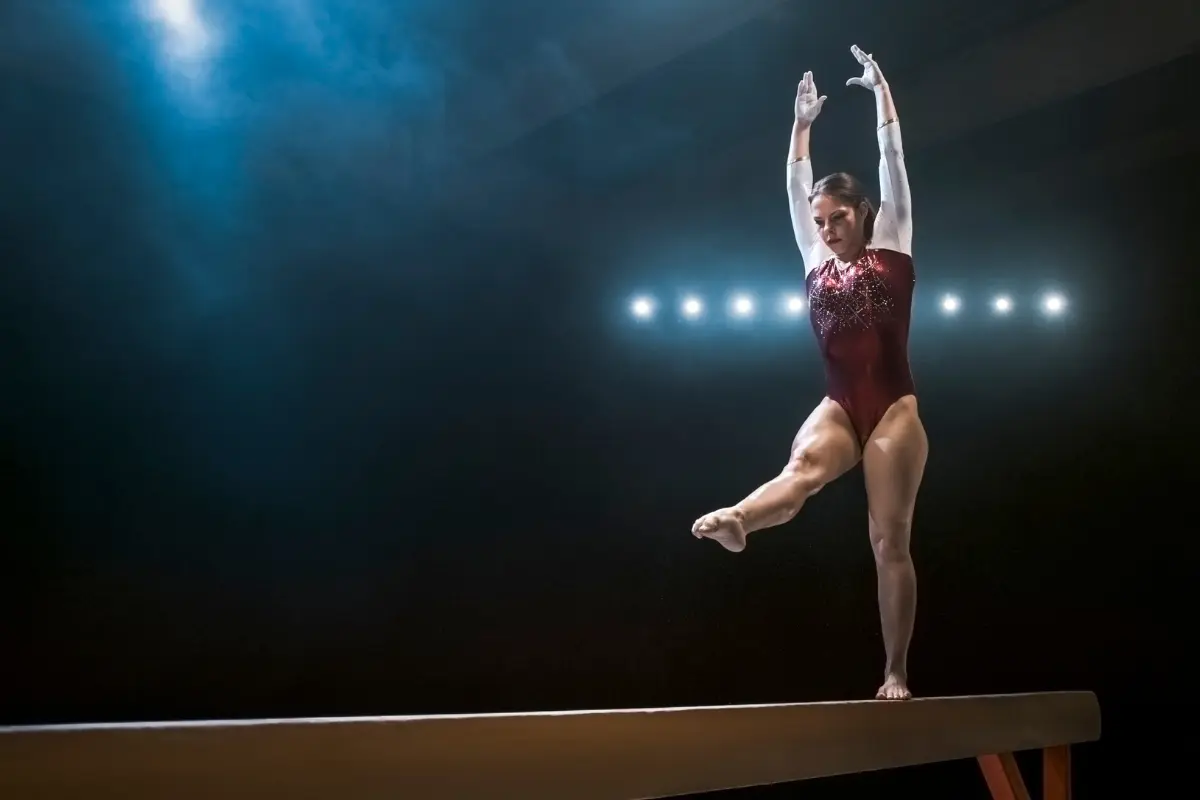
In gymnastics, the dismount is the last thing judges see, the final impression you make, and often the difference between a medal and a missed podium. On beam, sticking your landing is especially challenging. You’ve just performed 70–90 seconds of high-concentration skills on a 10 cm-wide surface, and now you have to leave it with perfect form, height, and control.
Contents
Why the Dismount Matters
On beam, a dismount can be worth anywhere from A (0.10) to H (0.80) in Difficulty Value (DV) under the 2025–2028 FIG Code. But beyond the DV:
- Execution deductions for landing faults such as steps and hops can reach 0.80 if there’s no fall, and a fall costs 1.00.
- Artistry deductions apply for posture, presentation, and connection into the dismount.
- A stuck landing leaves a lasting impression that can sway judges in your favor.
The takeaway: a flawless dismount is both a scoring opportunity and a competitive advantage.
Types of Beam Dismounts
Under the FIG and USAG Women’s Development Program, beam dismounts typically fall into three main families:
1. Simple Salto Dismounts (Levels 5–7)
- Examples: Tuck, pike, or layout salto.
- Common in compulsory and lower optional levels.
- Prioritize form and control over difficulty.
2. Twisting Salto Dismounts (Optional & Elite)
- Examples: Full twist, double twist, Arabian double front.
- Require precise timing to avoid under- or over-rotation.
3. Acro Connection Dismounts (Elite & NCAA)
- Examples: Round-off → double tuck, aerial cartwheel → full twist.
- In NCAA, connecting a B or harder acro element into a C or harder dismount earns an extra 0.10. Under FIG rules there’s no connection value into the dismount, but a qualifying series ending in the dismount can earn the 0.10 series bonus. Either way, the connection demands seamless rhythm from the last beam element.
| Dismount | Example | Value (2025–2028 FIG Code) |
|---|---|---|
| Back salto (tuck, pike or layout) | Back tuck off the end of the beam | A (0.10) |
| Back salto with full twist | Back full | B (0.20) |
| Double back salto, tucked | Double tuck | D (0.40) |
| Double back salto, piked | Double pike | E (0.50) |
| Arabian double front | Patterson | G (0.70) |
| Double back salto, tucked, with double twist | Biles | H (0.80) |
Step-by-Step Technique for a Stuck Landing
Sticking your landing especially on the balance beam takes a mix of solid technique, strength, and mental focus.
1. Control Your Speed and Momentum
Before your dismount or final skill, avoid rushing. Keep your speed in check so you can land in a balanced position. If the skill involves a flip or twist, begin slowing the rotation as you approach the ground to prepare for a controlled finish.
2. Spot the Landing Early
During a flip or twist, keep your eyes open and find the floor as soon as possible. Spotting early helps you orient your body, make mid-air adjustments, and prepare for the moment of impact.
3. Maintain Body Alignment
Stay tight and aligned in the air—arms extended, legs straight, and core engaged. Proper alignment not only improves form but also makes the landing more stable and reduces the chance of wobbling.
4. Absorb the Landing
When your feet hit the ground, bend your knees slightly to absorb impact. This reduces stress on your joints and gives you more control over your balance. Keep the bend soft—enough to cushion, but not so deep that it breaks your posture.
5. Keep Your Center of Gravity Over Your Feet
Aim to land with your weight directly over your feet. If your balance shifts too far forward or backward, you may need to step, costing you points. A strong core and a straight head-to-toe line help maintain that centered position.
6. Place Your Feet Precisely
Land with both feet firmly and flat, about hip-width apart. Avoid landing too wide, too narrow, or with toes turned in. A natural, straight alignment supports balance and prevents unnecessary adjustments.
7. Use Your Arms for Balance
Hold your arms slightly in front or to the sides to steady yourself. Keep them controlled—active enough to help you balance, but not swinging wildly, which can throw off your stability.
8. Freeze Without a Step or Wobble
Once your feet touch down, lock into position for at least a moment. No steps, no extra shifts—just stillness. Even small movements can lead to deductions, so the goal is to “stick” it and show total control.
Finishing Strong
After the landing, complete your routine with confidence. Straighten up, make eye contact with the judges, and salute or hold your final pose. A confident finish reinforces that you owned the dismount from start to finish.
Biles’ Double-Double vs. Lee’s Double-Twisting Layout
At the top level, some beam dismounts are so complex they redefine the sport.
Simone Biles and the Double-Double
The double-twisting double backflip, often called the double-double, is one of the hardest beam dismounts in the world. It includes two backflips and two full twists (720°) in the air, all in a tucked position. Pulling this off takes huge power, perfect timing, and incredible air awareness.
Simone Biles has competed this skill before, but she didn’t perform it at the Tokyo 2020 Olympics. During the Games, she was dealing with the “twisties” and chose a safer dismount—a double pike—in the balance beam final on August 3, 2021. That decision helped her land securely and win the bronze medal.
In the FIG Code of Points, the double-double is rated H (0.80), the highest value on beam. Very few gymnasts attempt it because of how risky and demanding it is, but Biles has made it famous at the elite level.
Suni Lee’s Balance Beam Dismount
Suni Lee is known for her clean, precise beam work. In 2021 she dismounted with two back handsprings into a double-twisting layout (a back double full), a skill that looks smooth but requires a lot of control.
Here’s how it works:
- Back Handsprings: She pushes off the beam and flies backward twice, building momentum for the dismount.
- Double-Twisting Layout: Without tucking or piking, she keeps her body straight and completes two full twists while rotating backward before landing.
It’s rated C (0.30) in the current FIG Code, well below the double-double’s H, but sticking it perfectly takes strength, balance, and great timing.
In the Tokyo 2020 balance beam final on August 3, 2021, Lee had a big balance check and an unclean landing and finished fifth (13.866). China’s Guan Chenchen won the event, and Lee’s beam work had already helped her win the Olympic all-around title earlier in the Games.
Tips from the Gymnastics Community
Coaches often share progressions to help athletes learn safely. One ChalkBucket Gymnastics Forum coach advises:
“…it’s more commonly done as a half or quarter turn… kick into handstand, then turn to face the beam and land.”
Starting with these controlled half- or quarter-turn variations develops spatial awareness before moving on to high-risk blind forward landings.
In competition, a clean, confident dismount can boost your score, cement your routine in the judges’ minds, and show everyone in the arena that you own the beam from the first mount to the final salute.