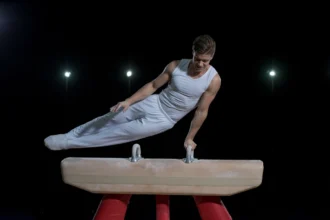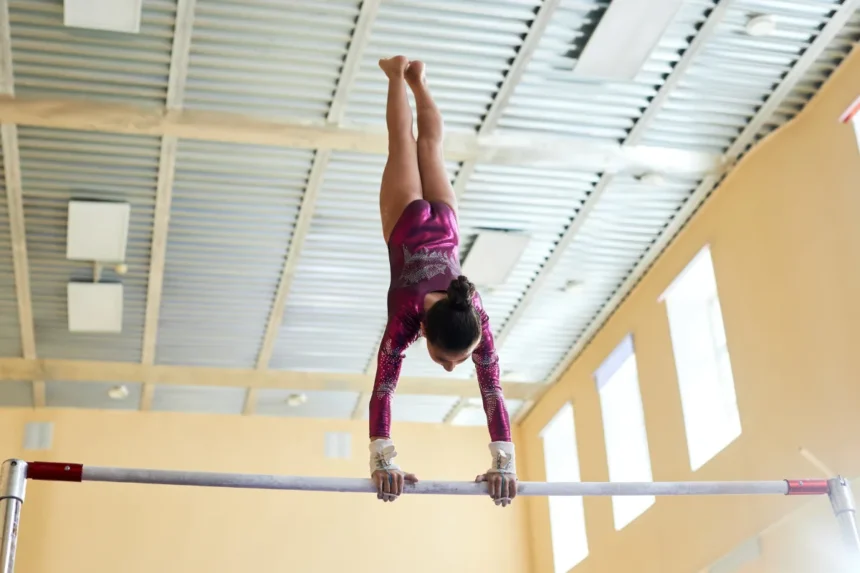
On the uneven bars, nothing captures the crowd’s attention quite like a gymnast flying into the air and regrasping the bar with perfect timing. These breathtaking skills, known as release moves, are some of the most daring elements in artistic gymnastics.
Among the most famous are the Tkachev, Jaeger, and Gienger, three releases that have become cornerstones of high-level bar routines.
What Are Release Moves?
In uneven bar routines, a release move is any skill where the gymnast lets go of the bar and performs a flight element before regrasping. These skills are not just for show—they are required at high levels of competition.
Release moves add difficulty value (D, E, or even higher depending on variations), help fulfill composition requirements, and showcase a gymnast’s courage, timing, and body control.
The three most performed and recognized releases are:
- Tkachev (reverse hecht family) – A backward release that travels over the high bar.
- Jaeger (forward salto release) – A forward flipping release that circles back to catch.
- Gienger (back salto + half twist) – A dynamic backward salto with a twist before regrasp.
The Tkachev: A Straddle Over the Bar
The Tkachev is named after Alexander Tkachev of the Soviet Union, who first performed it on the men’s high bar in 1977. His daring release changed the game—suddenly, gymnasts weren’t just swinging; they were soaring above the bar in open flight. The move quickly crossed into women’s gymnastics, where it became a staple of elite uneven bar routines.
How the Tkachev Works
At its core, the Tkachev is a backward release and regrasp skill.
- Swing Build-Up – The gymnast accelerates with strong giants, creating momentum.
- Lift-Off – From the backswing, they drive their hips upward and let go of the bar at just the right moment.
- Straddled Backflip – In the air, the gymnast performs a straddle-position backflip over the bar. The straddle opens the hips and slows rotation, giving more control.
- Regrasp – With precise timing, the gymnast re-catches the bar as it passes underneath, arms extended, ready to continue the routine.
When performed cleanly, the Tkachev looks like the gymnast floats effortlessly over the bar, legs extended in a perfect straddle.
Why the Tkachev Matters
The Tkachev is a scoring powerhouse. Under the 2025–2028 FIG Code of Points:
- A straddle Tkachev is valued as a D skill.
- Piked and layout variations increase the value to E.
- Connected Tkachevs (back-to-back or into pirouettes) earn connection bonuses.
Judges look for amplitude (height above the bar), clean body position, and a smooth regrasp with no form breaks. A low, rushed Tkachev loses its artistry; a soaring one earns admiration and points alike.
The Tkachev in Routines
Today, most elite uneven bar routines feature at least one Tkachev. Some gymnasts even perform two variations in one routine, such as a straddle Tkachev connected directly into a piked or layout Tkachev. This not only boosts difficulty but also showcases variety.
On the men’s high bar, Tkachev variations are often combined with other releases, like Kovacs or Kolmans, in daring sequences that push the limits of flight.
The Jaeger: A Forward Flight on the Bars
The Jaeger was first performed by Bernd Jäger of East Germany in 1974 on the men’s high bar. His creation quickly caught attention because it was the first forward-facing release of its kind. By the late 1970s and 80s, women’s gymnasts adopted it for uneven bars, where it has remained a staple ever since.
How the Jaeger Works
Unlike the Tkachev, which starts from a back swing, the Jaeger is performed out of a front giant.
- Front Giant Swing – The gymnast builds momentum facing the bar, circling around in a controlled front swing.
- Release Point – At the peak of the giant, the gymnast lets go.
- Forward Somersault – While in the air, they perform a forward flip—usually straddled for control, though other shapes are possible.
- Regrasp – The gymnast re-catches the bar as they rotate down, seamlessly continuing into the next skill.
When well executed, the Jaeger has a floating quality, almost like the gymnast is suspended in midair before snapping back into swing.
Why the Jaeger Matters
The Jaeger adds variety because it contrasts backward releases like the Tkachev. Under the 2025–2028 FIG Code of Points:
- Straddle Jaeger → D value
- Piked Jaeger → E value
- Layout Jaeger → E or higher, depending on execution
- Jaeger with half twist → high difficulty, plus bonus if connected
Judges reward amplitude, body shape, and smooth rhythm into the next skill. A “low” Jaeger, where the gymnast barely clears the bar, often leads to deductions.
The Jaeger in Modern Routines
Today, the Jaeger is nearly universal in elite uneven bar routines. It’s often used in release combinations, such as Jaeger + Pak salto (high bar to low bar transition), or Jaeger connected directly into pirouettes. These combinations build difficulty while maintaining rhythm and variety.
On the men’s high bar, Jaegers are frequently linked with other releases in daring sequences, sometimes followed by multiple flips like Kovacs or Kolman.
The Gienger: Twisting Flight on the Uneven Bars
The Gienger is named after Eberhard Gienger of West Germany, who first performed it on the high bar in 1972. His pioneering skill introduced a twisting element to release moves, which at the time was groundbreaking. In women’s gymnastics, the Gienger became a way for gymnasts to stand out with a less common but eye-catching release.
How the Gienger Works
The Gienger begins like a standard backward release, but with a twist—literally.
- Back Swing Build-Up – The gymnast generates momentum with giants.
- Release Point – From the back swing, the gymnast lets go of the bar.
- Backflip with ½ Twist – While airborne, they complete a back salto while simultaneously rotating a half twist.
- Regrasp – They catch the bar facing the opposite direction, ready to continue the routine in rhythm.
The Gienger’s challenge lies in combining two motions at once—flipping and twisting—while still spotting the bar for a safe regrasp.
Why the Gienger Matters
The Gienger is valued not just for difficulty, but also for variety and originality. Under the 2025–2028 FIG Code of Points:
- Standard Gienger → D value
- Layout/piked variations → higher DV depending on execution
Judges focus on clean alignment during the twist and salto, amplitude, and a secure regrasp. A messy catch or tilted axis leads to heavy deductions.
The Gienger in Modern Routines
In women’s gymnastics, the Gienger is less common today than the Jaeger or Tkachev, but when it appears, it immediately stands out. It’s often performed as a standalone highlight, giving routines extra flair.
On the men’s high bar, however, Giengers and their variations remain staples, especially in twisting release sequences that connect multiple flips and rotations.
Comparing the Big Three
| Skill | Direction of Release | Shape/Action | Difficulty Value (WAG 2025–2028) | Signature Feature |
|---|---|---|---|---|
| Tkachev | Backward | Straddle, Pike, Layout | D–E (depending on variation) | High-flying arch over bar |
| Jaeger | Forward | Straddle, Pike, Layout | D–E | Smooth forward somersault |
| Gienger | Backward | Layout with ½ twist | D (higher for variations) | Flip + twist combo |
In summary, the Tkachev shows soaring backward flight, the Jaeger adds graceful forward rotation, and the Gienger dares to twist midair. Each skill has its own style and difficulty, yet all demand the same essentials—courage, control, and flawless timing.