Tkatchev, Jaeger and Gienger: A Guide to Recognizing Bar Releases
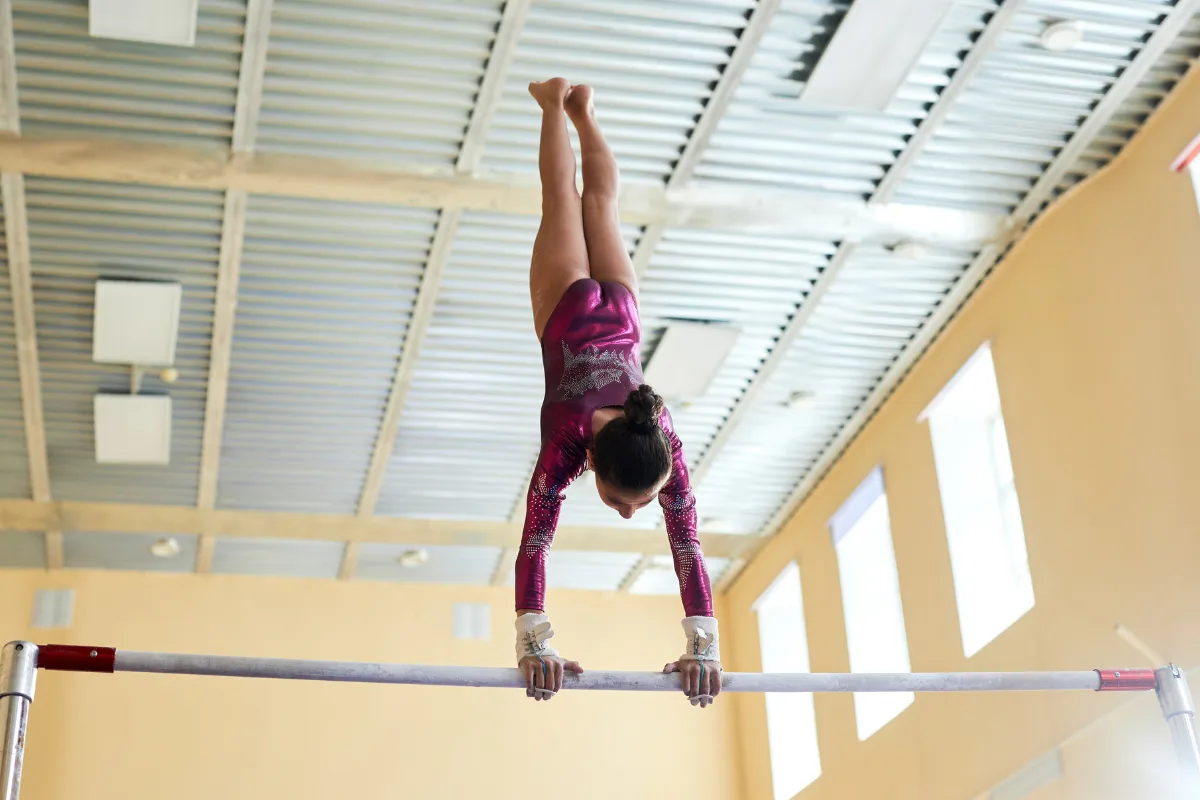
A Tkatchev, a Jaeger and a Gienger all involve letting go of the bar, traveling through the air and catching it again. Their flight paths are different, however. Watching the direction of the body and whether it somersaults makes the names easier to recognize.
Contents
This comparison focuses on women’s uneven bars. These skill families also appear in men’s horizontal bar, but difficulty values and apparatus rules should not be transferred between the two events.
Three Release Families at a Glance
| Family | Main flight action | Useful visual clue |
|---|---|---|
| Tkatchev | Counterflight over the bar | The body clears the bar and returns to catch it without a full somersault |
| Jaeger | Forward somersault | The gymnast flips forward before catching the same bar |
| Gienger | Backward somersault with a half twist | The turn changes the gymnast’s orientation for the catch |
All three are same-bar releases in this comparison. A flight from the low bar to the high bar, or from high to low, is a different kind of release. The broader uneven bars release guide covers both same-bar flights and transitions between the bars.
The Tkatchev: Flight Across the Bar
The familiar straddled Tkatchev shows the gymnast passing over the bar with her legs apart, then reaching back to regrasp it. It is a counterflight, often described as a reverse hecht. Calling it a straddled backflip is misleading: the standard Tkatchev does not contain a full backward somersault.
The straddle is a helpful clue, but it does not define the whole family. Other variations use a piked or stretched body. The circle performed before release can also distinguish one named skill from another, even when the flight looks similar.
For example, a release initiated from a toe-on circle is not identified solely by its airborne shape. The entry, flight position and any turn all matter. This is why an unfamiliar Tkatchev-type skill is best described by its visible movement before assigning an exact name.
The Jaeger: A Forward Somersault
In a Jaeger, the gymnast releases into a forward somersault and catches the same bar. The familiar versions can show a straddled or piked position. A stretched version keeps the body extended through the flight.
The clearest difference from a Tkatchev is the rotation. A Jaeger flips forward; a Tkatchev counterflies across the bar without completing that somersault. Both can show separated legs, so leg position alone is not a reliable way to tell them apart.
A side view can make the forward rotation easier to follow. Broadcast angles sometimes hide the bar or compress the flight path, so a single image may be insufficient to identify the skill confidently.
The Gienger: A Backward Somersault and Half Twist
The Gienger combines a backward somersault with a half twist before the regrasp. The twist distinguishes it from a release that simply flips and returns without changing orientation in that way.
The piked Gienger listed in the women’s Code is recognized by its compact shape and turning flight. A stretched version is a distinct variation, rather than a higher score awarded for executing the same named version neatly.
Difficulty and execution are separate judgments. Completing a harder recognized variation can change difficulty credit; bent knees, insufficient height or a poor catch can produce execution deductions. Clean technique does not by itself change an element’s listed difficulty value.
Why the Same Leg Shape Can Belong to Different Skills
A straddle tells you that the legs are apart. It does not tell you whether the gymnast is somersaulting. That is the central trap when comparing a straddled Jaeger with a straddled Tkatchev. To distinguish them, follow the torso through the whole flight rather than using the split-leg silhouette as the answer.
Likewise, a pike describes a bend at the hips with straight knees. A piked Tkatchev, a piked Jaeger and a piked Gienger do not become the same movement because they share that body shape. Shape, somersault direction and twist are separate observations that must be combined.
The flip-versus-twist comparison helps separate the rotations. In a Gienger, for example, identifying a half twist does not replace identifying the backward somersault. Both belong in the description.
Why the Catch Matters
The gymnast needs more than contact with the bar to produce a fluent routine. The catch should let her continue into the next swing or circle. Too little distance can crowd the bar, while too much can make the regrasp difficult.
Release recognition and connection credit also depend on the applicable rules. Connecting a release to another difficult element does not guarantee bonus. The uneven bars scoring guide explains how difficulty, requirements, connections and execution contribute to the score, using the current FIG women’s Code of Points.
Describe What You Can Actually See
Suppose a replay clearly shows counterflight over the high bar, but starts too late to show the preceding circle. “A Tkatchev-type release” may be the most accurate description available. Guessing a specific named variation would add certainty that the clip does not support.
If another replay shows a forward somersault but the legs disappear behind the bar, the Jaeger family may be identifiable while the precise shape remains uncertain. A third clip might show the Gienger’s turning backward flight but cut away before the catch. In that case, identifying the intended skill does not establish how successfully it was completed.
Separate those questions when discussing a routine: What family is it? Which variation? Was it recognized? How was it executed? A commentator may answer the first two quickly, while the judges must also assess the latter two under the applicable rules.
A Simple Viewing Sequence
Watch the circle before release, the direction of flight, the body shape and the catch. Those four observations are more useful than guessing from the legs alone. For the surrounding mounts, circles and dismounts, the uneven bars routine guide puts each release back into the full exercise.
Once the individual release is familiar, watch the next movement. A clean regrasp followed by fluent continuation can make a difficult sequence look effortless. The full sequence gives a more informative picture than a freeze-frame at maximum height.