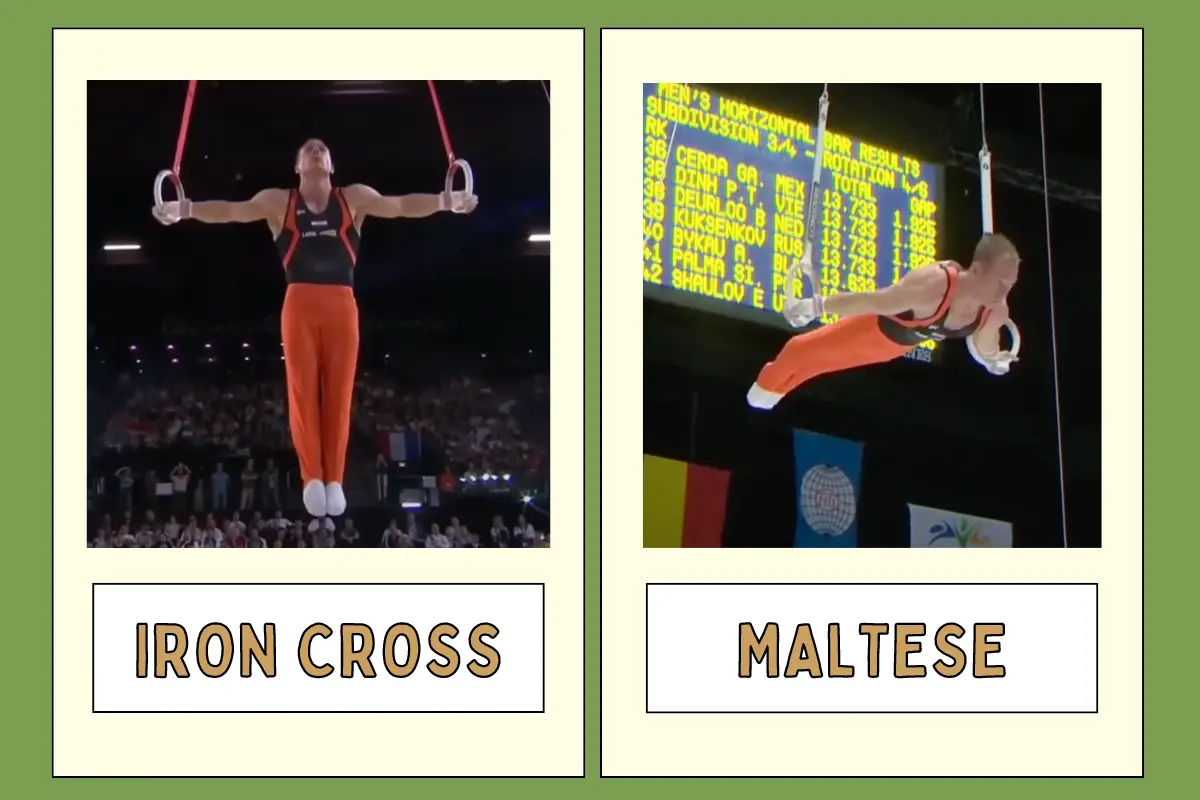
The Iron Cross and Maltese are two of the most iconic and challenging strength holds performed on the still rings in men’s artistic gymnastics. Both showcase immense power, control, and dedication, but they differ significantly in technique, difficulty, and execution.
What Is the Iron Cross?
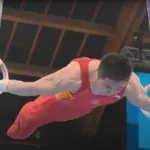
The Iron Cross is a classic strength hold where the gymnast’s body is vertical, arms fully extended out to the sides at shoulder height, forming a cross shape. The rings are held slightly turned out, and the gymnast must stop all swing while maintaining the position for at least two seconds to receive full credit in competition.
From a judging standpoint, the Iron Cross is a foundational elite rings skill. It appears in many high-level routines and is often one of the first true “cross” strength elements gymnasts aim to master.
Key characteristics of the Iron Cross
- Body remains upright and vertical
- Arms fully straight at shoulder level
- Rings turned slightly outward
- Emphasis on shoulder adduction strength and joint stability
In Men’s Artistic Gymnastics, the Iron Cross is recognized in the FIG Code of Points as a B-level difficulty strength element. While “lower” in value compared to other elite ring skills, it remains a defining benchmark of advanced rings strength.
What Is the Maltese?
The Maltese Cross, sometimes called the swallow, takes the Iron Cross concept and makes it significantly harder. Instead of staying vertical, the gymnast lowers their body until it is nearly horizontal, parallel to the floor, while keeping the arms fully extended at ring height.
This dramatically increases torque at the shoulders and places enormous stress on the biceps, chest, shoulders, elbows, and connective tissues. Even among elite ring specialists, the Maltese is considered one of the most punishing static holds in the sport.
Key characteristics of the Maltese
- Body held near-horizontal
- Arms fully straight at ring height
- Rings pushed slightly outward and down
- Extreme shoulder extension and straight-arm strength demands
Because of these demands, the Maltese carries a much higher difficulty value (D) in the FIG Code and is considered one of the most punishing static strength holds in gymnastics.
Iron Cross vs. Maltese: Side-by-Side Comparison
| Feature | Iron Cross | Maltese Cross |
|---|---|---|
| Body orientation | Vertical, upright torso | Horizontal, body parallel to floor |
| Arm position | Arms straight at shoulder level | Arms straight, supporting horizontal body |
| FIG difficulty | B (advanced but foundational) | D (elite, high-risk strength skill) |
| Primary stress | Shoulders, chest, lats, triceps | Shoulders, chest, biceps, upper back, core |
| Mechanical demand | Shorter lever | Extremely long lever |
| Who trains it | Advanced & elite gymnasts | Elite specialists only |
Why the Maltese Is Significantly Harder
The reason the Maltese is harder comes down to physics and leverage.
In the Iron Cross, the gymnast’s center of mass stays relatively close to the shoulders. Gravity acts downward, and the shoulders must resist rotation with strong adduction and stabilization.
In the Maltese, the entire body becomes a horizontal lever arm. This dramatically increases:
- Torque at the shoulder joint
- Stress on the biceps and elbow tendons
- Demand on core rigidity to prevent sagging
Even a gymnast with a rock-solid Iron Cross will often struggle to hold a partial Maltese at first. This is why many training systems treat the Iron Cross as a non-negotiable prerequisite before serious Maltese work begins.
Training Focus: Iron Cross
Primary Goals
- Build straight-arm shoulder strength
- Condition connective tissue around shoulders and elbows
- Develop control in isometric strength holds
Common Training Methods
- Ring support holds with full turn-out
- Band-assisted cross holds
- Partial cross positions (rings slightly above shoulder level)
- Eccentric cross lowers
- Accessory work: ring dips, fly variations, scapular stability drills
Progression Strategy
Most athletes move from:
- Basic support holds →
- Assisted “T” positions →
- Partial unassisted cross →
- Full Iron Cross with longer hold times
Smart programs keep volume controlled and emphasize perfect alignment over duration.
Training Focus: Maltese Cross
Primary Goals
- Develop extreme straight-arm pushing strength
- Build horizontal body tension
- Condition biceps, shoulders, and connective tissue for high torque
Common Training Methods
- Foundational straight-arm skills (back lever, planche variations)
- Band-assisted Maltese holds on rings
- Maltese leans on parallettes or floor
- Eccentric Maltese lowers
- Progressions from tuck → straddle → full Maltese
Unlike the Iron Cross, Maltese training is usually low-volume and highly selective. Many elite gymnasts train it only during specific phases of the season due to its injury risk.
Community Insights
On forums like Reddit’s r/Calisthenics and GymnasticBodies, athletes often describe the contrast between the two holds:
- “I finally managed to hold the Iron Cross, but the Maltese feels like another universe. It just wrecks my elbows if I don’t ease into it.”
- “You can muscle into a Cross with raw strength, but the Maltese punishes you if your tendons aren’t ready.”
Coaches tend to agree with this perspective. Even though both skills look static from the outside, the real limiting factor is the connective tissues. Tendons and joints adapt much more slowly than muscles, especially under the extreme leverage of the Maltese.
Across athletes and coaches, a few clear lessons come up again and again:
- Patience matters. Rushing Maltese training is one of the quickest ways to get injured.
- Prerequisites aren’t optional. A strong Iron Cross, along with solid planche and back lever strength, should already be in place.
- Assistance is smart, not cheating. Bands, cables, and spotters help manage load and protect joints while progressing.
- Think long-term. Many elite ring specialists warn that pushing Maltese progress too fast can lead to chronic elbow pain that stalls training for months or even years.
Which Skill Should Be Learned First?
The answer is clear: the Iron Cross comes first.
The Iron Cross builds the foundation, while the Maltese tests the limits of that foundation. Training success with either skill depends on patience, smart progressions, and respect for joint health.