Beam Choreography Explained: Poses, Balances and Connected Movement
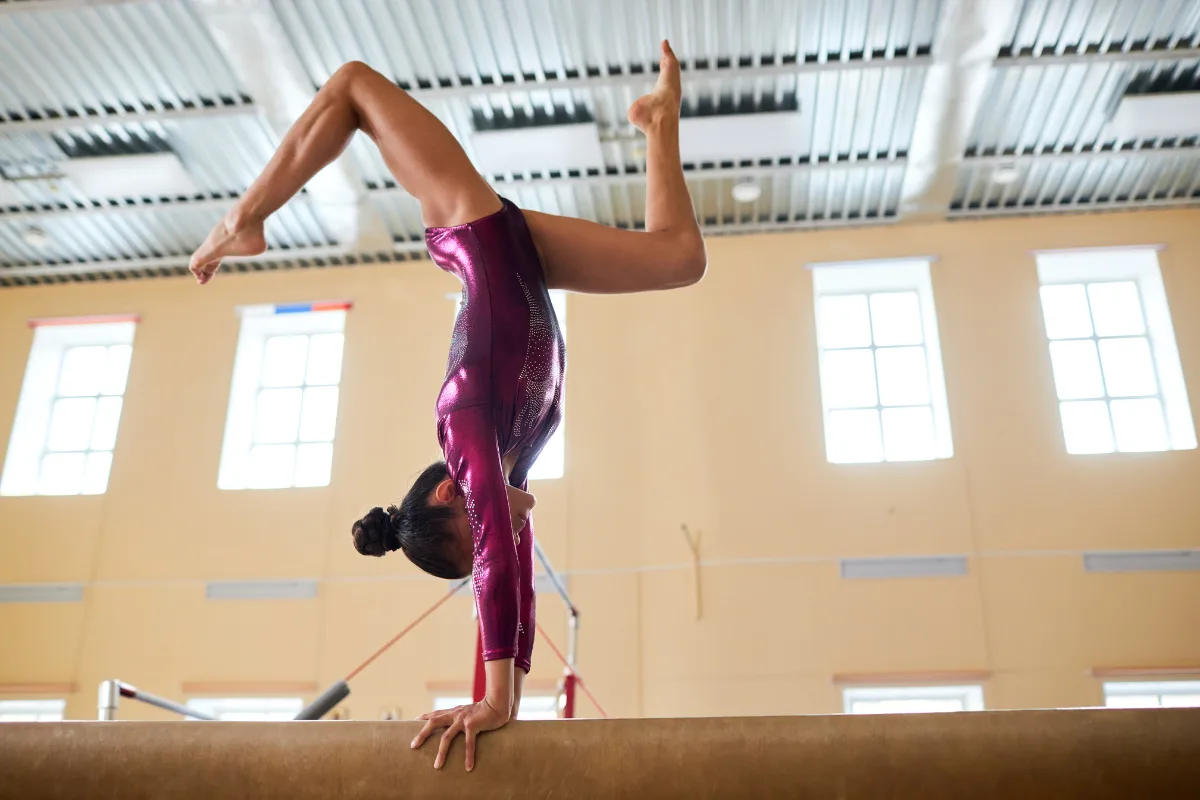
Beam choreography uses body shapes, changes of level, direction and rhythm to connect a routine. A pose can contribute to that movement, but no single list of poses earns difficulty or artistry credit in every gymnastics program.
Contents
- A Pose, a Balance and an Element Are Different Ideas
- What Beam Artistry Is Trying to Show
- Upright Shapes and Leg Lines
- Low Positions and Contact With the Beam
- Balances Need the Right Definition
- Keep Turns and Leaps in Their Own Categories
- Review the Transitions, Not Only the Positions
- Respect the Program and the Gymnast
The useful distinction is between a choreographic position, a recognized difficulty element and a composition requirement. They can relate to one another, but they are not the same thing. Understanding those roles prevents a familiar balance or dramatic shape from being assigned points it does not automatically earn.
A Pose, a Balance and an Element Are Different Ideas
A pose describes a body position. A balance describes the task of maintaining control in a position. A credited element has a specific definition in the applicable rules. The casual name used in a class may not contain every detail needed to identify that element.
For example, “arabesque” can describe a line with the free leg behind the body. That word alone does not establish a particular Code entry, a required hold duration or a difficulty value. The position and its context need to match the relevant definition.
A turn and a leap are movements rather than static poses. A wolf turn includes rotation, and a split leap includes flight. Freezing either at an attractive moment does not explain the whole element or how it is evaluated.
What Beam Artistry Is Trying to Show
The FIG women’s Code, Section 12 describes beam as a continuous composition with varied movement, direction, level and rhythm. Its artistry deductions address matters such as posture, amplitude, body involvement, footwork and fluency.
Beam is performed without individual musical accompaniment. A gymnast may hear music from floor or the venue, but that is not a soundtrack the beam routine is required to interpret. Instructions to “land with the music” or use a beam pose to accent the routine’s musical phrase confuse the two events.
Rhythm still matters without music. A movement can accelerate, settle or flow into another action. The challenge is to make that variation deliberate while avoiding a routine that becomes a series of unrelated frozen positions.
Upright Shapes and Leg Lines
Standing choreography can use changes in the arms, head, trunk and leg position. A modest leg lift may create a clearer line than an extreme position that the gymnast cannot control. Height alone does not make the movement more expressive.
An arabesque-like line, a front leg extension and a side leg shape offer different silhouettes. The coach or choreographer chooses what fits the gymnast’s movement range and the transition. These examples are a vocabulary for discussion, not a requirement to include all three.
Watch how the gymnast enters and leaves the position. If the next element requires a different facing or support leg, the route needs to be planned. A pose that works in isolation may still interrupt the routine when placed between two other movements.
Low Positions and Contact With the Beam
Choreography can move closer to the apparatus through sitting, kneeling or other controlled positions appropriate to the gymnast. This changes the visual level and the relationship of the body to the beam.
In FIG composition, there is a specific expectation for a combination of movements or elements close to the beam with a body part covered by the rule, such as the thigh, knee or head, touching the apparatus. A difficulty element is not necessary for that particular expectation. This illustrates how choreography can serve a composition purpose without being a separately valuable skill.
A quick touch doesn’t automatically meet the requirement, and adding a skill such as a chest stand is the coach’s decision, within the program’s rules. Extreme back positions are not a shortcut to artistry.
Balances Need the Right Definition
Names such as needle, Y-scale and front scale can be used loosely across activities. Before attaching a value or a hold time, identify the actual movement and the rules being applied. A flexible-looking shape is not automatically a recognized beam difficulty.
The same caution applies to seated shapes. The FIG beam difficulty tables have no V-sit or other V hold, so a V-shaped position in choreography has no difficulty value of its own under the FIG Code. In other programs, check that program’s rules before treating a seated shape as an element.
For a learner, the practical question is what the coach is teaching: a balance exercise, a choreographic shape or a specific competition element. A training exercise can be worthwhile without appearing as its own difficulty entry in a routine.
Keep Turns and Leaps in Their Own Categories
A wolf turn requires the gymnast to rotate in the specified low shape; a still low position does not become a wolf turn. Likewise, the split position at the top of a leap is only one part of the leap’s takeoff, flight and landing.
These distinctions matter when reading a routine checklist. Including an attractive static split cannot be assumed to replace a required split leap or jump. Showing an extended leg cannot be assumed to satisfy a turn requirement.
The beam skills guide groups the movement families. The beam scoring guide explains how recognized content, requirements, connections and execution combine.
Review the Transitions, Not Only the Positions
| What to review | A useful question |
|---|---|
| Entry | Does the preceding movement arrive in a workable position? |
| Shape | Is the intended line clear and appropriate for the gymnast? |
| Exit | Can the gymnast continue without an unplanned adjustment? |
| Rhythm | Does the movement fit the pace of the surrounding sequence? |
| Role | Is it choreography, a specified element or part of a requirement? |
A short section filmed at normal speed can reveal a repeated pause that a photograph cannot. Review the movement with the coach and identify its purpose before adding more detail. Sometimes simplifying an arm pathway or changing the direction of a transition makes the section clearer.
Respect the Program and the Gymnast
Compulsory gymnasts follow prescribed choreography. Optional and Xcel routines allow different choices within their own requirements and restrictions. An elite example cannot be copied into every program with the expectation of the same credit.
Even when a shape is allowed, the gymnast must be ready to perform it on the chosen apparatus and within the sequence. The low-to-high-beam progression guide explains why changing height changes the practice task.
Useful beam choreography comes from suitable movement joined clearly. Rather than collecting a set of supposedly essential poses, ask how each position helps the gymnast move through the exercise with control, variety and purpose. That creates a stronger basis for both learning and performance.