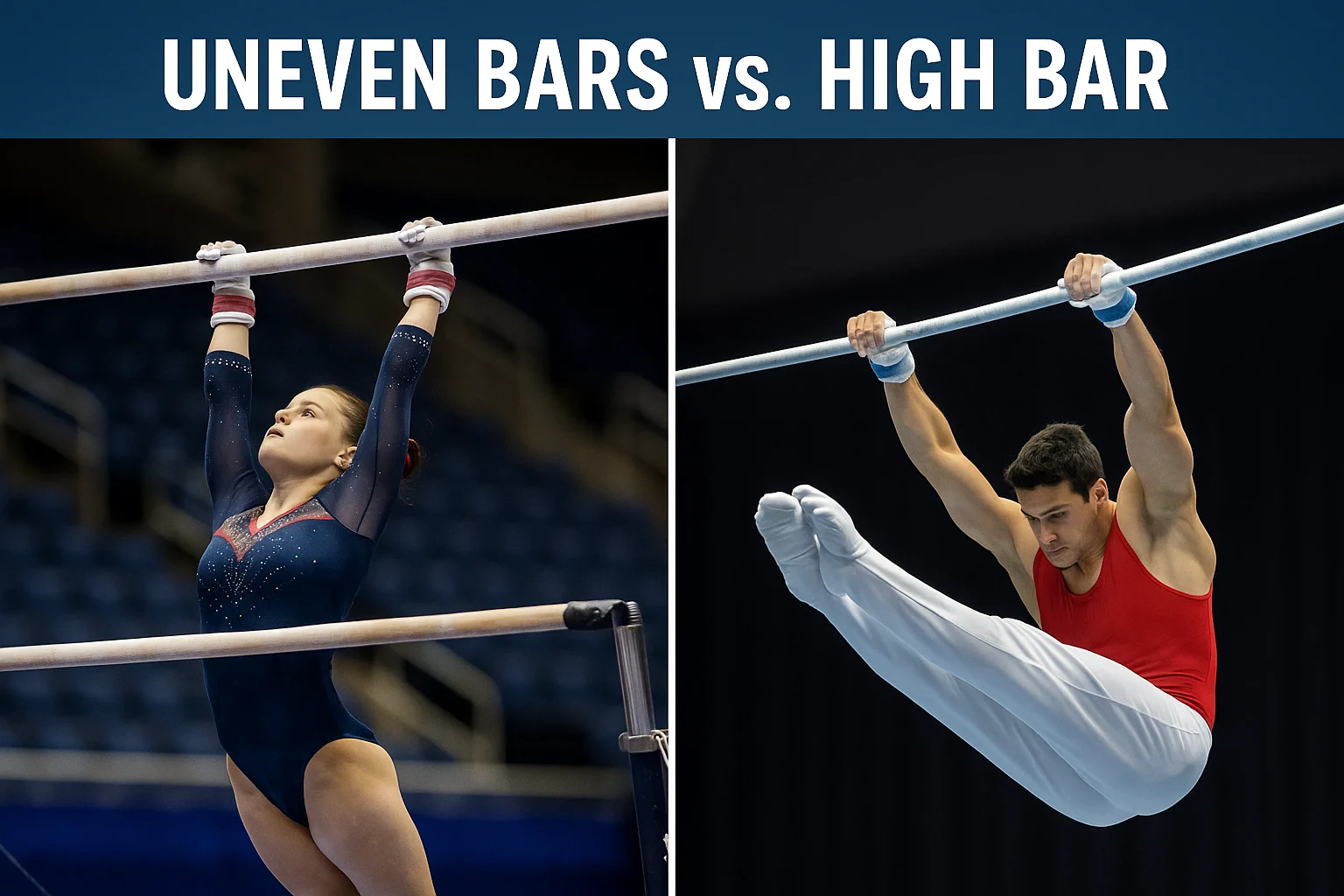
Uneven bars and high bar share the excitement of swinging, releasing and catching, but they are different artistic gymnastics events. Uneven bars uses two rails at different heights and includes movement between them. High bar, also called horizontal bar, develops the routine around a single rail.
In FIG international competition, uneven bars belongs to the women’s program and high bar to the men’s. The difference extends beyond the event list: the rails have different dimensions and surfaces, and each Code of Points defines its own skills and routine requirements. Understanding those details makes both events much easier to follow.
The equipment differences you can see
| Feature | Uneven bars | High bar |
|---|---|---|
| Competition abbreviation | UB | HB |
| Rails | Two, at different heights | One |
| Nominal rail height above the floor | 175 cm and 255 cm | 280 cm |
| Nominal rail diameter | 4 cm | 2.8 cm |
| Distinctive routine feature | Transitions between low and high rails | Swinging, turning and flight around one rail |
These measurements follow the 2026 FIG Apparatus Norms. They are reference competition dimensions, with specified tolerances and adjustment provisions. The uneven-bar heights are defined at the stated 181 cm inner-diagonal setting. All heights above refer to the floor, not the top of the landing mat.
That last distinction matters when comparing descriptions. “Height above the floor” and “clearance above the mat” are different measurements. A figure in an older guide can also reflect an earlier equipment standard. Avoid combining numbers from different dates or measurement points into one diagram.
The rails do not have the same construction
From a television camera, both apparatus can look like narrow horizontal lines. Up close, the diameter and surface differences are more obvious. A gymnast’s hands—and any appropriate handguards—interact with a particular rail, not with an abstract category called “bars.”
Manufacturers provide useful concrete examples. SPIETH’s Fiberflex Pro uneven-bar rail has a fiberglass structure and a natural-fiber coating. Its Stuttgart horizontal bar uses a special stainless-steel rail. Those are specific products, but they illustrate why calling uneven bars simply “wooden bars” is incomplete.
The visible flexibility of a bar is also part of an engineered apparatus. It should not be interpreted as a reason to change cable tension, substitute a rail or tighten components until everything feels rigid. Equipment setup is a job for appropriately trained staff following the manufacturer’s instructions.
For athletes, this means an apparently familiar skill still needs apparatus-specific coaching. Experience on one surface does not establish readiness to use another, and buying the same handguards seen on a favorite gymnast does not make the equipment interchangeable.
How to follow an uneven-bars routine
Start by watching where the gymnast is going. Is the next action staying on the same rail, moving from low to high, returning from high to low or finishing on the landing mat? This gives the routine a clear structure even before you know individual skill names.
A transition between rails is different from a release that returns to the same rail. Both can involve flight, but the gymnast is solving a different movement problem. A high-to-low transition must arrive at the other rail in a position that allows the exercise to continue; a same-bar release must return to its original support.
The women’s Code of Points includes requirements for flight from high to low bar, same-bar flight, different grips and a specified turning element. These composition requirements help explain why a routine cannot consist only of a gymnast’s favorite release repeated over and over.
Watch the handstands and the movement immediately after each catch as well. A successful catch is exciting, but the gymnast still needs to continue the planned sequence. A pause, extra adjustment or loss of shape can matter even when the athlete stays on the apparatus.
How to follow a high-bar routine
On high bar, there is no second rail to visit. The variety comes from the direction and shape of swings, turns, grip changes, movements close to the rail and releases that travel away from it before the gymnast catches again.
A giant swing is a large circle around the bar with the body extended through much of the movement. It can connect other elements and help organize the routine. It is not simply waiting time between the exciting skills; its direction and control affect what can follow.
For a beginner viewer, it helps to separate three observations: a turn while maintaining support, a flight element with a return to the rail, and the final dismount to the mat. A television replay may focus on the airborne moment, but the entry and the next swing explain whether the movement fitted smoothly into the exercise.
The men’s Code treats horizontal bar as a continuous swinging, turning and flight exercise. Its difficulty tables and construction rules belong to high bar; they should not be copied from an uneven-bars explanation just because a skill name sounds familiar.
Why similar skills do not guarantee similar scores
At FIG level, both events use difficulty and execution in the result. However, each event has its own recognized elements, connection rules and composition demands. Two moves can share a family resemblance without carrying the same value or serving the same purpose in a routine.
Think of a hypothetical comparison: one athlete performs a clean routine with fewer difficult connections; another attempts a harder sequence but loses control on several elements. You cannot determine the winner by counting releases alone. You need the difficulty awarded and the execution deductions, along with any applicable penalties.
The landing is part of that assessment, not the whole assessment. A stuck dismount is memorable, but it cannot retroactively correct earlier errors. Conversely, one visible step does not tell you everything about the quality of the preceding routine.
Domestic development programs can use different scoring structures and skill expectations. Identify the program and level before applying an elite television explanation to a child’s meet.
What changes in a beginner’s class?
A beginner may use a low single rail, a separately supported training bar or stations designed for basic shapes and movement. That does not necessarily mean the class is teaching the men’s high-bar competition event. Training equipment and competition event names do not always match one-to-one.
Ask the coach which skill the station develops and what the next progression is. Questions about handguards, chalk and rail preparation should also go to the coach, because the answer depends on the apparatus and athlete. Our guide to water and chalk on uneven bars explains that preparation separately.
When watching a meet, use the simplest distinction first: uneven bars tells a story across two rails; high bar builds its variety around one. Then look more closely at the catches, hand positions and continuity. The complete artistic apparatus guide puts both events alongside the rest of the program.