Gymnastics Vault Families: The Five FIG Groups Explained
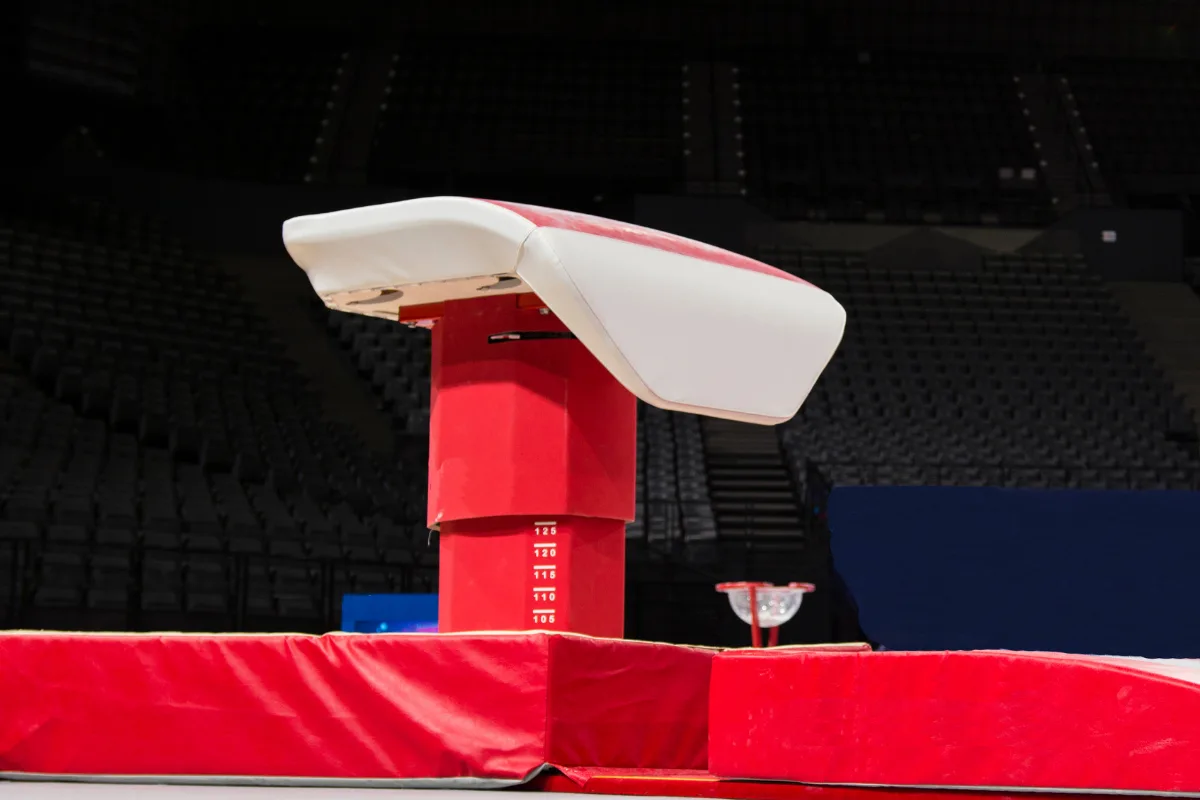
The current FIG Codes divide vaults into five official groups for women and five for men. The two systems use different group boundaries, even when the vault names sound familiar.
Contents
Names such as handspring, Tsukahara and Yurchenko are useful for describing how a gymnast reaches the table. An official group also takes account of what happens after the table. That is why a list of familiar entry families does not always match the numbered groups exactly.
This guide explains the 2025–2028 FIG classifications, checked September 21, 2026. The vault moves list identifies individual vaults and their selected difficulty values.
What Does a Vault Family Describe?
A family usually brings together vaults with a related entry. To follow the names, divide a vault into two flights: the first flight goes from the springboard to the table; the second flight goes from the table toward the landing.
A salto is a flip without hand support. The gymnast can change a vault by adding a salto, changing its body shape or adding twists. A twist turns the body around its length, rather than completing another flip.
Four familiar entry patterns provide a useful starting point:
| Entry pattern | Main identifying feature | Example |
|---|---|---|
| Front handspring | Forward-facing board takeoff into forward hand support on the table | Handspring front tuck |
| Tsukahara | Forward-facing board takeoff with a quarter- to half-turn during the first flight | Tsukahara tuck |
| Yurchenko | Roundoff onto the board, then a back handspring onto the table | Yurchenko layout |
| Roundoff half-on | Roundoff onto the board, then a half-turn on the way to the table | Cheng |
These are practical descriptions, not four official FIG groups or every possible entry variation. The Tsukahara–Yurchenko comparison explains the two frequently confused approaches more closely.
The Five Women’s FIG Vault Groups
Women’s artistic gymnastics is often abbreviated WAG. Its official groups separate vaults without a salto from several entry patterns that lead to saltos.
| WAG group | What belongs in it | Example |
|---|---|---|
| 1 | Vaults without a salto, including handspring, Yamashita and roundoff-entry variations; turns may be present | Basic front handspring |
| 2 | Forward handspring entries, with or without a full turn in the first flight, followed by forward or backward saltos with or without twists | Handspring front tuck; Produnova |
| 3 | Quarter- to half-turn handspring entries followed by backward saltos, with or without twists | Tsukahara tuck or layout |
| 4 | Yurchenko entries, including the Code’s three-quarter-turn-on variations, followed by backward saltos with or without twists | Double-twisting Yurchenko; Amanar |
| 5 | Roundoff entries with a half-turn in the first flight, followed by forward or backward saltos with or without twists | Cheng; Biles I |
These are the categories in FIG Women’s Code Section 10.3. The illustrated vault tables identify the individual movements within them.
Why a handspring can belong to Group 1 or Group 2
A basic front handspring passes upside down through hand support and then lands on the feet. There is no additional unsupported flip after the table, so it belongs to Group 1.
A handspring front tuck adds a forward salto in the second flight. It belongs to Group 2. The shared handspring entry does not give both vaults the same group.
The same caution applies to roundoff entries. The women’s Code includes roundoff-entry vaults without a salto in Group 1. Seeing a roundoff is therefore not enough to assign every vault to Group 4 or 5.
Where the half-on and three-quarter-on entries go
The Cheng uses a roundoff and half-turn onto the table, placing it in Group 5. The Luconi uses a roundoff entry with a three-quarter-turn onto the table and a tucked backward salto, placing it in Group 4.
The amount of turn before the table matters. These variations should not all be labeled simply “Yurchenko” when the question concerns the official group.
The Five Men’s FIG Vault Groups
Men’s artistic gymnastics, or MAG, uses a different system. Its groups distinguish twisting complexity and single or double saltos as well as entry.
The table below translates the group headings into shorter descriptions. The Code’s terms “simple” and “complex” twists belong to its classification; they are not one universal twist-count cutoff that can be applied to every entry.
| MAG group | Main coverage | Example |
|---|---|---|
| I | Single-salto vaults with complex twists | Yang Hak Seon; full-twisting stretched Tsukahara |
| II | Handspring vaults with or without simple twists, including double forward saltos | Front handspring; Roche; Dragulescu |
| III | Sideways handspring and Tsukahara vaults with or without simple twists, including double backward saltos in this entry family | Tsukahara tuck; double Tsukahara |
| IV | Roundoff-entry vaults with a single salto and complex twists | Full-twisting stretched Yurchenko; Shirai 2 |
| V | Roundoff-entry vaults with no twist or simple twists, including double saltos | Tucked Yurchenko; Yurchenko double pike |
The official headings and individual entries appear in FIG Men’s Code Section 13.2.2 and the vault tables.
One entry family can span several groups
In the men’s Code, a tucked Yurchenko belongs to Group V, while a full-twisting stretched Yurchenko belongs to Group IV. They share the roundoff–back-handspring entry, but their complete movements place them in different groups.
In the women’s Code, both of those vaults belong to Group 4. A men’s group number cannot be carried over into a women’s reference just because the entry name matches.
The men’s table also includes basic vaults without saltos. Those remain in the appropriate entry groups rather than being collected into a separate group corresponding to women’s Group 1.
Names That Do Not Create Extra Official Groups
Cuervo and Kasamatsu
Cuervo describes a handspring-entry variation. It is not a roundoff-entry family added as a sixth FIG group. The men’s Code lists Cuervo variations alongside equivalent twisting handspring saltos within Group I.
Kasamatsu is associated with a sideways handspring entry. In the men’s Code, certain Kasamatsu and Tsukahara versions share a vault-table entry and value, but use different twist counts in their names. For example, a stretched Kasamatsu is listed with the stretched Tsukahara with one twist.
The named technique and the numbered group answer different questions. The name describes a movement or variation; the group locates the complete vault in the relevant Code.
A similar second flight does not establish the entry
A handspring front layout with 1½ twists uses a forward handspring entry. A Cheng also contains a stretched forward salto with 1½ twists, but begins with a roundoff half-on entry.
In women’s gymnastics, the first vault belongs to Group 2 and the Cheng belongs to Group 5. Describing only the salto and twist count leaves out the distinction that determines their groups.
There is also no sixth women’s or men’s FIG vault group titled “Arabian and legacy entries.” A less familiar vault must be identified from the actual table rather than placed in an invented catch-all category.
Why the Official Group Matters
The group helps identify the correct vault and matters when a gymnast must perform a pair for a vault final.
Under the current FIG women’s and men’s rules, the two vaults used for vault-final qualification and the apparatus final must come from different groups. In women’s gymnastics, a full-twisting Yurchenko and a double-twisting Yurchenko are different vaults, but both are in Group 4. Changing the twist count alone does not satisfy that group requirement.
A Cheng and a standard twisting Yurchenko belong to different women’s groups. That illustrates the classification rule; it is not a claim that every gymnast should train that particular pair. Sources: FIG Women’s Code, Section 10.4, FIG Men’s Code, Section 13.2.2.
A group is not a score, and a higher group number does not automatically indicate a harder vault. Each exact vault has its own assigned value. Execution and any separate penalties also affect the result; the vault scoring guide covers those systems in detail.
These FIG groups should not be used as a USAG level progression. The introductory vault requirements answer the separate question of what early Development Program levels compete.
Frequently Asked Questions
Are there five or six official FIG vault groups?
Five in the current women’s Code and five in the current men’s Code. Informal teaching categories do not change those official totals.
Are men’s and women’s vault groups the same?
No. Both have five groups, but their definitions differ. Some vaults that share one women’s group fall into separate men’s groups.
Are all Yurchenko-entry vaults in women’s Group 4?
No. Roundoff half-on vaults with saltos belong to Group 5, and the Code also includes roundoff-entry vaults without a salto in Group 1.
Is the group number a difficulty value?
No. It classifies the vault. The exact movement has a separate numerical difficulty value.
What You Should Know
Entry names make vaults easier to recognize. Official groups classify the complete movement under a particular Code. Checking both the entry and second flight, and whether the rules are women’s or men’s, prevents most family-name mix-ups.