Flip or Twist? How to Tell Gymnastics Rotations Apart
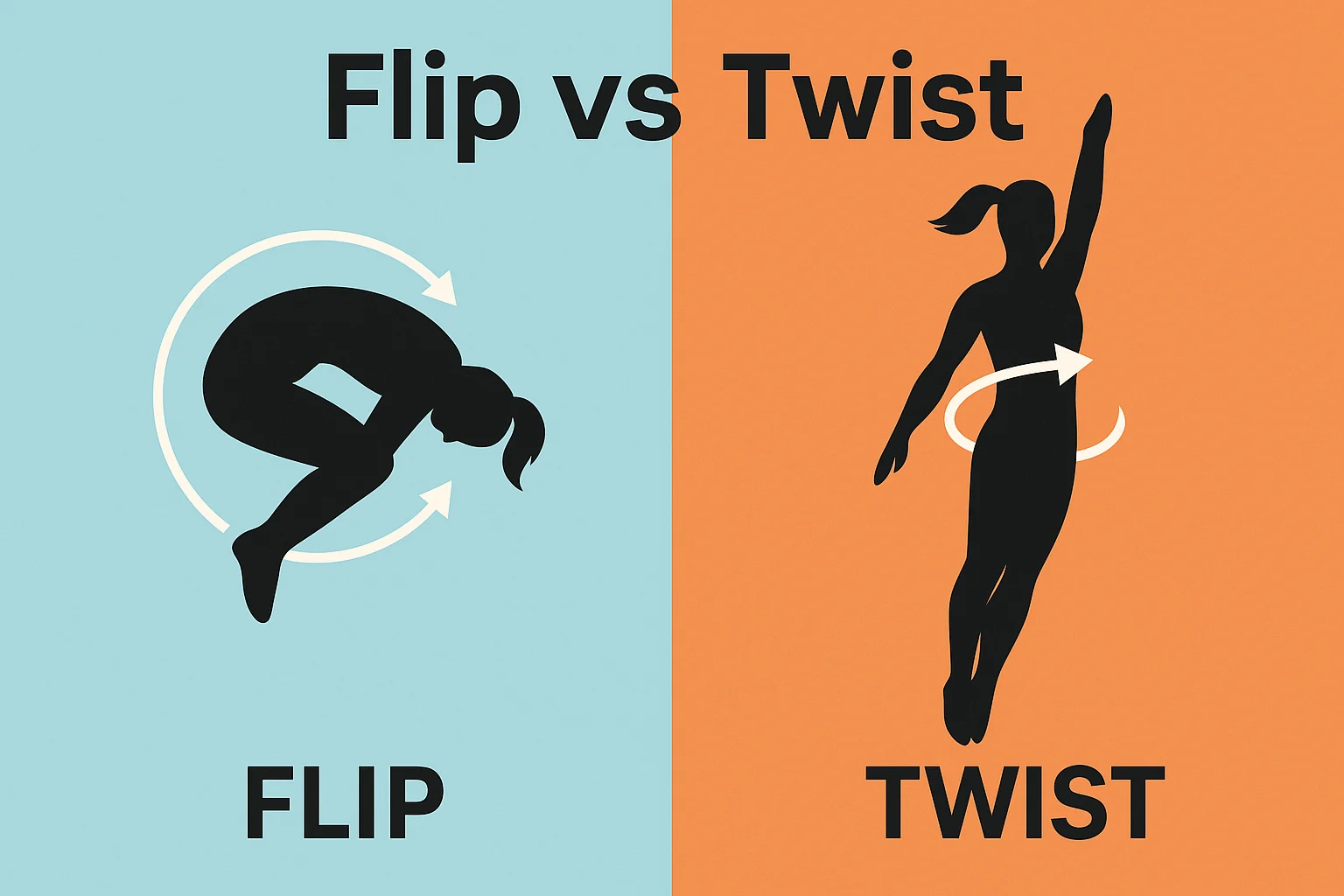
A flip turns the gymnast over in a somersault. A twist turns the gymnast around the body’s head-to-foot axis. One skill can contain either type of rotation or combine both.
Contents
A straight jump with a full turn includes a twist without a somersault. A back tuck includes a somersault without a twist. A full-twisting back layout combines one of each.
What changes when the gymnast flips?
In a forward or backward somersault, the body rotates end over end around an axis running across the body. Gymnastics commonly calls this a salto. The USA Gymnastics glossary distinguishes that motion from twisting around the body’s long axis.
The gymnast can show different body shapes while somersaulting. Those shapes do not change a flip into a twist. A back tuck and a back layout both rotate backward; their shapes differ.
A handspring also takes the feet over the head, but the gymnast supports and pushes through the hands during the skill. It should not be labeled a salto simply because the gymnast turns upside down. The introduction to tumbling skill families separates rolls, handsprings and other common movements.
Travel and rotation are different observations. A gymnast can move backward across the floor while performing several kinds of action. The direction of travel does not, by itself, tell the viewer whether the body is somersaulting, twisting or doing both. Follow the body’s orientation as well as its path through the room.
Support matters too. A forward roll turns the body over while it stays in contact with the floor. A giant swing turns a gymnast around a bar. Those actions include rotation, but a floor salto is an unsupported somersault. Calling every upside-down movement a “flip” hides useful distinctions between skill families.
The twist axis travels with the gymnast
The twist axis is sometimes called “vertical,” which can be misleading. It runs along the gymnast’s body, from head toward feet. It is vertical relative to the room only when the gymnast is upright.
During a twisting somersault, that body axis changes orientation as the gymnast flips. The athlete can therefore twist while upside down or nearly horizontal. Twisting and somersaulting are not two separate tricks that must happen one after the other.
A half twist is 180 degrees around that long axis; a full twist is 360 degrees. The guide to twist counts and names explains how fractions and multiple twists are described.
Imagine a line through the center of a long pencil from its point to its eraser. Turning the pencil around that line illustrates its long-axis rotation. Now imagine the pencil turning end over end. The two descriptions remain different even if the pencil is tilted relative to the desk. This is a viewing analogy, not a model of how a gymnast generates rotation.
The same idea explains why following only the athlete’s head can be confusing. During a twisting salto, the head moves with the somersault while the body also turns around its own length. A moving camera introduces another change of viewpoint. The screen’s “up” and “down” are therefore poor substitutes for identifying the gymnast’s body axes.
Count the two rotations separately
| Example | Somersaults | Twists |
|---|---|---|
| Straight jump with a full turn | None | One |
| Back tuck | One backward | None |
| Full-twisting back layout | One backward | One |
| Double back tuck | Two backward | None |
| Double-twisting double back | Two backward | Two |
The last example contains two counts. “Double-twisting” counts the twists, and “double back” counts the backward somersaults. Hearing the word “double” alone is not enough to identify the movement.
When reading a full element name, the meaning of salto provides a useful starting point. Shape, direction and rotation count each contribute a different piece of information.
A practical way to read a replay
Start with an uninterrupted view of the whole airborne element, including takeoff and landing. On the first viewing, look for the end-over-end rotation. On the next, look for turning around the body line. Finally, add the body shape. Separating these observations is usually easier than trying to decode every part at full speed.
Consider a hypothetical caption reading “double-twisting double back tucked.” Read it in three pieces: two backward somersaults, two twists, and a tucked position. If the caption instead says “double full,” the usual floor-tumbling meaning is one stretched salto containing two twists. Similar words can describe very different amounts of somersaulting.
Landing direction is a clue, but it cannot supply the whole twist count. Adding a complete revolution returns the gymnast to the same orientation around the twisting axis. A final still image therefore cannot distinguish all skills that finish facing the same way. The flight between takeoff and landing contains the missing information.
Video analysis also has limits. A 2022 study using competition videos explicitly addressed perspective errors when camera views were not perpendicular to the movement. For ordinary viewing, the practical lesson is to avoid treating an awkward camera angle as a precise measurement of body position or completed rotation.
Which is more difficult?
The answer depends on the complete skill. An upright half-turn jump and a backward somersault are not comparable just because one twists and the other flips. Adding twisting to an already demanding salto creates a different task, but the exact difficulty value still depends on the apparatus and rulebook.
There is no single numerical bonus that applies whenever a gymnast adds a twist. Likewise, a skill name is not a training progression: knowing how many rotations it contains does not explain how to learn it.
When a commentator names a skill, separate the description from the evaluation. “Two twists” describes an amount of motion. “Well performed” describes execution. “High difficulty” requires a comparison under an identified rule system. Those statements may appear together in a broadcast, but they answer different questions.
If a name still seems unclear, write down the whole phrase instead of retaining only its largest number. Include the apparatus and whether the action was a floor element, a vault or a dismount. Those details make a later lookup far more reliable than searching for “the gymnast’s double.”
The Main Point
Keep two questions separate: how many times does the gymnast somersault, and how much does the gymnast twist? That distinction makes complex acrobatic skills easier to recognize without confusing their shape or difficulty with their rotation count.