Gymnastics Vaults: How to Recognize the Names and Families
A vault name becomes easier to understand when it is split into two parts: how the gymnast reaches the table, and what happens after leaving it. The entry, body shape, number of flips and number of twists identify the movement.
Contents
This guide explains those parts and lists selected women’s and men’s vaults. Difficulty values refer to the 2025–2028 FIG Codes of Points, checked against the documents available on September 28, 2026. They are not USAG Development Program, Xcel or NCAA start values.
This guide helps readers recognize vaults in competition. The selected examples are not a prescribed learning order or a complete list of every vault in the Code.
How to Read a Vault Name
The first flight runs from the springboard to the table. After a brief period of hand support, the gymnast pushes away into the second flight, which ends at the landing. That push away from the table is commonly called the block.
A salto is a flip without hand support. A twist turns the body around its length, like a spinning pencil. One flip and one twist describe different rotations, even when both happen during the same flight.
Three body positions appear throughout vault names:
| Position | What it means |
|---|---|
| Tuck | The hips and knees bend, drawing the legs toward the body. |
| Pike | The hips bend while the knees stay straight. |
| Layout or stretched | The body stays extended, with straight hips and knees. |
The body shape belongs to the name: changing from tuck to pike can identify a different vault even when the entry stays the same.
For example, a Yurchenko layout with two twists has a Yurchenko entry, one backward flip in a stretched position, and two twists after the table. The familiar abbreviation DTY means double-twisting Yurchenko. It does not mean two flips, and it is not the same vault as a Yurchenko with 1½ twists.
Fractions describe complete turns: ½ is 180 degrees, one twist is 360 degrees, and 1½ twists is 540 degrees. “Half-on” describes a turn on the way to the table; “half-off” describes a turn after leaving it.
The Main Entry Patterns
Recognizing the approach is often the quickest way to tell vaults apart. These four entry patterns are useful viewing categories; they should not be mistaken for a complete list of official FIG groups.
Front handspring
The gymnast takes off from the board facing the table and passes forward through hand support. A basic handspring finishes on the feet without an additional airborne flip after the table. Other handspring-entry vaults add saltos and twists in the second flight.
That distinction matters. A handspring and a handspring double front share an entry, but their second flights are very different.
Tsukahara
A Tsukahara begins with a forward-facing board takeoff and a quarter- to half-turn during the first flight, followed by a backward salto after the table. Unlike a Yurchenko, it does not begin with a roundoff onto the springboard.
The tucked, piked and stretched versions are different vaults. Adding twists creates further variations.
Yurchenko
The gymnast performs a roundoff onto the springboard, arriving with the back toward the table, then a back handspring onto it. The second flight continues into a backward salto.
“Yurchenko” can describe this entry family or, in a more specific context, its original tucked vault. A complete description adds the body position and any flips or twists.
Roundoff with a half-turn onto the table
This entry also begins with a roundoff onto the board. The gymnast adds a half-turn on the way to the table, changing the orientation for the second flight. The Cheng and Biles I use this entry and a stretched forward salto with twisting.
A Cheng and a Yurchenko with 1½ twists both contain 1½ twists after the table. They remain different vaults because the entry and salto direction differ.
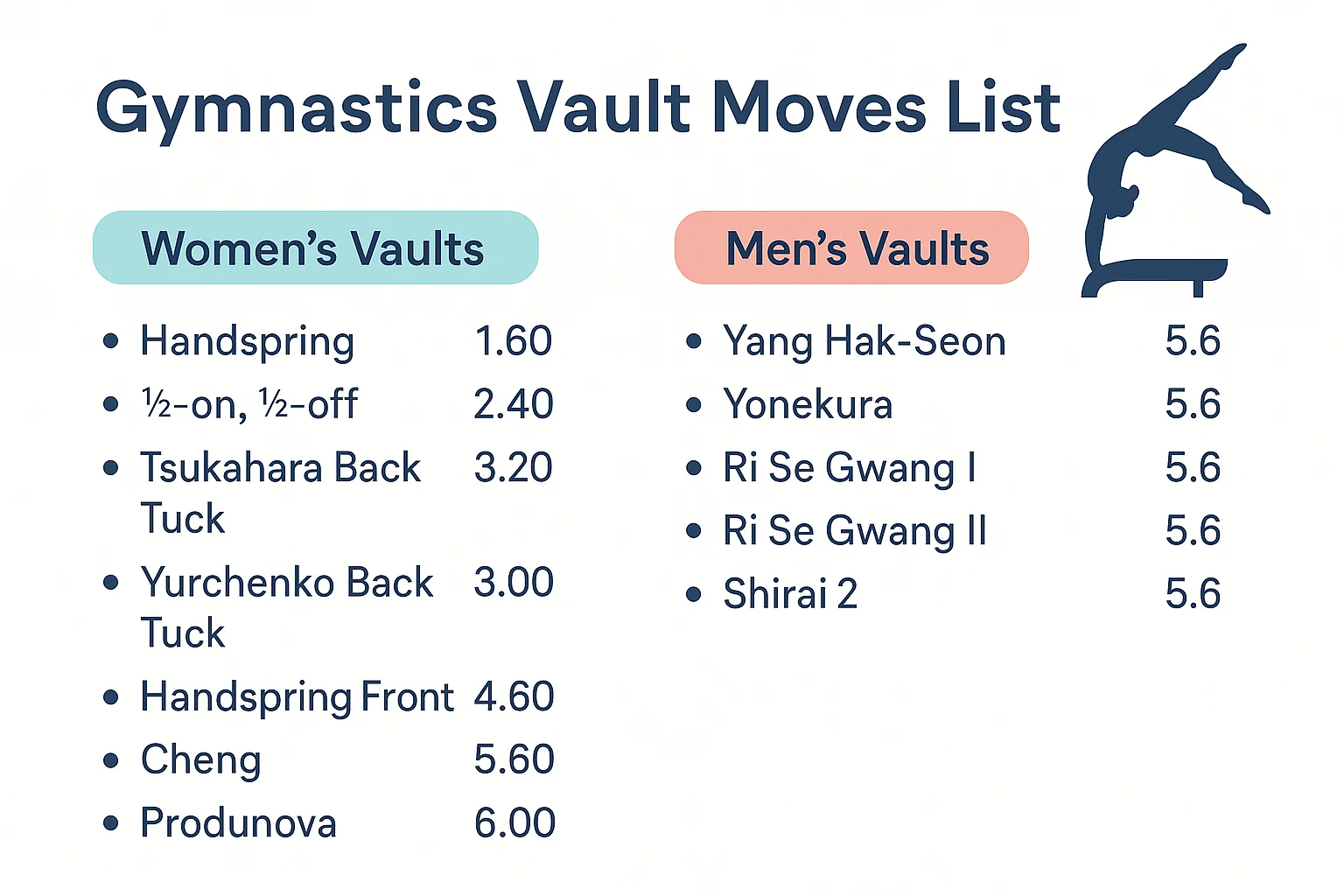
Women’s Vault Moves and FIG Difficulty Values
Women’s artistic gymnastics uses five official vault groups. The guide to vault families compares the women’s and men’s grouping systems. Here, the focus is recognizing individual vaults and reading their names.
The following are selected vaults, identified by their exact variation. The D-value is the vault’s difficulty contribution, not its final score. Source: FIG Women’s Code, Section 10 and vault tables.
| Vault | What happens after the table | WAG group | D-value |
|---|---|---|---|
| Front handspring | Flight to the feet without an additional salto | 1 | 1.6 |
| Handspring front tuck | One forward salto, tucked | 2 | 3.6 |
| Handspring front pike | One forward salto, piked | 2 | 3.8 |
| Handspring front layout with 1½ twists | One stretched forward salto with 1½ twists | 2 | 5.4 |
| Produnova | Two forward saltos, tucked | 2 | 6.0 |
| Tsukahara tuck | One backward salto, tucked | 3 | 3.2 |
| Tsukahara layout with one twist | One stretched backward salto with one twist | 3 | 4.4 |
| Yurchenko tuck | One backward salto, tucked | 4 | 3.0 |
| Yurchenko layout with one twist | One stretched backward salto with one twist | 4 | 4.2 |
| Yurchenko layout with 1½ twists | One stretched backward salto with 1½ twists | 4 | 4.6 |
| DTY | One stretched backward salto with two twists | 4 | 5.0 |
| Amanar | One stretched backward salto with 2½ twists | 4 | 5.4 |
| Biles II: Yurchenko double pike | Two backward saltos, piked | 4 | 6.4 |
| Cheng | One stretched forward salto with 1½ twists, after a roundoff half-on entry | 5 | 5.6 |
| Biles I | One stretched forward salto with two twists, after a roundoff half-on entry | 5 | 6.0 |
Biles I and Biles II are different vaults
Biles I uses the roundoff half-on entry and a single stretched forward salto with two twists. Biles II uses a Yurchenko entry and two backward saltos in a pike, without a twist in that second flight.
“Double” therefore means different things in double-twisting Yurchenko and Yurchenko double pike. The first describes the twists; the second describes the flips.
A basic handspring still turns upside down
Calling a handspring a “vault without a salto” does not mean the gymnast stays upright. The gymnast passes through an inverted position with hands on the table. The distinction is that there is no additional unsupported flip in the second flight.
Men’s Vault Moves Use Their Own Values
Men’s artistic gymnastics also uses five FIG vault groups, but their boundaries differ from the women’s groups. Entry, twisting complexity and single or double saltos all affect the grouping. The women’s group numbers and values should not be copied into a men’s list.
For example, the men’s Code places a tucked Yurchenko in Group V and a full-twisting stretched Yurchenko in Group IV. In the women’s Code, both belong to Group 4.
These selected men’s vaults show why the full movement description matters. Source: FIG Men’s Code, Section 13 and vault tables.
| Vault | Movement description | MAG group | D-value |
|---|---|---|---|
| Roche | Handspring entry, then two forward saltos in a tuck | II | 4.8 |
| Dragulescu | Handspring entry, then two forward saltos in a tuck with a half-twist | II | 5.2 |
| Yang Hak Seon | Handspring entry, then one stretched forward salto with three twists | I | 5.6 |
| Yonekura | Stretched Kasamatsu with 2½ twists, listed alongside the stretched Tsukahara with 3½ twists | I | 5.6 |
| Ri Se Gwang | Double Tsukahara in a tuck with one twist | III | 5.6 |
| Ri Se Gwang 2 | The piked version of the Dragulescu: handspring entry, double forward salto with a half-twist | II | 5.6 |
| Shirai 2 | Yurchenko entry, then one stretched backward salto with 3½ twists | IV | 5.6 |
The Yonekura contains a single stretched salto. It is not a double-piked vault. The two Ri Se Gwang vaults also need separate descriptions: they use different entries and salto directions.
Kasamatsu and Tsukahara descriptions use different twist counts for related vaults. The Code lists equivalent versions together, so the full name must stay attached to its count. “Kasamatsu with 2½ twists” should not be shortened to “Tsukahara with 2½ twists.”
Several vaults above carry a 5.6 difficulty value. That does not establish a permanent maximum for men’s vault: new elements can be submitted and evaluated under the FIG rules.
How This List Relates to Levels and Scoring
A vault’s FIG difficulty value does not identify the USAG level at which a gymnast may compete it. Domestic programs have their own permitted vaults, equipment rules and start values. Some introductory vault exercises also use a mat stack instead of a completed table vault.
For the early women’s Development Program, the vault requirements guide is the relevant starting point. This list should not be used to assign an elite D-value to a compulsory training exercise.
Final scores also depend on execution and the rules of the competition. More twists do not automatically produce a higher final score if the performance has larger errors. The vault scoring comparison explains the differences between FIG, USAG, Xcel and NCAA scoring.
The order in this article is for identification. It does not mean every gymnast should learn every entry or follow the same sequence of vaults.
Frequently Asked Questions
Is a DTY a Yurchenko with 1½ twists?
No. A DTY has two twists in a single stretched backward salto. A Yurchenko with 1½ twists is a separate vault with a different value.
What is the difference between a Cheng and an Amanar?
A Cheng has a roundoff half-on entry followed by a stretched forward salto with 1½ twists. An Amanar has a Yurchenko entry followed by a stretched backward salto with 2½ twists.
Are there six official FIG vault families?
The current women’s and men’s Codes each organize vault into five official groups. Informal family names can be useful, but they do not replace those separate grouping systems.
Does “double pike” mean two twists?
No. It means two saltos in a piked body position. Any twists would need to be stated separately.
Are women’s and men’s difficulty values interchangeable?
No. Each discipline has its own table of values. Domestic programs may assign different start values again.
Look Up a Vault After Watching It
The entry is the first clue; the second flight completes the name. Identifying the body shape, flip count and twist count makes it much easier to distinguish a DTY from a double pike, or a Cheng from an Amanar.
After identifying the entry and body shape, use the Gymnastics Skill Explorer to browse selected vault records. Check the discipline and source date on the record; the explorer is a curated reference, not an automatic feed of every FIG change.