Still Rings Skills: Holds, Swings and Dismounts to Recognize
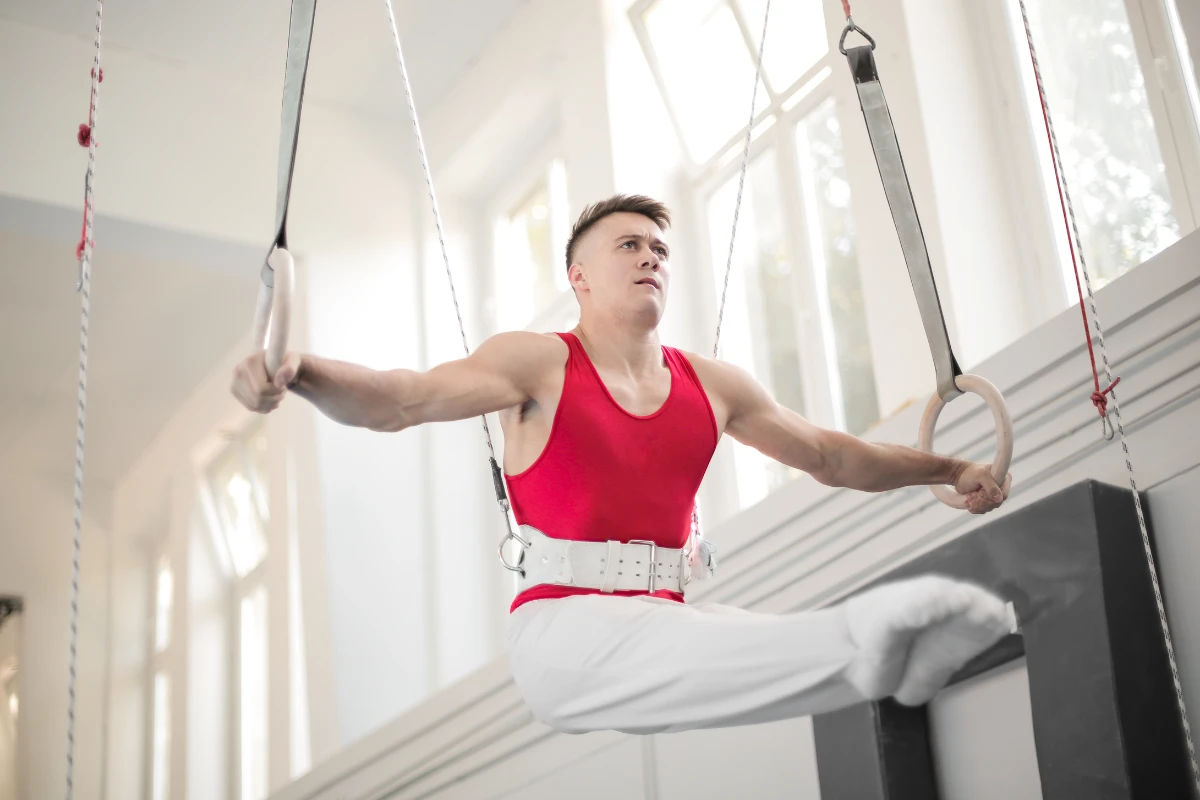
A still rings routine alternates between moments that look almost motionless and powerful swinging movements. The skill is not only holding a difficult shape. The gymnast also has to arrive in that shape under control, leave it cleanly and finish with a dismount.
Contents
- Three Parts of a Rings Routine
- The Holds Worth Recognizing First
- A Few FIG Values, With the Exact Position Attached
- What the Two-Second Hold Means
- Swings Make Rings More Than a Strength Display
- Why the Entry Changes the Skill
- The Dismount Completes the Exercise
- What to Watch Besides the Difficulty
- Follow the Transition, Then the Hold
This guide explains the main holds, swings and transitions seen in men’s artistic gymnastics. The selected difficulty values refer to the 2025–2028 FIG Men’s Code of Points; they are not a training order or a list of requirements for a USAG level.
Three Parts of a Rings Routine
Strength and hold work includes recognizable positions such as a cross or planche, together with controlled movements between positions. Swing work uses the gymnast’s movement through and around the hanging rings. The dismount releases the apparatus and ends on the landing mat.
The transitions matter as much as the snapshots. A gymnast who swings directly into a strength hold performs a different kind of element from a gymnast who slowly presses into a similar final shape.
That is why a photograph can identify a position but may not reveal the complete skill. To understand the element, watch the entry, the held position and what happens next.
The Holds Worth Recognizing First
| Position | What to look for |
|---|---|
| L-sit | The gymnast supports the body above the rings with straight legs extended forward, making an L shape. |
| Front lever | The body is held horizontally, facing upward, below the hands. |
| Back lever | The body is held horizontally, facing downward, below the hands. |
| Cross, often called an iron cross | The body is upright and the straight arms extend outward to the sides. |
| Planche | The body faces downward in a horizontal support position above the rings. |
| Maltese, also called a swallow | The extended body is horizontal at ring height, with the arms reaching outward. |
| Inverted cross | The body points upward while the arms extend sideways: an upside-down cross position. |
| Handstand | The body is vertical above the supporting hands, with the feet uppermost. |
The planche and Maltese are easy to confuse because both show a face-down horizontal body. The relationship between the shoulders, hands and rings helps distinguish them. “Horizontal” alone is not enough to identify a rings hold.
A Few FIG Values, With the Exact Position Attached
The table below lists selected standalone held positions in Element Group II. It does not assign the same value to every entry or transition ending in that position.
| FIG position | Element number | Difficulty |
|---|---|---|
| L-sit or straddled L-sit, held two seconds | II.1 | A / 0.1 |
| Back lever, held two seconds | II.7 | A / 0.1 |
| Front lever, held two seconds | II.13 | A / 0.1 |
| Planche with legs together, held two seconds | II.9 | C / 0.3 |
| Cross, including the listed V-cross variation, held two seconds | II.15 | C / 0.3 |
| Inverted cross, held two seconds | II.4 | D / 0.4 |
| Maltese/swallow, held two seconds | II.10 | D / 0.4 |
A low difficulty letter does not mean a movement is easy for a beginner. A front lever has a low value within elite gymnastics scoring, yet still demands substantial control. Conversely, a familiar final hold can be part of a much more difficult transition.
The FIG letter scale is a scoring classification. It should not be relabeled “beginner, intermediate and advanced,” and F should not be described as a universal maximum for rings.
What the Two-Second Hold Means
FIG hold positions must be shown for at least two seconds. The count concerns the completed, static position, including the shoulders and feet—not the whole time spent moving toward it.
A short hold and no visible stop are different problems. The Code provides an execution deduction for an insufficient hold, while a hold element with no stop does not receive difficulty or element-group recognition. Other position errors can also affect the evaluation.
For a viewer, the practical question is whether the gymnast clearly establishes the position. Moving slowly through the shape is not the same as stopping in it.
Swings Make Rings More Than a Strength Display
Between holds, a gymnast can swing through hang, support and handstand. Hang means the body is suspended below the hands; support places the body above them.
Some swinging elements contain somersaulting actions while the gymnast keeps hold of the rings. The Yamawaki and Jonasson are examples of named swing elements that should keep moving through their action. They should not be interpreted as a succession of separate static poses.
A swing rising into a held handstand combines movement with a clear finish. Watch how the gymnast reaches the vertical position and stabilizes the rings, rather than looking only at the feet at the top.
Why the Entry Changes the Skill
The Azarian uses a slow backward rolling movement into a cross position. A Nakayama passes through a back-lever position and pulls toward a cross. Both may finish in a recognizable cross shape, but they take different routes to reach it.
This is where long lists can become misleading. Writing “cross” beside every such movement erases the part that distinguishes the elements. Equally, a calisthenics exercise name does not automatically identify an exact FIG table entry.
Use the Gymnastics Skill Explorer to look up selected named skills, checking the complete description and reviewed source information rather than matching only the final pose.
The Dismount Completes the Exercise
The gymnast builds swing, releases the rings and performs the airborne movement before landing. A dismount can include flips, twists and different body shapes.
A double salto means two flips. A double twist means two turns around the body’s length. Those descriptions are not interchangeable. The guide to gymnastics dismounts explains the wider terminology.
The landing is easy to notice, but it is only the final part of the performance. A stuck landing does not cancel mistakes in the holds and swings that came before it.
What to Watch Besides the Difficulty
Look for clear body positions, straight arms when the element requires them, controlled rings and distinct holds. Notice whether the gymnast reaches the intended shape directly or needs visible corrections.
For the score, the men’s FIG scoring guide explains difficulty and execution. Younger gymnasts compete under their own program rules; the men’s levels overview explains that pathway.
Follow the Transition, Then the Hold
Recognizing a cross or Maltese is a good start. Watching how the gymnast enters and leaves it reveals much more of the routine. That sequence—movement, position and transition—makes rings easier to understand than a ranked list of still photographs.
Reviewed September 28, 2026. FIG terminology applies to the exact element and code cycle; domestic programs have their own rules.