Men’s and Women’s Vault Compared: Height, Skills and Scoring
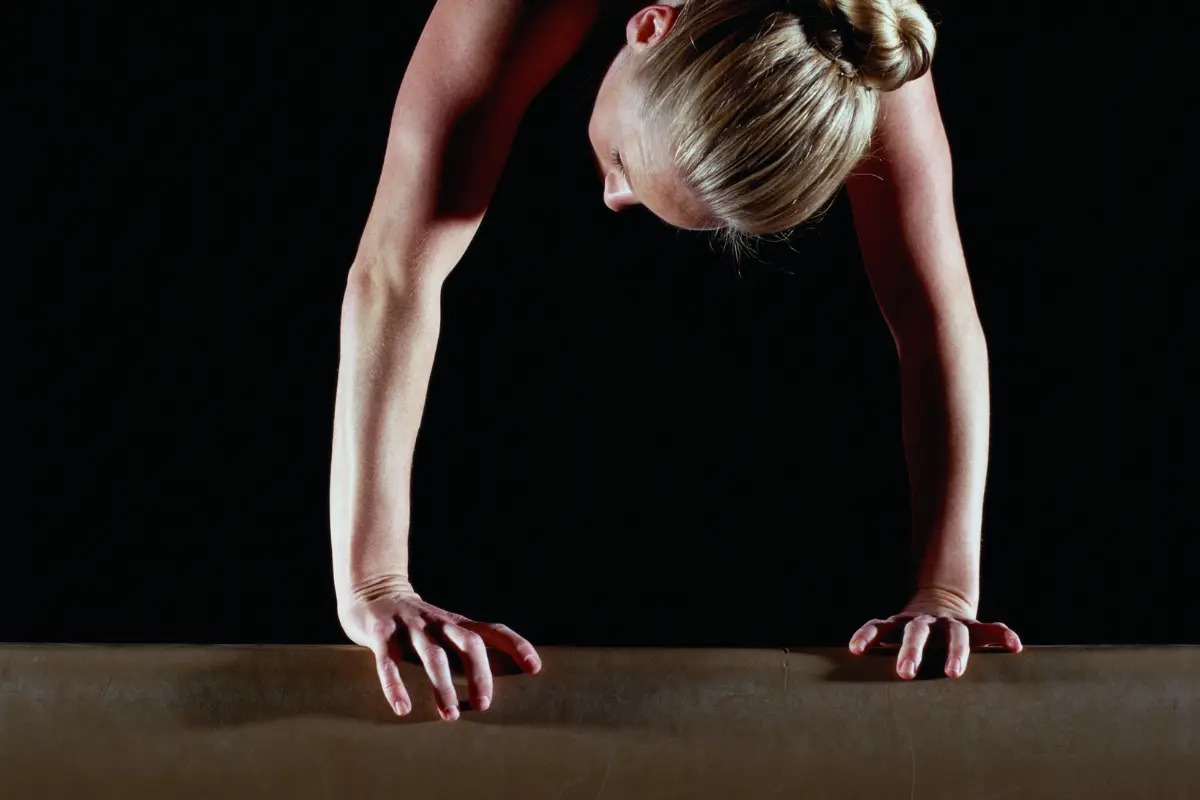
Men and women use the same type of vault table in international artistic gymnastics. The most visible equipment difference is its height: 135 cm for men and 125 cm for women under FIG rules. The table is not a completely different shape, and neither event can be explained simply as “power” versus “grace.”
Contents
The more important differences for a spectator are the separate vault difficulty tables and the competition format. Is the score contributing to a team or all-around result, or is the gymnast trying to qualify for a vault final? That question explains why you may see one vault from one athlete and two from another.
How the vault equipment compares
| FIG competition specification | Men | Women |
|---|---|---|
| Nominal table height | 135 cm | 125 cm |
| Table surface length | 120 cm | 120 cm |
| Table surface width | 95 cm | 95 cm |
| Maximum approach distance | 25 m | 25 m |
The dimensions come from the FIG Apparatus Norms and the respective Codes. The full specifications define the reference points and tolerances. Table height is measured at the marked point from the level of the runway, not from the top of the landing mat.
A maximum run distance is not an instruction that every gymnast must start at the same spot. Watch the athlete’s individual approach rather than assuming the farthest possible starting point automatically produces the best vault.
The complete station also includes the runway, springboard, landing area and required protective equipment. The table alone does not define the entire setup. For a broader introduction to those parts, see the artistic gymnastics apparatus guide.
Both events have the same broad phases
A vault begins with an approach and takeoff from the springboard, followed by flight to the table, hand support and repulsion, another flight phase, and landing. Those stages happen quickly, so a replay is often more informative than the first live view.
The first flight is the movement from the board to the table. The second flight begins after the hands leave the table. When a commentator discusses the height or shape of the vault after the push, they are talking about a different phase from the entry onto the apparatus.
Entry styles also vary. A forward handspring entry looks different from a round-off entry in which the gymnast approaches the board backward after placing the hands on the runway. Twists can appear at different points in the vault, so counting the total visible turns without identifying the phases can be misleading. Our guide to vault names and families shows how vaults are grouped and named.
Men’s and women’s vault both demand speed, coordination, body control and a prepared landing. The lower table setting in women’s competition does not mean the event is a beginner version of men’s vault. It is an elite event with its own difficulty system and technical demands.
Why one gymnast performs one vault and another performs two
Under the women’s 2025–2028 Code, one vault contributes to the team and all-around calculation. A gymnast seeking a place in the vault apparatus final performs two, and the first vault still supplies the team or all-around contribution during qualification.
The men’s Code likewise distinguishes the single-vault team or all-around task from the two-vault apparatus qualification and final. In both Codes, the apparatus-final pair must come from different vault groups under the applicable classification.
The second vault is therefore not simply a free attempt to replace a disappointing first score. It has a separate purpose within the two-vault result. A gymnast may be well prepared for the team event without presenting the pair needed for apparatus-final qualification.
This is why the event heading on a results sheet matters. A number labeled “vault” in an all-around table and a two-vault apparatus ranking may refer to different calculations. Before comparing them, check which performance or combination the displayed score represents.
How to read the two-vault average
In the apparatus-final format, both vaults matter. As a simple hypothetical example, scores of 14.200 and 13.600 produce an average of 13.900. The calculation is the total of the two scores divided by two; it is not the better score alone. In senior women’s competition, 0.20 is then added when the two vaults have saltos in different directions (one forward, one backward) and neither ends in a fall.
Another athlete with scores of 14.000 and 13.900 would average 13.950. That athlete would be ahead in this example despite having the lower best single vault. The comparison shows why consistency across the required pair matters.
These are arithmetic examples, not complete judging cases. Actual results must also account for the relevant rules, valid vault selection, penalties and any tie procedures. A blank, an invalid vault or a did-not-start entry should not be casually replaced with an invented number.
For families watching developmental meets, do not import this averaging explanation without checking the program. A local level may allow a different number of attempts or use a different method to determine the event score.
Why men’s and women’s difficulty values differ
The men’s and women’s Codes have separate vault tables. Each identifies vaults and assigns difficulty within its own system. A familiar name or a similar-looking flight does not guarantee an identical value in the other Code.
That distinction matters when comparing scores across events. A larger number on a men’s results sheet does not, by itself, establish that the performance was better than a women’s vault. The difficulty assigned and the rules used to evaluate it are part of the comparison.
Execution also extends beyond sticking the landing. Watch the body shape in flight, leg position and control through the different phases. A gymnast can land without a step and still have made earlier errors; another can take a small step after otherwise strong execution.
Difficulty values may change between rule cycles. An older broadcast can accurately describe the rules of its own competition while giving a value that is no longer current. Check the event date before treating commentary as a present-day scoring reference.
Why a child’s vault setup may look different
Elite FIG dimensions are not a universal prescription for youth classes. The 2026–2027 USAG women’s equipment rules list mat-stack setups for some early levels and divisions, along with separate provisions for vault tables. A child can therefore be learning a recognized vault progression without using the Olympic-style table setup.
Coaches select and supervise the appropriate progression within the program. Parents can ask which vault is being taught, what equipment the level uses and how the meet score will be determined. Those questions are more useful than asking why the apparatus does not match a television competition.
When watching men’s and women’s vault, remember three things: identify the equipment standard, identify the competition phase, and read the score under the correct Code. The shared table makes the events look closely related; those details explain where the comparison needs more care.