How Gymnasts Earn Bonus Points: Difficulty, Connections & Landings
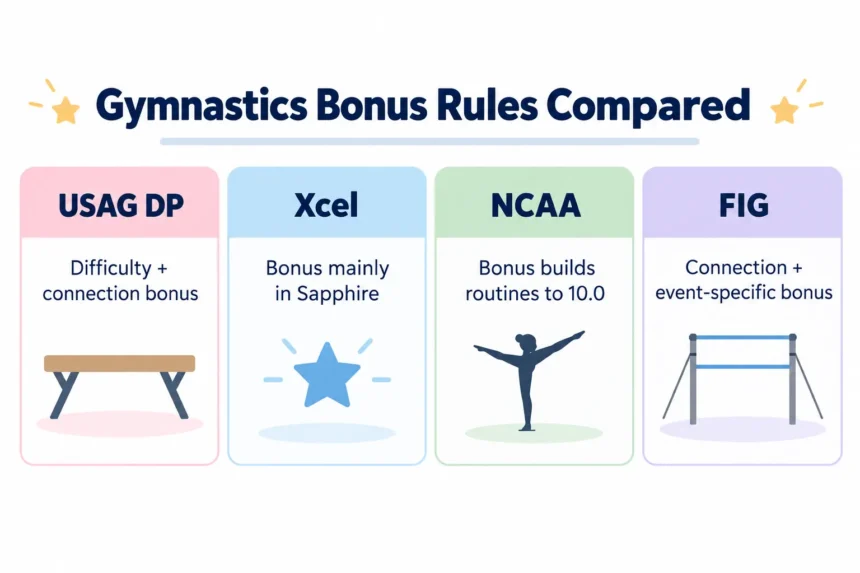
Connecting two skills can earn a gymnast extra points. So can performing certain difficult elements or, in some competitions, sticking a landing. These rewards are often called bonus, but the rules change with the scoring system.
Contents
In many domestic women’s programs, bonus helps a routine reach a 10.0 Start Value, the score available before performance deductions. In FIG elite gymnastics, connections and certain bonuses increase the D-Score, the difficulty portion of the score. Other bonuses are added separately.
This guide compares the women’s USA Gymnastics (USAG) Development Program, Xcel and NCAA college systems with senior FIG women’s and men’s artistic gymnastics. It explains what earns bonus, where those points go and why a harder routine does not always receive a higher score.
Rules checked September 13, 2026, using the 2026–2030 Development Program materials, current Xcel updates, 2026–27 NCAA women’s rules and 2025–2028 FIG Codes with current clarifications.
The Three Main Ways Gymnasts Earn Bonus
Bonus follows specific rules. Judges award it when a skill, combination or landing meets the conditions for that program and event.
1. Performing Difficult Skills
Some programs give extra credit for particular higher-difficulty skills. This is commonly called Difficulty Value Bonus, or DV Bonus.
For example, an eligible D-rated skill in USAG Level 10 generally earns 0.10 in difficulty bonus, while an eligible E earns 0.20. In Xcel Sapphire, eligible C and D skills can each earn 0.10, subject to the division’s limits.
The letter alone does not establish the bonus across every program. In FIG, a D-rated skill’s normal value of 0.40 is its individual difficulty credit; it should not automatically be described as an extra 0.40 bonus.
2. Connecting Skills
Performing qualifying skills together can earn Connection Value, or CV. Some programs use the term Connection Bonus or Connection Points instead.
A direct connection links one skill straight into the next without a break that invalidates the combination. The permitted connections may involve tumbling, dance skills, bar movements or a mixture, depending on the event.
Floor can also reward certain indirect acrobatic connections. Here, flips are linked through movements such as a round-off or back handspring within the same tumbling pass. “Indirect” does not mean the gymnast may stop and begin again later. The relevant Code specifies what may happen between the skills.
3. Completing a Qualifying Landing
A stuck landing shows control without a step or hop. In FIG men’s gymnastics, an eligible stick can earn an additional 0.10.
In the women’s domestic systems covered here, sticking normally helps by avoiding landing deductions. It does not automatically add a separate tenth. Other bonuses may require a successful landing without a fall, which is different from requiring a stick.
Where Does Bonus Go?
| Scoring system | Main bonus opportunities | Where the points go |
|---|---|---|
| USAG women’s Development Program | Difficulty and connections at Levels 9–10; additional Level 10 bonuses | Usually into Start Value; specified extra bonuses sit outside it |
| Xcel Sapphire | Difficulty and connections | Into Start Value, from a 9.60 base toward 10.0 |
| NCAA women | Difficulty and connections on Bars, Beam and Floor | Into Start Value, up to the 10.0 maximum |
| FIG women | Connections, Beam series, qualifying dismounts and a qualifying pair of vaults | Into the D-Score, except the two-vault bonus is added to the vault average |
| FIG men | Connections and qualifying stuck landings | Connections enter the D-Score; official results can show the stick bonus separately |
The placement matters when reading a scoreboard. A bonus already included in a Start Value or D-Score must not be added a second time.
How USAG Development Program Bonus Works
In the Women’s Development Program, the regular difficulty and connection bonus system applies to Levels 9 and 10 on Uneven Bars, Balance Beam and Floor Exercise.
These routines also use Composition Credit, which rewards specific difficulty and construction choices for the event. Composition Credit and bonus are separate parts of the Start Value.
| Level | Base Start Value* | Maximum Composition Credit | Regular bonus toward 10.0 | Full Start Value |
|---|---|---|---|---|
| 8 | 9.80 | +0.20 | None | 10.00 |
| 9 | 9.50 | +0.20 | +0.30 | 10.00 |
| 10 | 9.20 | +0.30 | +0.50 | 10.00 |
The base assumes the routine has the required number and difficulty of skills, measured through Value Parts, and the required types of content, called Special Requirements. Missing required content can lower it.
Level 8 appears in the table because reaching 10.0 does not always involve bonus. At that level, the available Composition Credit fills the gap above the 9.80 base. The current bases and composition provisions appear in USA Gymnastics’ Levels 6–8 and Levels 9–10 reference sheets.
Level 9: Up to 0.30 Bonus
Level 9 can reach its full regular bonus through 0.30 Connection Value, or 0.20 Connection Value plus 0.10 Difficulty Value Bonus.
The difficulty bonus is limited to the first qualifying D or E under the event’s rules. Level 9 also restricts higher-difficulty content, so adding several D or E skills is not a substitute for following those restrictions.
If a routine receives all its required credit and full Composition Credit but earns only 0.20 bonus, its Start Value is 9.90. Execution deductions are then taken from that lower starting score.
Level 10: Up to 0.50 Regular Bonus
To receive the full 0.50, Level 10 needs at least 0.10 in difficulty bonus and 0.10 in connection credit. The remaining 0.30 can come from either source.
For example, 0.20 difficulty bonus and 0.30 connection credit provide the full 0.50. The gymnast must still earn the other required Start Value components; collecting bonus does not automatically supply missing Composition Credit or Special Requirements.
The guide to building a USAG optional Start Value explains how those parts fit together.
The Additional Level 10 Tenth
Level 10 has a separate +0.10 bonus outside the Start Value on Bars, Beam and Floor. The current score sheet requires a 10.0 Start Value, at least 0.60 total bonus and the specified event-specific difficulty conditions.
Those conditions include particular release skills on Bars and qualifying E-rated acrobatics on Beam and Floor. The exact provisions and exclusions appear on the official Level 9–10 score sheet.
The Start Value remains capped at 10.0, with the additional tenth applied separately when earned.
Vault has its own Level 10 provision: qualifying 10.0-start vaults receive +0.10 when completed without a fall or spotting assistance. Some 10.0 vaults are excluded, so the bonus is not automatic for every vault with that Start Value. Level 10 vault chart and bonus exceptions.
How Xcel Sapphire Bonus Works
On Bars, Beam and Floor, Bronze through Diamond use a 10.0 starting structure without Sapphire’s bonus system. Sapphire begins from 9.60 and can add up to 0.40 bonus.
Sapphire allows all 0.40 to come from difficulty, connections or a combination. It does not require a minimum amount from both categories.
Difficulty and Connection Limits
| Sapphire bonus | How it is awarded |
|---|---|
| C difficulty | +0.10 for each qualifying C skill; the same skill earns difficulty bonus only once |
| D difficulty | +0.10 for a maximum of one qualifying D skill per event |
| Connections | +0.10 for qualifying B + B or harder combinations under the event’s rules |
The C used to meet the routine’s required skill count may also earn difficulty bonus. Additional D skills may be permitted, but they do not generate additional D difficulty bonuses.
A skill can sometimes help in both ways. It may earn its own difficulty bonus and also form part of a qualifying bonus connection. Repetition rules still apply, and only skills receiving the necessary Value Part credit can earn bonus. These provisions are set out in the current Xcel bonus rules, General/Judges pages 25–26.
A Sapphire Example
Suppose a routine earns 0.20 difficulty bonus and 0.20 connection bonus, with all required content credited:
9.60 + 0.20 + 0.20 = 10.00 Start Value
If the routine is missing one Special Requirement, the 0.50 reduction still applies:
9.60 + 0.40 − 0.50 = 9.50 Start Value
Maximum bonus does not erase that missing requirement. The broader explanation of Sapphire and the other Xcel Start Values covers the remaining calculation.
How NCAA Women’s Gymnastics Bonus Works
For 2026–27, NCAA women’s Bars, Beam and Floor use:
9.20 base + up to 0.60 bonus + up to 0.20 Composition Credit = 10.00 Start Value
The full 0.60 bonus must include at least 0.10 Difficulty Value Bonus and 0.10 Connection Value. The remaining 0.40 can come from either category.
For example, 0.30 difficulty bonus plus 0.30 connection credit works, as does 0.20 difficulty bonus plus 0.40 connection credit. Both combinations provide the same total despite using different routine construction.
The NCAA rules require bonus elements to receive Value Part credit and be performed without a fall or spot. Composition Credit has separate conditions, so a mistake may affect bonus and Composition Credit differently. 2026–27 NCAA rules, Section 1.5.
Bonus Does Not Replace Composition Credit
A routine with the full 0.60 bonus but only 0.10 Composition Credit starts from:
9.20 + 0.60 + 0.10 = 9.90
The maximum individual NCAA score remains 10.0. Vault uses its own assigned Start Values, and NCAA explicitly does not apply the USAG Level 10 vault bonus. The guide to women’s college gymnastics scoring explains the complete individual and team systems.
How FIG Women’s Bonus Works
FIG women’s artistic gymnastics, abbreviated WAG, uses an open-ended difficulty score. Connections and routine bonuses can increase that score rather than filling a domestic Start Value up to 10.0.
Most of the bonuses below enter the D-Score. The two-vault bonus is the exception.
Connection Value and Beam Series Bonus
Bars, Beam and Floor award Connection Value for combinations that meet their event-specific formulas, commonly worth 0.10 or 0.20. Floor includes qualifying indirect tumbling connections as well as direct connections.
Beam also awards 0.10 Series Bonus for qualifying series of three or more elements. Simply linking any three skills is not enough: the series must meet the required difficulty and connection conditions. One series can sometimes earn both ordinary Connection Value and Series Bonus.
These points are added alongside the individual skill values. They should not be added again after the final D-Score is displayed. See the connection sections of the 2025–2028 WAG Code.
The 0.20 Dismount Bonus
On Bars, Beam and Floor, a qualifying D-or-higher dismount can earn 0.20 when performed without a fall. A dismount is the finishing skill; on Floor, the rules identify the finishing acrobatic element.
Floor has extra conditions. The routine must contain more than two acrobatic lines, meaning at least three qualifying tumbling lines, and the final line must be performed without a fall.
This is not a stick bonus. A step can receive an execution deduction while the gymnast still earns the dismount bonus, provided all its conditions are satisfied. The distinction is explained in the WAG Code, Section 7.4.3 and Floor rules.
The 0.20 Two-Vault Bonus
In qualification for the vault final and in the final itself, women perform two vaults whose scores are averaged. A qualifying pair can earn 0.20 added to that average.
The vaults must include flips in opposite directions during the flight from the table to the landing: one forward and one backward. (For this rule, a Cuervo-type vault counts as forward.) Both must be performed without a fall. Vault groups are a separate rule: senior women must show two vaults from different groups, or 2.00 comes off the second vault before the two scores are averaged. See WAG Code, Section 10.4.
For a hypothetical qualifying pair scoring 14.000 and 14.400:
(14.000 + 14.400) ÷ 2 + 0.200 = 14.400
The extra 0.20 is applied once to the average. It is not added to each vault’s D-Score. WAG Help Desk, vault bonus provisions.
How FIG Men’s Connection and Landing Bonuses Work
FIG men’s artistic gymnastics, or MAG, also rewards certain difficult combinations. Floor and Horizontal Bar have specific Connection Points rules that increase the D-Score.
On men’s Floor, qualifying direct combinations can earn 0.10 or 0.20. The required skills must be among the counting elements, and the connection must satisfy the event’s additional restrictions. A difficulty-letter combination alone is not enough to establish credit.
The full explanation of FIG D-Score construction separates individual skill difficulty, required content and connection credit.
The 0.10 Stick Bonus
A qualifying stuck dismount of at least C difficulty can earn 0.10, including an eligible finishing element on Floor. Vaults containing a flip can also qualify. Pommel Horse is excluded.
The difficulty judges, called the D-Jury, award the bonus. Official MAG results can display it separately from the D-Score and the E-Score, which measures execution. In that format, a hypothetical routine with 5.800 difficulty, 8.400 execution, a 0.100 stick bonus and no penalty scores:
5.800 + 8.400 + 0.100 = 14.300
The separate bonus column can be seen in the 2025 World Championships men’s results.
Some other deductions, such as certain arm movements or feet apart, can coexist with the bonus. However, raising the heels or toes to maintain balance prevents it. The MAG Code and December 2025 clarification set out these conditions.
A clarification effective September 1, 2026 also confirms that a Floor or Vault landing can receive both a stick bonus and a boundary penalty. Control and landing location are separate judgments. July 2026 MAG newsletter.
What Can Cause a Gymnast to Lose Bonus?
A routine may be planned with enough bonus but receive less when performed. The most common reasons are an uncredited skill, a broken connection or a fall that invalidates the relevant bonus.
Repetition and difficulty restrictions also matter. A gymnast cannot assume that repeating a bonus skill or adding a harder element will provide more credit. Each program limits what may count and how often.
Does a Fall Remove Every Bonus?
No. The effect depends on which skill or connection involved the fall.
For example, the Xcel rules describe a three-element series where the gymnast falls on the final element. A qualifying connection between the first two skills can still receive bonus, while the connection into the fallen skill does not. Previously earned bonus elsewhere in the routine is not automatically erased. Xcel bonus clarification examples.
The fall deduction and the lost bonus are separate effects. A gymnast may lose points for the fall and also receive less Start Value or difficulty credit than planned.
Does More Bonus Always Produce a Higher Score?
Once a routine reaches its maximum ordinary Start Value, extra difficulty may provide no further increase unless a specific additional-bonus rule applies.
For two hypothetical routines with the same 10.0 Start Value and no separate additional bonus, 0.10 in deductions produces 9.90, while 0.25 produces 9.75. The second routine does not win simply because it contains harder skills.
In FIG, more difficulty can raise the scoring potential, but execution losses can still outweigh the gain. Coaches balance the available bonus against how consistently the gymnast can perform the skills.
Frequently Asked Questions
Can One Skill Earn Difficulty Bonus and Connection Bonus?
Yes, when the program’s rules allow it. A skill may earn individual difficulty bonus and also form part of a qualifying connection. Each type of credit has to meet its own conditions.
Is Composition Credit Another Name for Bonus?
No. They are separate scoring components. Composition Credit rewards specified routine construction, while difficulty and connection bonuses follow their own formulas. Earning one does not automatically supply the other.
Can a Stuck Landing Raise an NCAA Score Above 10?
No. NCAA women’s individual scores are capped at 10.0. Sticking helps avoid deductions; it does not earn the FIG men’s separate 0.10 stick bonus.
Can USAG Level 10 Score Above 10?
The Start Value remains capped at 10.0, but an eligible routine or vault can receive the separate additional 0.10 described above. The ordinary Start Value bonus and this additional tenth are different provisions.
Does the Program With the Most Bonus Have the Hardest Routines?
Not necessarily. NCAA’s 0.60, Level 10’s 0.50 and Sapphire’s 0.40 operate within different requirements and skill tables. The size of the bonus allowance alone does not measure routine difficulty.