How Start Value Is Calculated in Xcel Gymnastics (Bronze to Sapphire)
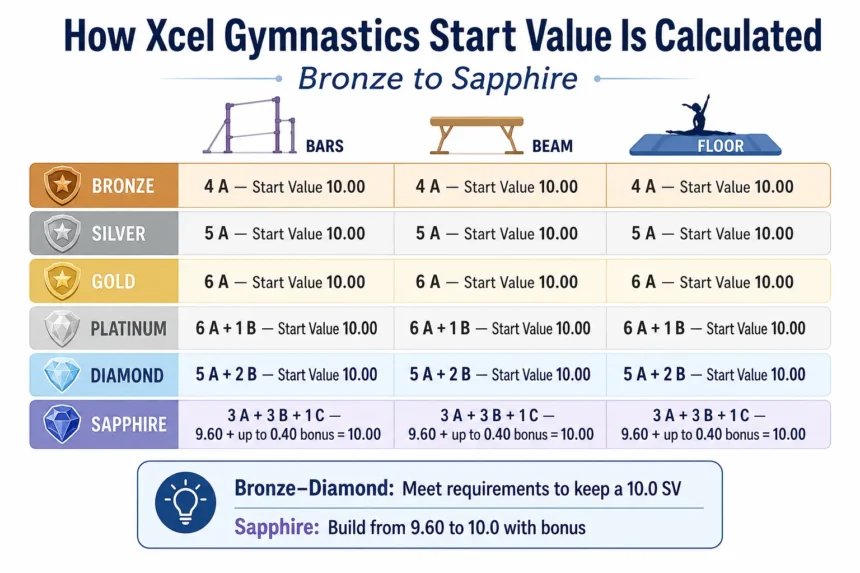
Two Xcel gymnasts can perform different routines and still have the same 10.0 Start Value. Judges check whether each routine meets its division’s requirements, then deduct for mistakes in the performance.
Contents
On uneven bars, balance beam and floor exercise, Bronze through Diamond begin from 10.00 before any Start Value reductions. Sapphire begins from 9.60 and can add up to 0.40 bonus. Missing requirements or performing restricted skills can lower those starting scores.
This guide follows the USA Gymnastics Xcel Code introduced in 2022, extended through July 31, 2028, and read with its August 2026 updates. Vault uses separate values, explained later in the article.
New to the term? Our beginner’s guide to Start Value covers the basics first.
Xcel Start Value by Division
Each division requires a certain number of skills at specified difficulty levels. These are called Value Parts (VP) and are identified by letters such as A, B and C.
The basic structure for bars, beam and floor is:
| Division | Required Value Parts | Starting value before reductions | Bonus available | Maximum Start Value |
|---|---|---|---|---|
| Bronze | 4 A | 10.00 | — | 10.00 |
| Silver | 5 A | 10.00 | — | 10.00 |
| Gold | 6 A | 10.00 | — | 10.00 |
| Platinum | 6 A + 1 B | 10.00 | — | 10.00 |
| Diamond | 5 A + 2 B | 10.00 | — | 10.00 |
| Sapphire | 3 A + 3 B + 1 C | 9.60 | Up to 0.40 | 10.00 |
Every division also has four Special Requirements on each of these events. The table assumes those requirements and all required Value Parts receive credit, with no other Start Value losses. The values and skill counts appear in the current USA Gymnastics Xcel score sheets.
The higher divisions require more difficulty even though the maximum Start Value stays at 10.0. A Diamond gymnast does not earn a higher starting maximum simply because her routine is harder than a Bronze routine.
How Judges Calculate the Start Value
For Bronze through Diamond, the calculation is:
10.00 − Start Value reductions = awarded Start Value
For Sapphire, it is:
9.60 + eligible bonus, up to 0.40 − Start Value reductions = awarded Start Value
The starting numbers already account for the required skills and Special Requirements. Judges do not add the skill values or another 2.00 for Special Requirements on top of 10.00 or 9.60.
1. Check Whether Enough Value Parts Receive Credit
An A, B or C tells judges the difficulty classification of a skill. Each division’s required combination appears in the opening table.
For example, Platinum requires six A Value Parts and one B. A routine with seven A skills is still missing the required B: having enough movements is different from having enough difficulty at the required level.
Allowed higher-value skills can replace lower required Value Parts. A higher-value skill fills one place in the count, however; it does not replace several missing skills at once. Easier skills cannot replace a missing harder Value Part.
Judges also check how each skill was performed. A planned B skill must meet the rules for B credit. If it receives only A credit, the routine may be left short of its required difficulty.
The resulting Start Value losses are:
| Missing Value Part | Loss from Start Value |
|---|---|
| Each required A | 0.10 |
| Each required B | 0.30 |
| Required C in Sapphire | 0.50 |
These amounts belong to the Xcel Start Value calculation. They should not be used as the numerical difficulty values for FIG elite gymnastics.
2. Check the Four Special Requirements
A routine must also include particular types of movements. These are its Special Requirements (SR).
The four requirements vary by division and apparatus. Bars may require a circling skill, beam may require particular dance and acrobatic content, and floor may require specific tumbling and dance passages.
Each missing Special Requirement costs 0.50 from Start Value. A gymnast can therefore perform enough skills to meet her Value Part count but still lose half a point because a required type of movement is missing.
For bars, beam or floor, work through the routine requirements with the guided checker. It flags possible gaps from the answers entered; it does not award an official Start Value.
One skill can help with several parts of the calculation. A qualifying dismount, for instance, may count as a Value Part and fulfill the dismount Special Requirement. The requirements do not automatically call for four additional skills beyond the Value Part count.
3. Check for Restricted Skills and Missing Dismounts
Some movements are not permitted in a particular division. These are restricted elements.
Performing one generally costs 0.50 from Start Value, and the skill receives no Value Part or Special Requirement credit. Execution deductions can still apply to the movement itself.
As a result, a restricted skill can cost more than 0.50 overall. If the gymnast was relying on it to fill a required Value Part or Special Requirement, those missing points must also be considered.
The restrictions depend on both the division and the apparatus. They cannot always be reduced to a rule such as “all A skills are allowed.” Even some easier skills are restricted in the lower divisions. Sapphire permits A–D skills but does not allow E elements.
Bars and beam also have a 0.30 deduction from Start Value for no dismount. A dismount is the finishing skill that takes the gymnast off the apparatus.
If a beam gymnast ends without a dismount, she can lose both:
| Missing part | Start Value loss |
|---|---|
| Dismount Special Requirement | 0.50 |
| No dismount | 0.30 |
| Combined loss | 0.80 |
A missing Value Part could increase that loss further. A restricted dismount can also trigger the no-dismount deduction. These checks are separate from a fall or landing deduction and follow the event’s specific rules in the Xcel Code and current revisions.
The 0.30 is not a general penalty for an untidy finish. Judges distinguish between performing a dismount with errors and a situation that the rules treat as having no dismount.
To check a routine against its division’s main requirements before a meet, try the Routine Requirements Checker. It flags possible gaps and details for a coach to review.
How Sapphire Bonus Builds the Start Value
Sapphire adds a bonus calculation to the same basic checks for required skills and Special Requirements.
A routine that meets those requirements begins from 9.60. It can then earn up to 0.40 bonus from harder skills, valuable connections, or a combination of both.
Unlike some other gymnastics bonus systems, Sapphire allows the full 0.40 to come from either category. A gymnast does not have to divide it equally between difficulty and connections.
Difficulty Bonus: Eligible C and D Skills
Sapphire’s difficulty bonus works like this:
| Skill receiving credit | Difficulty bonus |
|---|---|
| Each eligible C skill | 0.10 |
| One eligible D skill per event | 0.10 |
The C skill used to meet the required Value Part count can also earn its 0.10 bonus. It does not have to be an extra C beyond the minimum requirement.
Each skill can receive difficulty bonus only once. Repeating the same C does not earn another 0.10 for that skill. Additional D skills may be allowed, but only one D receives the D difficulty bonus on each event.
A D is therefore not automatically worth more bonus than a C in Sapphire. Both receive 0.10 when eligible, and the restriction on D bonus still applies.
Connection Bonus: Eligible Skills Performed Together
A qualifying B + B connection or higher can earn 0.10 connection bonus. The skills must be able to connect as required by the rules, and each must receive Value Part credit.
On floor, some indirect tumbling connections also qualify. Here, the two flips are linked through other tumbling movements instead of following each other immediately.
Dance connections work differently: the dance skills must connect directly to earn connection bonus. A dance passage with steps between its elements may fulfill a Special Requirement without earning this bonus.
The same exact connection cannot earn connection bonus repeatedly. Repeating an individual skill may sometimes contribute to another eligible connection, but the skill must still receive Value Part credit under the repetition rules.
One Combination Can Earn Both Types of Bonus
Suppose two different C skills are performed in a qualifying direct connection. Neither has already earned difficulty bonus in the routine, and both are completed with the required credit and without a fall or spotting deduction.
The combination can earn:
| Source of bonus | Amount |
|---|---|
| First C skill | 0.10 |
| Second, different C skill | 0.10 |
| Qualifying C + C connection | 0.10 |
| Total bonus from the combination | 0.30 |
Another 0.10 of eligible bonus elsewhere could bring the routine to the full 0.40. Sapphire’s difficulty, connection and repetition rules are detailed in the current bonus chapter, General/Judges pages 25–26.
Bonus Does Not Replace Missing Requirements
The maximum bonus that can count toward a Sapphire Start Value is 0.40. Judges still subtract any losses for missing requirements or other Start Value faults.
For example, a routine with full bonus but one missing Special Requirement receives:
9.60 + 0.40 bonus − 0.50 missing SR = 9.50 Start Value
Having still more bonus in the routine would not fill that gap. The bonus contribution is capped before the missing-requirement deduction is considered.
Worked Examples Across the Six Divisions
The following examples are hypothetical. Each isolates the stated Start Value issue and assumes all other requirements are satisfied.
| Division | Example situation | Calculation | Awarded Start Value |
|---|---|---|---|
| Bronze | One Special Requirement missing | 10.00 − 0.50 | 9.50 |
| Silver | One required A missing | 10.00 − 0.10 | 9.90 |
| Gold | One restricted skill; enough other allowed skills fulfill all requirements | 10.00 − 0.50 | 9.50 |
| Platinum | Required B missing | 10.00 − 0.30 | 9.70 |
| Diamond | One required B and one Special Requirement missing | 10.00 − 0.30 − 0.50 | 9.20 |
| Sapphire | All requirements met; 0.30 bonus earned | 9.60 + 0.30 | 9.90 |
A lower Start Value can therefore have several explanations. The gymnast may need another qualifying skill, a missing type of movement, a permitted replacement for a restricted skill, or additional bonus in Sapphire.
From Start Value to the Final Score
Once Start Value is established, judges apply execution, artistry and other applicable deductions.
Suppose a Diamond routine has a 9.70 Start Value and receives 0.65 in total deductions, with no other adjustments:
9.70 − 0.65 = 9.05 final score
The missing B that produced the 9.70 Start Value is already accounted for. It should not be subtracted again as part of the 0.65 performance deductions.
Use the Xcel score calculator to try these numbers. Choose Xcel, enter the awarded Start Value of 9.70 and total deductions of 0.65, then calculate the result.
This distinction helps explain a score that seems unexpectedly low. A routine may have relatively few visible mistakes but begin with less than the full starting value. The gymnastics deductions comparison explains the different kinds of score loss.
A Fall Can Affect Performance and Bonus Separately
A fall in Xcel costs 0.50 in execution. Whether the Start Value also changes depends on which skills, requirements and bonuses still receive credit.
In Sapphire, a skill performed with a fall or spotting deduction cannot earn bonus. A fall can also break a planned connection. Earlier skills completed successfully may keep their own difficulty bonus, so judges do not automatically remove every bonus point from the sequence.
For example, a gymnast might lose a planned 0.10 bonus and receive the separate 0.50 fall deduction. However, if enough other eligible bonus remains to reach the 0.40 maximum, losing that particular bonus tenth may not lower the final Start Value.
How Xcel Vault Start Value Is Calculated
Vault uses the assigned value for the vault performed under the gymnast’s division rules. It does not use the Value Part counts, four Special Requirements or Sapphire connection bonus from the routine calculations above.
Bronze and Silver use their own introductory vault options. The higher divisions use allowable vaults and division-specific values, so the same vault can have a different Start Value in different divisions.
For a hypothetical vault assigned a 9.50 Start Value, 0.60 in total deductions would produce:
9.50 − 0.60 = 8.90
Sapphire’s 9.60 routine base should not be applied to vault. The complete vault scoring explanation covers vault values, attempts and deductions separately.
Xcel Start Value Compared With DP and FIG
Xcel and the USA Gymnastics Development Program both use Start Values, Value Parts and Special Requirements. Their formulas still need to be kept separate.
Xcel does not add the Composition Credit used at the higher optional Development Program levels. Bronze through Diamond also do not need Sapphire-style difficulty or connection bonus to reach a 10.0 on bars, beam or floor.
FIG elite gymnastics uses a different structure: judges calculate difficulty as a D-Score, then add an execution score. Xcel does not build an open-ended D-Score by adding more and more difficult skills.
Frequently Asked Questions
Can an Xcel gymnast score a perfect 10?
Yes. A routine with a 10.0 Start Value and no deductions can receive 10.000. Earning the full Start Value provides the opportunity; the quality of the performance determines how much remains.
Does every movement count as a Value Part?
No. Choreography, transitions and other movements do not automatically receive Value Part credit. Judges count recognized skills according to the Code and the division’s rules.
Can extra A skills replace a missing B?
No. Several easier skills do not combine to replace a required B. The routine needs an allowed skill that receives B or permitted higher-value credit.
Does Sapphire have to earn both difficulty and connection bonus?
No. Its 0.40 bonus may come entirely from either category or from a combination of the two, provided the bonus rules are satisfied.
Why can two gymnasts perform different skills and have the same Start Value?
There is often more than one way to meet a division’s requirements. Once both routines earn 10.0, their Start Values are equal even if their skills differ. Execution and other deductions then determine their final scores.
Conclusion
An Xcel Start Value comes from the requirements the routine actually fulfills. Bronze through Diamond begin from 10.0 before Start Value losses; Sapphire adds eligible bonus to a 9.60 base.
Checking required skills, Special Requirements and restricted content first makes the score easier to follow. The next question is how well the gymnast performed the routine, and how much judges deducted from that starting value.