What Are Composition Requirements in FIG Women’s Gymnastics?
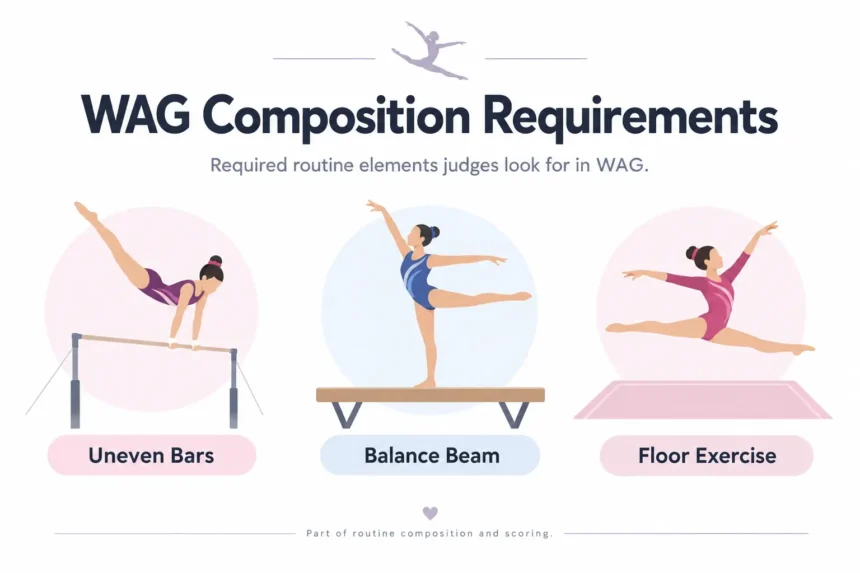
An elite gymnastics routine needs a mix of required content as well as difficult skills. On Uneven Bars, Balance Beam and Floor Exercise, these rules are called Composition Requirements (CR).
Contents
Each of those events has four requirements worth 0.50 each. Fulfilling all four adds 2.00 points to the routine’s difficulty score, or D-Score.
The requirements change by event. Bars emphasizes flight, grips and turns. Beam requires dance and acrobatic variety. Floor needs a dance passage and specific types of tumbling.
This guide covers the standard FIG women’s artistic gymnastics requirements in the 2025–2028 Code of Points, including the clarifications in the WAG Help Desk (2nd edition, April 2026). Vault uses a separate difficulty system. Official WAG rules and updates.
How Composition Requirements Affect the D-Score
The D-Score rewards several parts of a routine. Difficulty Values measure individual skills, Composition Requirements cover required content, and Connection Value rewards eligible combinations. Other bonuses may also apply.
For Bars, Beam and Floor:
Difficulty Values + Composition Requirements + Connection Value + applicable bonuses = D-Score
Judges evaluate each CR separately. A routine earns 2.00 for four fulfilled requirements, 1.50 for three, 1.00 for two and 0.50 for one. These credits are set out in Section 7.3 and the apparatus sections of the FIG women’s Code of Points.
For example, consider two hypothetical calculations where only the CR credit changes:
| D-Score component | All four CRs fulfilled | One CR missing |
|---|---|---|
| Counting Difficulty Values | 3.20 | 3.20 |
| Composition Requirements | 2.00 | 1.50 |
| Connection Value | 0.30 | 0.30 |
| Applicable bonus | 0.20 | 0.20 |
| D-Score | 5.70 | 5.20 |
The missing requirement costs 0.50 in difficulty credit. Judges do not take that half-point from the execution score, or E-Score, and it is not a separate neutral penalty.
In an actual routine, the mistake that caused the missing requirement might also affect a skill’s Difficulty Value, a connection or execution. The table isolates the CR difference to show how that part works.
For the other components, see how the FIG D-Score is calculated.
Uneven Bars Composition Requirements
Bars has two flight requirements, a grip requirement and a turning requirement. Each is worth 0.50.
| Requirement | What the routine must include |
|---|---|
| 1. High-to-low flight | A recognized flight element from the high bar to the low bar |
| 2. Same-bar flight | A qualifying release that returns to the same bar |
| 3. Different grips | Eligible elements showing different grips; casts, mounts and dismounts are excluded |
| 4. Non-flight turn | A non-flight element with at least a full 360° turn; mounts are excluded |
These are the four requirements in Section 11.3 of the WAG Code.
Why the two flight requirements are separate
A transition from the low bar to the high bar does not satisfy the first requirement: the required direction is high to low.
The second requirement concerns a release and catch on the same bar. A routine can therefore have several bar changes and still miss the same-bar flight requirement. Group 1 mounts cannot be used to fulfill that requirement, as clarified in Section 11.3 of the WAG Help Desk.
Grips and turns must appear in eligible elements
The grip requirement concerns how the gymnast holds the bar during recognized elements. Showing another grip only in a dismount does not fulfill it, because dismounts are excluded from that CR.
The turning requirement also has a specific condition: the element must be classified as non-flight and contain at least a full turn. A twisting release does not automatically replace the required non-flight turning element.
Balance Beam Composition Requirements
Beam’s requirements combine dance, turning and acrobatics. A salto is a flip performed without hand support; other flight elements, such as handsprings, can include hand contact with the beam.
| Requirement | What the routine must include |
|---|---|
| 1. Dance connection | At least two different connected dance elements, including a leap or jump with a 180° split or straddle |
| 2. Turn or permitted alternative | A turn from the Code’s turn category, Group 3, or one of the specifically listed roll/flair alternatives |
| 3. Acrobatic series | At least two connected flight elements, including at least one salto; the elements may be the same |
| 4. Acrobatic directions | Forward or sideward acrobatics, plus backward acrobatics |
Each row earns 0.50 when fulfilled. The exact requirements and eligible roll/flair alternatives appear in Section 12.3 of the WAG Code.
Dance and acrobatic connections have different conditions
For the dance requirement, the connected elements must be different. Repeating the same jump does not create the required dance connection.
For the acrobatic series, the Code specifically allows the elements to be the same. The series must still contain at least two flight elements and at least one salto.
A recognized back handspring connected to a backward salto can satisfy the acrobatic-series requirement. That combination also supplies backward acrobatics for the directional requirement, but the gymnast still needs forward or sideward acrobatics elsewhere on the beam.
Meeting a connection-based CR does not automatically earn Connection Value. For example, the Help Desk permits both rebounding and non-rebounding acrobatic series for CR.
A rebound sends the gymnast directly from a landing into the next flight. Acrobatic Connection Value has additional conditions, so a continuous connection can fulfill the required content without earning extra connection points. WAG Help Desk, Section 12.3.
Which movements can satisfy the turn and direction requirements?
The turn requirement has specific roll/flair alternatives listed in the Code. An arbitrary roll does not qualify, and some listed alternatives have additional technical conditions.
The dance connection, Group 3 turn, acrobatic series and directional acrobatics must be performed on the beam. A forward dismount cannot supply the forward acrobatics needed for CR 4.
Handstands and holds cannot fulfill Beam CRs, and rolls can be used only for CR 2. A forward roll therefore does not replace the forward or sideward acrobatics required by CR 4.
Floor Exercise Composition Requirements
Floor requires a traveling dance passage and three types of tumbling content.
| Requirement | What the routine must include |
|---|---|
| 1. Dance passage | Two different leaps or hops, connected directly or indirectly, including one with a 180° split or straddle |
| 2. Twisting salto | A salto with at least one full 360° twist |
| 3. Double salto | An element containing two flips in one flight |
| 4. Salto directions | Both a forward salto and a backward salto, in the same or different acrobatic lines |
Each requirement is worth 0.50. The saltos for CRs 2–4 must occur within counting acrobatic lines. WAG Code, Section 13.3; WAG Help Desk, Section 13.3.
What makes a valid dance passage?
The two qualifying elements must be leaps or hops. They can connect immediately or through permitted traveling movements, such as running steps, small hops, chassé steps or traveling chainé turns.
The passage must flow across the floor. Stops, poses, walking steps and back-and-forth travel do not meet the current Help Desk conditions. The first qualifying leap or hop must land on one foot.
Stationary jumps and turns cannot replace the required leaps or hops. Traveling chainé turns are permitted as connecting steps, but they do not replace either of the two qualifying dance elements.
What counts for the tumbling requirements?
A double salto contains two flips within one airborne element. Two separate single saltos connected together do not fulfill the double-salto requirement.
Floor’s directional requirement specifically calls for forward and backward saltos. Unlike Beam, sideward acrobatics cannot substitute for the forward content. A side aerial therefore does not satisfy the forward-salto requirement.
A counting acrobatic line contains at least two directly connected flight elements, including a salto.
A routine can have up to four counting acrobatic lines; adding the missing salto in an extra fifth line does not fulfill the tumbling CR. These line-counting rules are separate from the selection of individual Difficulty Values. WAG Code, Section 13.2; WAG Help Desk, Section 13.3.
Which Skills Can Fulfill a Composition Requirement?
The gymnast must perform recognized elements from the Code’s Table of Elements. Judges then check whether those elements meet the conditions of the particular CR.
Can one skill fulfill more than one requirement?
Yes. One recognized element can satisfy more than one CR when it meets all the relevant conditions.
For example, a full-twisting double back in a counting Floor acrobatic line can fulfill both the twisting-salto requirement and the double-salto requirement. It also supplies the backward salto needed for CR 4. A forward salto is still needed to complete that fourth requirement.
The gymnast receives the applicable CR credit alongside the element’s normal difficulty credit. The WAG Help Desk, Section 13.3illustrates this use of one element for multiple requirements.
Must the skill be among the eight counting Difficulty Values?
No, not necessarily. Selecting the eight counting Difficulty Values and identifying the elements that fulfill CR are separate checks. A recognized element can fulfill a requirement even when its difficulty is not selected among the eight counting values.
For example, a recognized A-rated full turn on Beam can satisfy the turn requirement even if higher-valued elements occupy the routine’s eight counting slots. This follows the separate DV-selection and CR rules in Sections 7.2–7.3 of the WAG Code.
That does not remove the event-specific conditions. On Floor, the saltos used for CRs 2–4 must still be within counting acrobatic lines. A skill outside the eight selected DVs and a skill in a non-counting fifth tumbling line are different situations.
The guide to FIG Difficulty Values explains how the letter ratings contribute to the skill-difficulty portion of the score.
Can a repeated skill fulfill another requirement?
The general rule is that an element cannot be repeated to fulfill another CR. One performance may satisfy multiple requirements, but repeating an already credited element later does not automatically provide a new opportunity to fulfill a different CR.
Beam’s acrobatic-series rule has an explicit allowance for the same elements within that series. That allowance should not be confused with permission to reuse an earlier element anywhere in the routine. WAG Code, Sections 7.3 and 12.3.
Does an execution mistake always remove CR credit?
No. A skill can remain recognizable and fulfill a requirement while receiving deductions for bent legs, poor posture or other execution faults.
A more serious error can prevent the requirement from being fulfilled. Failing to catch a qualifying same-bar release, for example, can cost the flight requirement if no other eligible element fulfills it. Breaking the required Beam acrobatic series can also cost its CR.
Judges distinguish between a skill performed with faults and one that no longer meets the technical conditions for recognition. The resulting difficulty losses and execution deductions are assessed separately. WAG Code, Sections 7–9.
Frequently Asked Questions
Are Composition Requirements the same as USAG Special Requirements?
They have a similar purpose: ensuring that a routine contains required types of gymnastics. They belong to different scoring systems, however. FIG WAG Composition Requirements contribute to the D-Score; USAG Development Program and Xcel Special Requirements affect Start Value and have their own criteria.
For the domestic optional program, see USAG Special Requirements for Levels 6–10.
Are Composition Requirements the same as Composition Credit?
No. Composition Credit is a separate term used in the USAG Development Program’s Start Value calculation at Levels 8–10. It should not be substituted for FIG’s Composition Requirements.
The guide to Composition Credit in USAG Levels 8–10 explains that system.
Does Vault have four Composition Requirements?
No. Each recognized vault has a predetermined Difficulty Value. Vault does not add four routine-content requirements worth 0.50 each.
Do men use these Composition Requirements?
No. Men’s artistic gymnastics uses Element Groups on its non-vault events. The four WAG requirements described here apply specifically to women’s Bars, Beam and Floor.
Is a dismount one of the four requirements?
There is no separate dismount CR in the current four-requirement lists. Dismount difficulty and applicable dismount bonuses still matter in other parts of the scoring calculation.