Think Gymnasts Are Short? Meet the Tallest Female Gymnasts in Olympic History
When most people picture a female Olympic gymnast, they probably imagine someone small and compact. Simone Biles, for example, is officially listed at just 4’8″ (142 cm).
Contents
But not every Olympic gymnast fits that image.
A handful of women have competed in artistic gymnastics at 5’7″, 5’8″ and even 5’9″. Some were Olympic medalists. Others became world champions. A few were so tall that the uneven bars had to be adjusted for them.
So who was the tallest female gymnast in Olympic history?
Based on published Olympic biographical records that can be verified, Sandra Ruddick of the United States and Bénédicte Evrard of Belgium are both listed at 176 cm, or about 5’9″. Ruddick competed at Melbourne 1956 and Evrard at Barcelona 1992.
Among recent Olympic artistic gymnasts, Georgia-Rose Brown is one of the tallest clear examples. Her FIG athlete profile lists her at 1.73 m (5’8″) (profile last updated July 2024), and she represented New Zealand at Paris 2024.
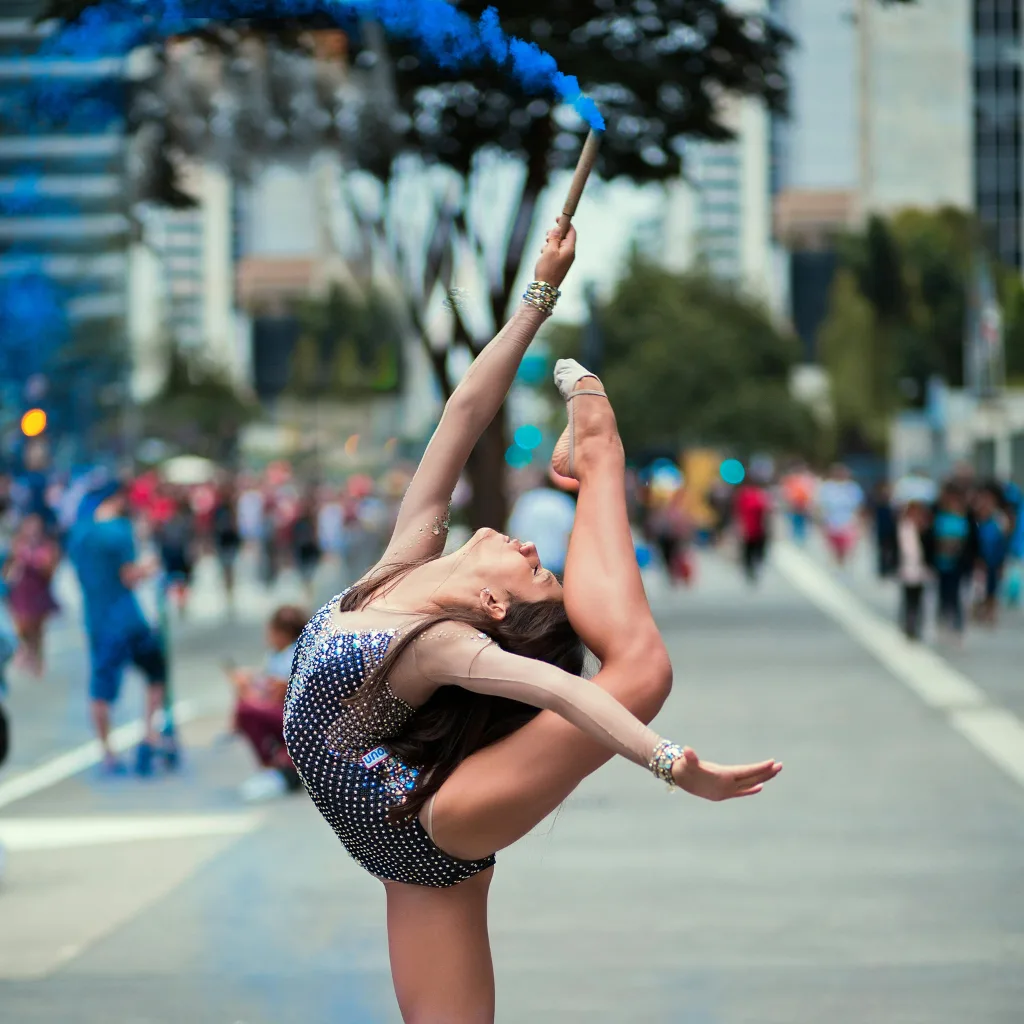
Note: This article focuses on women’s artistic gymnastics (WAG). Rhythmic gymnastics is a separate discipline, and its athletes are often taller.
Tallest Female Olympic Artistic Gymnasts
The heights below use Olympic records and Olympedia measurements where available. Because gymnasts can continue growing and different databases sometimes record measurements from different points in an athlete’s career, the list should be viewed as a best-documented historical comparison rather than an official Olympic height ranking.
| Gymnast | Country at Olympics | Height | Olympic Games |
|---|---|---|---|
| Sandra Ruddick | United States | 176 cm / 5’9″ | 1956 |
| Bénédicte Evrard | Belgium | 176 cm / 5’9″ | 1992 |
| Katarína Šarišská | Czechoslovakia | 174 cm / 5’8½” | 1980 |
| Georgia-Rose Brown | New Zealand | 173 cm / 5’8″ | 2024 |
| Christine Schmitt | East Germany | 172 cm / 5’7¾” | 1972 |
| Diana Varinska | Ukraine | 172 cm / 5’7¾” | 2020 |
| Ute Starke | Germany / East Germany | 171 cm / 5’7¼” | 1960, 1964, 1968 |
| Marie-Sophie Hindermann | Germany | 171 cm / 5’7¼”* | 2008 |
| Jacqueline Brisepierre | France | 170 cm / 5’7″ | 1964, 1968 |
| Suzanne Harmes | Netherlands | 170 cm / 5’7″ | 2004, 2008 |
*Hindermann is frequently listed at 175 cm later in her career, but her Olympic database measurement is 171 cm.
Sandra Ruddick — 5’9″ (176 cm)
Country: United States
Olympics: Melbourne 1956
Sandra Ruddick may be one of the most surprising names on the list.
Olympedia records the American gymnast at 176 cm (5’9″). She represented the United States at the 1956 Melbourne Olympics, competing in the individual all-around, team competition, floor, vault, uneven bars and balance beam.
Ruddick was also the top U.S. woman in the Olympic all-around, finishing 51st. Before Melbourne, she won the all-around at the 1956 AAU meet that doubled as the U.S. Olympic Trials.
Her height is especially interesting because modern fans often associate very tall artistic gymnasts with athletes such as Hindermann and Brown. Ruddick shows that unusually tall Olympic gymnasts existed decades earlier.
Georgia-Rose Brown — 5’8″ (173 cm)
Country: New Zealand
Olympics: Paris 2024
Georgia-Rose Brown is perhaps the best modern example proving that a gymnast does not need to be short to reach the Olympics.
At 173 cm, or about 5’8″, Brown stood far above the usual height of the women’s artistic field at Paris 2024. World Gymnastics explicitly describes her as one of the taller female artistic gymnasts.
Her height is particularly noticeable on uneven bars.
In her FIG profile, Brown says the bars have to be raised 10 cm for her, which FIG’s equipment rules allow when a gymnast’s feet would otherwise touch the mat. She adds that her height lets her do some things shorter gymnasts may not be able to.
She finally made her Olympic debut for New Zealand at age 29 and competed in the all-around qualification in Paris. Brown is therefore one of the strongest examples of a genuinely tall gymnast competing successfully in modern elite artistic gymnastics.
Marie-Sophie Hindermann — About 5’7″ to 5’9″
Country: Germany
Olympics: Beijing 2008
Marie-Sophie Hindermann is probably the gymnast most often mentioned when people ask about the tallest female artistic gymnasts.
But her height illustrates why historical rankings can become confusing.
Olympedia lists Hindermann at 171 cm, while later biographical sources list her at 175 cm (5’9″). Sources discussing her 2008 Olympic appearance commonly describe her as approximately 5’7″ at the time.
Hindermann represented Germany at the Beijing 2008 Olympics and had already established herself internationally, including a fifth-place finish on uneven bars at the 2007 World Championships.
What About Svetlana Khorkina?
No article about tall female gymnasts would feel complete without Svetlana Khorkina.
At 165 cm (5’5″), Khorkina is actually shorter than everyone near the top of this list. But during the 1990s and early 2000s, she was considered unusually tall for women’s artistic gymnastics.
More importantly, she demonstrated just how successful a taller gymnast could become.
Khorkina won seven Olympic medals, including back-to-back uneven bars gold medals in 1996 and 2000. She also became a three-time world all-around champion.
Her proportions influenced her gymnastics so much that she developed skills suited to her body. Eight elements in the Code of Points have carried her name: two on vault, three on bars, two on beam and one on floor. The FIG table of named elements (May 2025 edition) shows that four of them still do: one on vault, one on bars and both beam elements. Her name was removed from the other four at the end of 2005.
And What About Nina Derwael?
Belgium’s Nina Derwael is another modern gymnast frequently described as tall.
There is some variation in her published height. Olympedia lists her Olympic measurement at 165 cm, while later sources commonly give her height as about 170 cm (5’7″).
Whatever measurement is used, her long lines are particularly noticeable on uneven bars.
Derwael became the Tokyo 2020 Olympic uneven bars champion, the first Belgian woman to win an Olympic artistic gymnastics gold medal.
She returned at Paris 2024 and finished fourth in the bars final.
Why Are Most Female Gymnasts Short?
There is a physical reason shorter athletes are common in artistic gymnastics.
A study examining Olympic artistic gymnasts between 1996 and 2016 reported average female heights ranging from 151.76 cm at Atlanta 1996 to 155.39 cm at London 2012. The Rio 2016 group averaged 154.64 cm.
A compact body can offer useful mechanical advantages. The study’s introduction, citing earlier work by Nauright and Parrish (2012), notes that shorter, lighter gymnasts can have favorable strength-to-weight ratios, greater stability and lower moments of inertia, which can help with rapid rotation.
That does not mean a gymnast must be short. Height is only one part of performance. Strength, flexibility, power, coordination, technique, body proportions and the ability to adapt skills to an athlete’s own physique all matter.
Khorkina, Hindermann, Brown and the historical gymnasts above demonstrate that there is more than one body type capable of reaching the Olympic level.