The 2024 U.S. Women’s Olympic Gymnastics Team: Ages and Starting Years
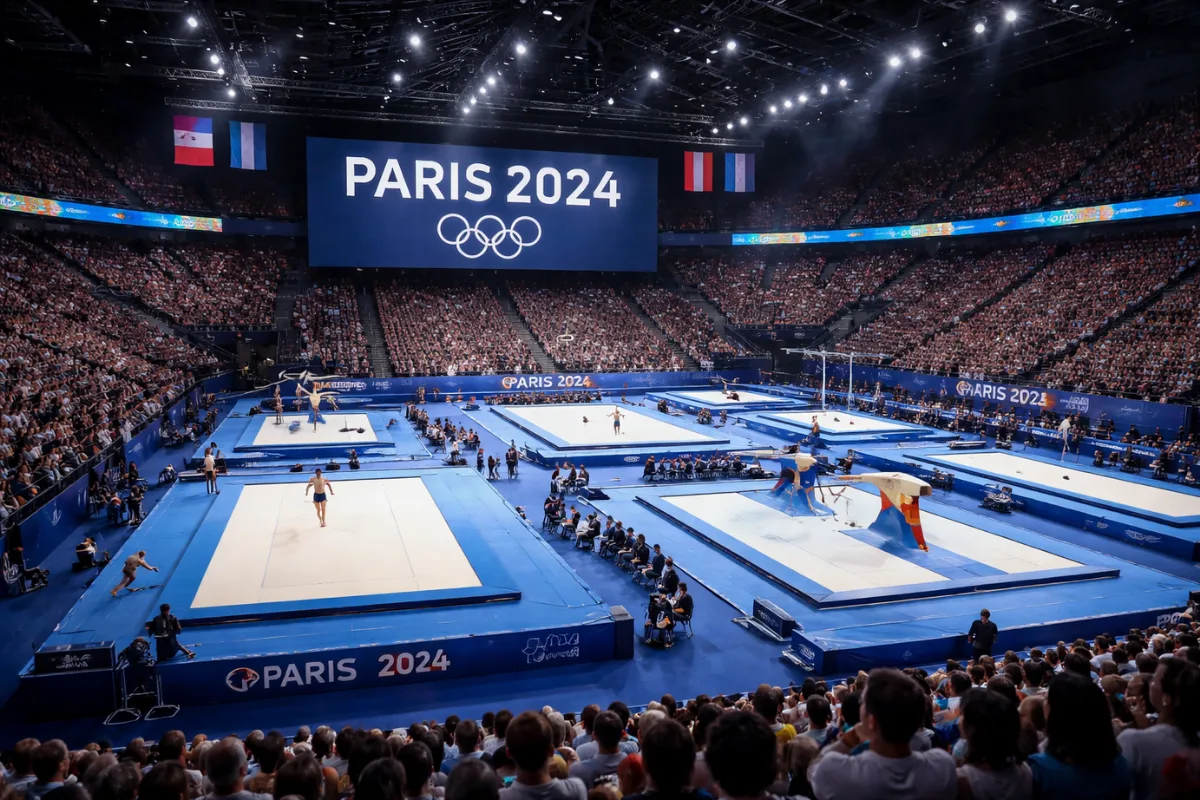
The five women on the 2024 U.S. Olympic artistic gymnastics team ranged from 16 to 27 years old. Simone Biles, Jade Carey, Jordan Chiles and Suni Lee returned after previous Olympic appearances; Hezly Rivera made her Olympic debut.
Contents
- The Paris 2024 roster by age
- When did they begin gymnastics?
- Simone Biles: a field trip and a long international career
- Jade Carey: growing up around a gym
- Jordan Chiles: early enthusiasm and two Olympic teams
- Suni Lee: childhood interest, Olympic success and college competition
- Hezly Rivera: the youngest member of the five
- What the comparison can—and cannot—tell parents
- Starting age is different from Olympic eligibility
This is a historical comparison of the Paris team, using ages on July 30, 2024, the date of the women’s team final. These are not the athletes’ current ages, and the roster should not be treated as a prediction of the next U.S. Olympic team.
The Paris 2024 roster by age
The birth dates below come from the entry list in the official Paris artistic gymnastics results book. Each age is the number of birthdays completed by the team-final date.
| Gymnast | Date of birth | Age on July 30, 2024 |
|---|---|---|
| Simone Biles | March 14, 1997 | 27 |
| Jade Carey | May 27, 2000 | 24 |
| Jordan Chiles | April 15, 2001 | 23 |
| Suni Lee | March 9, 2003 | 21 |
| Hezly Rivera | June 4, 2008 | 16 |
The arithmetic mean of those five completed-year ages is 22.2: add 27, 24, 23, 21 and 16, then divide by five. The median is 23, and the oldest-to-youngest difference is 11 years. This calculation is not an average based on exact ages in days.
When did they begin gymnastics?
USA Gymnastics athlete profiles list the following starting years. A starting year describes an introduction to gymnastics; it does not necessarily identify the beginning of team training, elite preparation or a full competitive schedule.
| Gymnast | Starting year listed by USA Gymnastics | Context |
|---|---|---|
| Simone Biles | 2003 | A daycare field trip introduced her to the gym. |
| Jade Carey | 2002 | Her parents owned a gym. |
| Jordan Chiles | 2007 | Her parents enrolled an energetic child who enjoyed acrobatics. |
| Suni Lee | 2009 | She describes enjoying flips and the activity. |
| Hezly Rivera | 2013 | A gymnastics birthday party prompted her introduction. |
Except where an athlete gives a specific starting age, subtracting birth year from starting year only gives the age reached during that year. It cannot tell us whether the first lesson happened before or after the birthday.
Simone Biles: a field trip and a long international career
Biles’ USA Gymnastics profile describes a visit to Bannon’s during which a coach noticed her imitating gymnasts. The gym sent a letter home encouraging her to join gymnastics or tumbling. That account explains an introduction, rather than a planned Olympic pathway from the outset.
Her results show senior world all-around titles beginning in 2013 and Olympic appearances in Rio, Tokyo and Paris. At 27 in Paris, she was the oldest member of this particular U.S. women’s team. Her career illustrates that an Olympic gymnast can compete well into adulthood; it does not establish a universal peak age.
Jade Carey: growing up around a gym
Carey’s profile lists 2002 as her starting year and explains that her parents owned a gym. That setting helps explain why her introduction came so early. It would be misleading to describe every year since then as equivalent elite-level training.
Her competition record includes the 2016 Junior Olympic National Championships, World vault and floor silver medals in 2017, and the Tokyo Olympic floor title. In Paris, she added team gold and vault bronze. Those milestones distinguish her early exposure to gymnastics from the later stages of a senior international career.
Jordan Chiles: early enthusiasm and two Olympic teams
Chiles’ profile lists 2007 and describes parents enrolling a child who cartwheeled through open spaces and enjoyed walking on her hands. The account is a personal origin story, not evidence that every child displaying similar behavior should enter intensive training.
She was 23 at the Paris team final, following her Tokyo team appearance. Her records also include NCAA competition with UCLA. College and elite gymnastics appear within the same athlete’s career, but their routines, scoring contexts and competition calendars need to be understood separately.
Suni Lee: childhood interest, Olympic success and college competition
Lee’s profile gives 2009 as her starting year and describes enjoying gymnastics and flips. It also records the Tokyo Olympic all-around title and her 2022 NCAA beam championship while competing for Auburn.
At Paris, she was 21 and won team gold plus bronze medals in the all-around and uneven bars. Her example helps separate starting age, age at a first Olympics and age at a later Olympics. Those are three different measurements, even though articles sometimes discuss them as if they answer the same question.
Hezly Rivera: the youngest member of the five
Rivera’s profile explicitly says she attended a gymnastics birthday party at five. It lists 2013 as her starting year and records junior national success before her senior Olympic season.
She turned 16 in June 2024, shortly before the Olympic Trials. Her inclusion alongside four returning Olympians made this a team with a substantial age range. Being the youngest did not mean that she followed a separate Olympic age rule, and being a first-year senior did not guarantee selection.
What the comparison can—and cannot—tell parents
These five biographies show that early introductions can lead into very different careers. They do not provide a controlled comparison of starting ages, coaching methods or training hours. Selecting only athletes who reached the Olympics also leaves out the much larger population who began gymnastics without taking that route.
A parent cannot use this table to calculate a child’s chance of selection or decide that a particular birthday is a deadline for beginning. Nor does the team’s average age tell a coach when an individual athlete should increase difficulty or training time.
For everyday decisions, focus on the actual class, the child’s interest and the coach’s assessment. Ask what the next step involves and why it suits the gymnast, rather than trying to reproduce an Olympian’s childhood timeline.
Starting age is different from Olympic eligibility
The 2024 U.S. women’s selection procedures required athletes to turn at least 16 during 2024. They also specified qualification, selection and membership requirements. Beginning young was not itself an entry requirement, and reaching the minimum age did not secure a place.
Our Olympic age guide explains the calendar-year rule. The elite qualification guide addresses the separate competitive pathway. Read the Paris ages as a dated portrait of five athletes, with distinct histories, rather than a timetable every gymnast must follow.