Why Coaches Change Uneven-Bar Settings Between Gymnasts
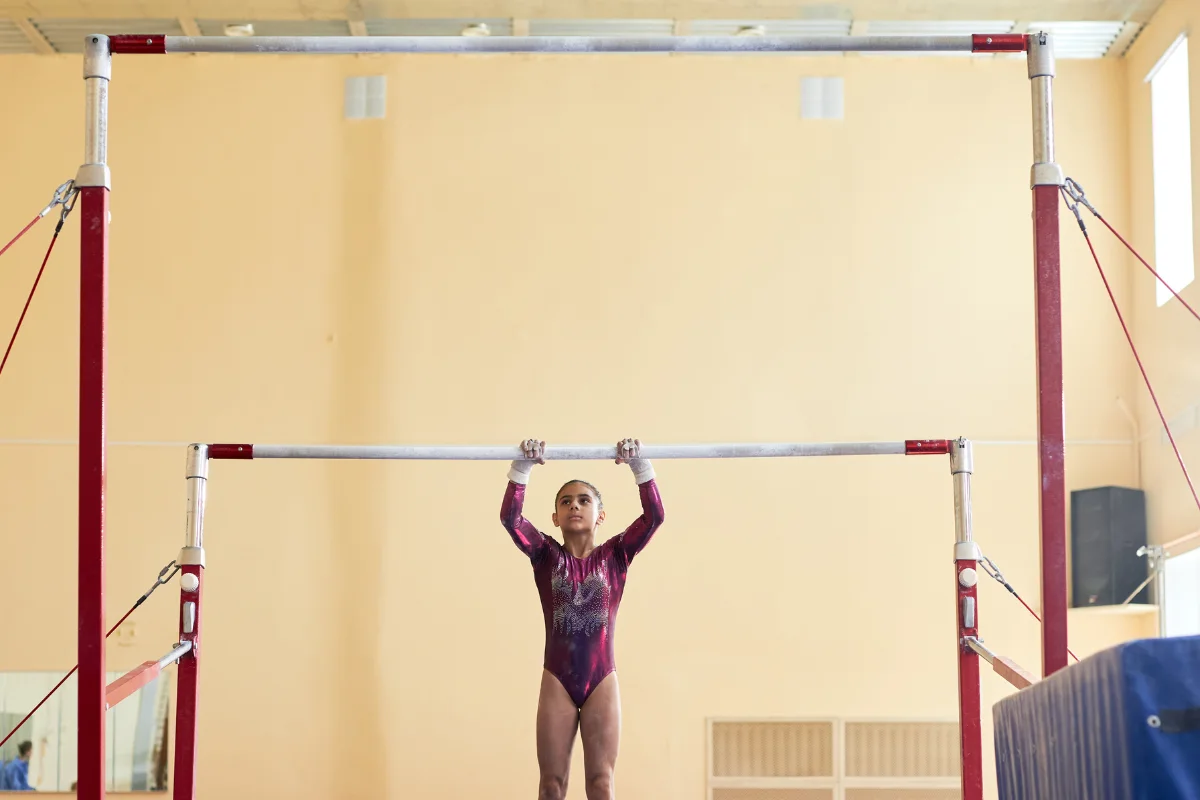
Coaches adjust uneven bars to establish a permitted setup for the gymnast and routine. Rail spacing affects the relationship between the low and high bars; height affects clearance from the mat. The changes must stay within the competition rules and the equipment manufacturer’s limits.
Contents
That is why a meet may pause while staff reset the apparatus between athletes. It does not mean every gymnast can choose any arrangement, or that the correct setting can be calculated from body height alone. Understanding the different adjustments helps parents and spectators make sense of the process without treating it as a do-it-yourself setup guide.
Height and spacing are different measurements
Uneven bars has two rails, one low and one high. Raising the apparatus changes its height relative to the floor. Changing the spread changes the relationship between the rails. These actions are related in the physical equipment, but they answer different questions.
A gymnast whose feet contact the mat during a swing has a clearance issue. A gymnast preparing a transition between rails needs an appropriate relationship between the takeoff rail and the catch rail. Moving the rails farther apart is not automatically the answer to both situations.
It also matters how spacing is measured. The FIG specification uses an inner-diagonal distance between the rails. That is not the same as laying a tape horizontally across the floor below them. Two numbers labeled simply “bar width” may describe different measurements.
Our uneven-bars and high-bar comparison explains the apparatus differences more broadly. Here, the focus is why one uneven-bar setup changes from gymnast to gymnast.
What the current FIG specifications say
| Reference measurement | 2026 FIG specification |
|---|---|
| Top of high rail above floor | 255 cm at the specified 181 cm inner-diagonal position |
| Top of low rail above floor | 175 cm at that position |
| Inner-diagonal spread at standard heights | Adjustable from 130 to 181 cm |
| Specified height-increase options | 5 cm or 10 cm, subject to the conditions and procedure |
The 2026 FIG Apparatus Norms give tolerances and further details, including the spread limits associated with increased heights. Height increases are provided for gymnasts whose feet touch the mat during exercise, with timely notification under the Code. Organizers or suppliers must provide trained staff for the adjustment.
These are equipment specifications, not instructions for a family to change a club’s bars. The reference height is measured from the floor. Adding the thickness of mats, or using a different point on the rail, changes the measurement you are describing.
A useful question when reading an equipment guide is therefore: “Measured from where, to where, and under which rules?” That resolves many apparent disagreements between a photograph, a product description and an official specification.
Why USAG developmental setups may differ
Do not assume every domestic competition must use the elite FIG settings without modification. The 2026–2027 USA Gymnastics women’s Rules and Policies permit bar-height adjustments outside FIG specifications when they meet the manufacturer’s safety parameters and locking requirements. They also allow the spread to suit the athlete within the manufacturer’s allowances.
That creates an important distinction: a setting different from an international reference figure is not automatically an error at a developmental meet. The relevant program’s rules may specifically allow it. Conversely, a domestic allowance does not establish permission to use the same setting in a FIG competition.
The gymnast’s level, the competition organization and the equipment all belong in the discussion. Parents should ask the coach about the actual meet rather than using one number found online as a universal standard.
Why a manufacturer’s adjustment range can be wider
A product may be capable of more settings than one competition format permits. It may serve training and different programs as well as elite meets. The physical adjustment range tells you what the model can do; the meet rules tell you which of those settings are allowed in that setting.
For example, SPIETH’s Munich uneven bars lists low-rail adjustment from 150 to 200 cm, high-rail adjustment from 230 to 280 cm and a rail-distance range up to 195 cm. Those product figures do not replace FIG’s competition specifications.
The same product description says tension must be adapted when its height is changed. That is a reminder that the rails, uprights and cable system work together. Moving one component and ignoring the rest is not a complete adjustment.
Equipment staff need the instructions for the specific model. Similar-looking apparatus can use different mechanisms or scales, so a remembered setting from one gym is not necessarily a complete description of the setup at another.
What coaches consider beyond the gymnast’s height
Body height is relevant to clearance, but the routine also matters. A gymnast must be able to perform the trained swings and transitions within a permitted setup. Reach, body positions and the path between the rails are part of that practical assessment.
Imagine two gymnasts of similar height whose routines use different transitions. It would be a mistake to conclude that they must prefer identical settings simply because they stand equally tall. Their coaches are preparing different sequences, and the athlete’s trained familiarity matters as well.
That does not mean a wider spread creates a better routine. A setting is not a difficulty score, and copying an elite athlete’s numbers does not create the technique needed for that athlete’s skills. The setup supports the routine; it does not teach it.
Likewise, repeated contact with the apparatus or a new concern during training should be assessed by the coach. It should not become a family experiment in changing rail spacing until a movement appears to work.
Why settings are recorded before a meet
Preparation is easier when the coach knows the gymnast’s established setup and the competition’s equipment arrangements. Recording the relevant settings helps communicate what needs to be checked, while the meet’s procedures determine how changes are requested and made.
The process involves more than a number shouted across the floor. Staff may need to confirm the model, adjust the apparatus, secure the mechanism and check the complete station before the athlete uses it. A brief pause can be part of careful preparation, not wasted competition time.
Surface preparation is another separate task. Water and chalk address the gripping surface; they do not change clearance or spread. The uneven-bar preparation guide explains that distinction.
For parents, the best role is to understand the purpose and leave equipment changes to authorized staff. Ask whether the adjustment concerns height, spread or another part of the setup. That single question often makes what you are seeing much clearer.