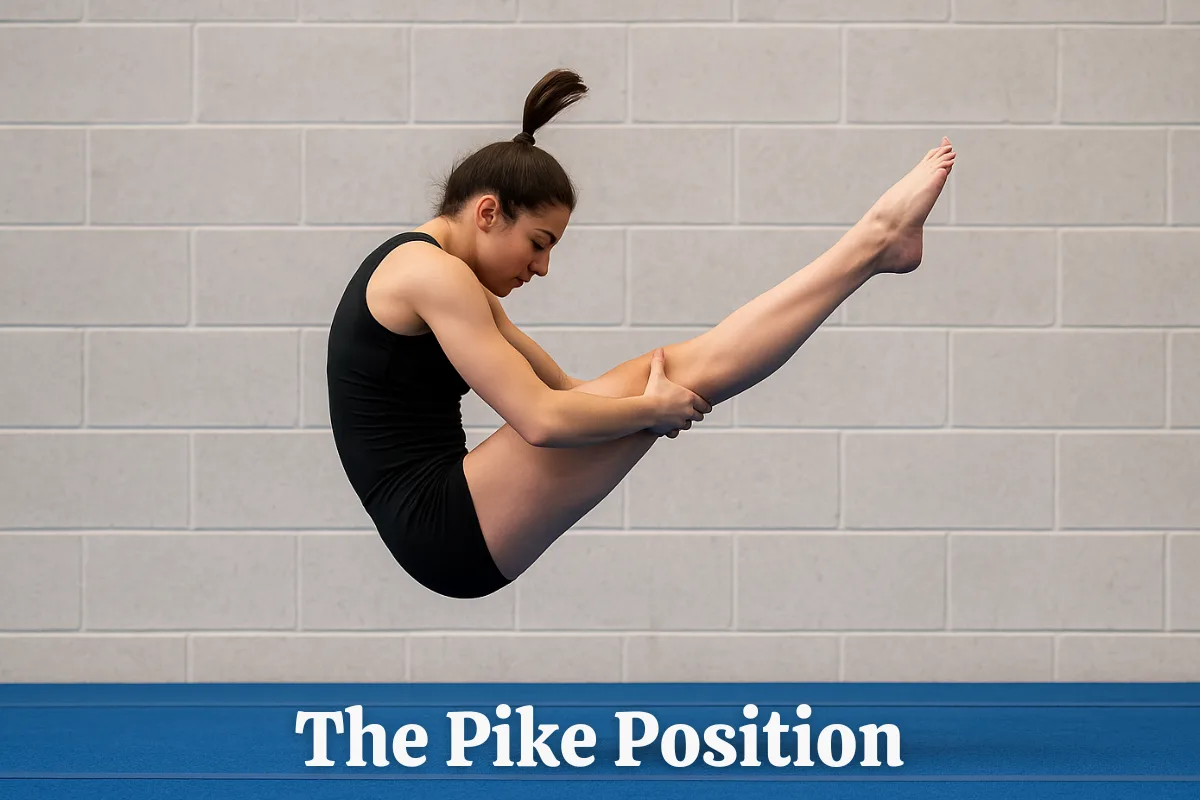
A pike combines straight knees with a bend at the hips. The legs fold toward the torso without becoming the bent-legged shape of a tuck. That distinction stays useful whether the gymnast is sitting on the floor, jumping or performing a somersault.
The word describes a body position. It does not tell the whole story of the skill, the gymnast’s flexibility or how much the element is worth.
What makes the shape a pike?
Look for the fold where the thighs meet the torso and then follow the line of the legs. In a clear pike, the knees remain extended. If the knees bend substantially toward the chest, the shape begins to resemble a tuck.
The arms can be in different places depending on the movement. Reaching toward the toes is common in a seated stretch, but touching the toes is not the definition of a piked salto. A gymnast does not have to reproduce a seated stretching pose in every airborne pike skill.
Competition standards are more specific than a spectator’s quick description. For example, Section 8 of the FIG women’s Code of Points addresses body position and element recognition separately. One hip-angle rule should not be applied indiscriminately to every exercise called a pike.
View the shape in relation to the gymnast’s body rather than the room. A piked gymnast can be upright, inverted or nearly horizontal during a skill. The hips are still the place to look for the fold. “The feet are high” is not enough: their height also changes as the whole athlete moves and rotates.
Imagine two side-view silhouettes with straight knees. In one, the thighs and torso make a marked angle; in the other, they continue in a long line. The first shows the defining hip fold of a pike. This comparison explains why straight legs can appear in both a pike and a layout without making the two shapes identical.
Pike and straddle describe different things
Pike describes the bend at the hips with straight legs. Straddle describes the legs opening sideways. They are not competing names for the same feature: a gymnast can show a straddled pike.
In an ordinary legs-together pike, the legs stay beside each other. In a straddle pike, they separate while the hips are still folded. A full split is not required merely for a position to be described as straddled.
This distinction helps when watching bars or dance elements. First notice whether the hips fold; then notice whether the legs remain together or open sideways. The broader comparison of tuck, pike and layout puts those observations alongside the other main shapes.
Keep those observations separate in a description. “Straight legs, folded hips, legs together” supplies different information from “straight legs, folded hips, legs apart.” An athlete can change leg separation without completely changing the amount of hip fold. Conversely, closing the legs does not necessarily open the hips.
This is useful when a photograph is partly obstructed. If one leg hides the other, the picture may show the hip fold clearly but leave leg separation uncertain. Describe what is visible rather than treating the hidden leg as proof of either a straddle or a legs-together position.
The same shape can serve different tasks
| Where the pike appears | What the viewer is seeing |
|---|---|
| Seated pike | A stationary legs-together position with extended knees |
| Pike jump | The shape shown during a jump, without a somersault being implied |
| Piked salto | A somersault identified by its piked body position |
| Straddle pike | A hip fold combined with sideways leg separation |
These examples are not a training ladder. A comfortable seated position does not demonstrate readiness for a piked salto. Flexibility, active control and the technique of an acrobatic skill are related but different abilities.
Recognizing a pike is different from measuring flexibility
A seated position lets a viewer notice the shape while the athlete is supported by the floor. An airborne pike must be formed and controlled during another movement. The shared geometry does not make a seated reach a complete test of the airborne skill.
For example, a gymnast might comfortably reach toward the feet while sitting yet find it difficult to show a clear pike in a jump. The observation does not identify the cause. Timing, understanding the exercise and controlling the moving body are different questions from how far the athlete can reach in a stationary position.
A coach can make feedback more specific by naming the feature being discussed: the hip fold, knee extension, leg separation or the moment the shape appears. “The pike is wrong” leaves all of those possibilities unresolved. The more precise description helps the gymnast understand which part of the exercise is being addressed.
A viewer should also allow for the transition into and out of the position. A gymnast performing a piked salto does not remain folded after landing. Seeing the hips open during preparation for landing does not, by itself, show that the entire element was intended as a layout.
Does a pike automatically score better?
No. A difficulty value belongs to a particular element in a particular rulebook. Adding the word “pike” does not create a universal bonus, and a straighter-looking leg line does not erase other execution errors.
It is also misleading to call pike the required middle step between tuck and layout for every gymnast. Coaches choose progressions for the actual skill. The guide to stretched body positions explains what changes visually when the hips open.
There are concrete examples of shared values. In the 2025–2028 FIG women’s floor table, the untwisted double back in tuck and in pike appears in the same D-valued entry, 5.402. The shape difference remains visible even though this particular difficulty value is the same. That is why “pike always adds a difficulty step” is an unreliable shortcut.
Keep recognition and execution separate here as well. A gymnast may show an identifiable pike while making another error. A score reflects more than whether the hips and knees match the basic shape description. The word pike explains one feature of the element, not the quality of the whole performance.
For ordinary viewing, use a complete phrase such as “a forward piked salto” or “a straddle-pike jump.” The extra words identify the action and prevent a broad position label from being mistaken for the name of one specific gymnastics skill.
In Summary
A pike is easiest to recognize by its straight knees and folded hips. Separating that description from leg separation, flexibility and skill difficulty makes gymnastics names much easier to read.