Reading Difficult Men’s Floor Skills: Five Examples Beyond the Twist Count
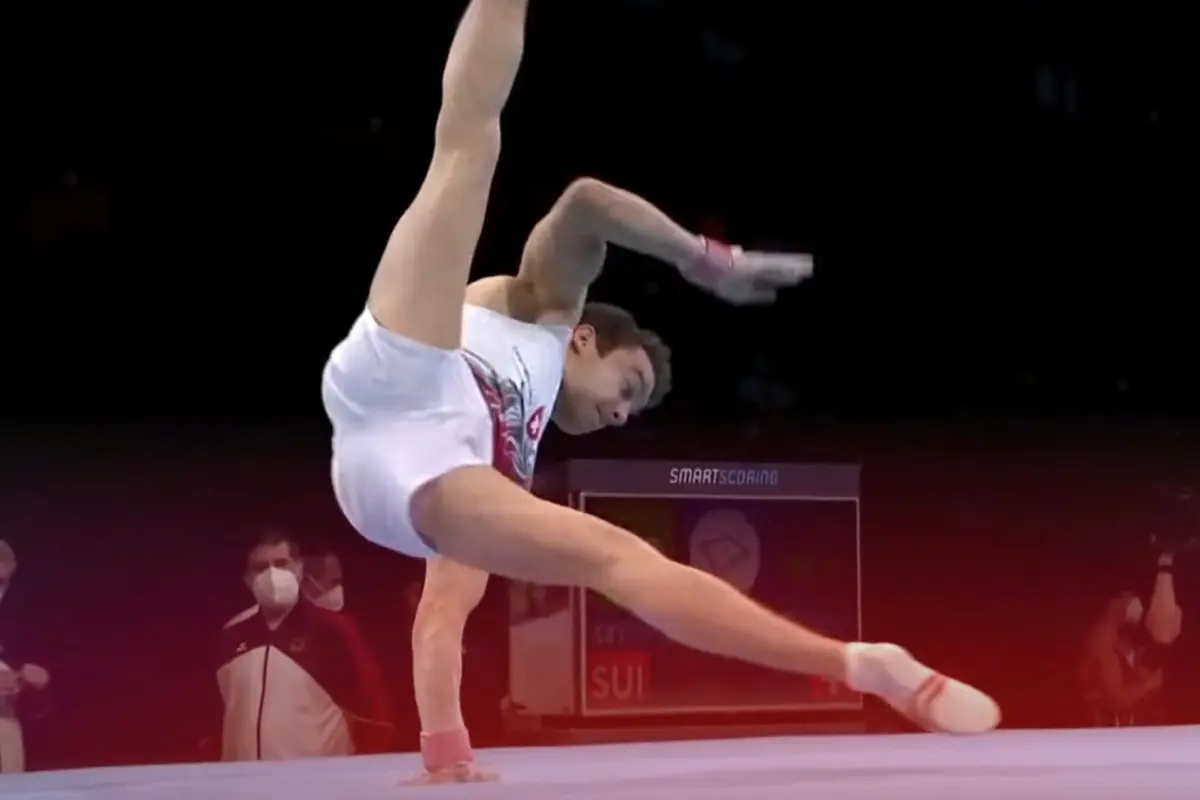
Some men’s floor skills combine several somersaults, several twists or a demanding body position. These five examples help a viewer recognize the differences. They are not a definitive ranking of the five hardest skills or a claim about how often each is competed.
Contents
The values below use the 2025–2028 FIG men’s Code of Points. A letter identifies the element’s difficulty value; it is not the final score for the pass or routine.
Five examples in the current Code
| Element | Movement to recognize | Difficulty value |
|---|---|---|
| Zapata 2 | Double forward salto piked or straight with 1½ twists | G: 0.7 |
| Double backward stretched salto with 2½ twists | Two backward somersaults in a stretched position, with two and a half twists | H: 0.8 |
| Liukin | Triple backward salto tucked | I: 0.9 |
| Shirai 3 | Double backward stretched salto with three twists | I: 0.9 |
| Nagornyy | Triple backward salto piked | J: 1.0 |
The precise version matters. The Zapata 2 is not the same element as the tucked Zapata, and a piked triple backward salto is not identified as the tucked Liukin. A familiar surname without its variant can therefore be ambiguous.
What makes each example useful to recognize?
Zapata 2: use this as the forward-tumbling example. Notice the direction of the somersaults as well as the twist count; do not identify every multi-rotation pass by how the gymnast faces at the landing. The current entry includes piked or straight versions. Its description therefore needs more information than the phrase “a twisting double.”
Double backward stretched with two and a half twists: this is a useful contrast with the Shirai 3. Both descriptions begin with two backward somersaults in a stretched position. The difference in this pair is the amount of twist. Separating those features makes a long skill name much easier to read.
Liukin: here the distinguishing feature is a third backward somersault in a tucked position. Three somersaults do not imply three twists. On a replay, follow the head-over-heels rotation first. If you are also trying to count twisting at the same time, it is easy to combine two different observations into an incorrect total.
Shirai 3: the floor element combines two backward somersaults with three twists in a stretched position. “Triple-double” is shorthand that can confuse a newcomer: in this context, the triple refers to twisting and the double to somersaulting. Attach the body position and apparatus to the name when making a viewing note.
Nagornyy: compare this directly with the Liukin. Both have three backward somersaults, but the Nagornyy uses a piked body position. This pair shows why counting rotations alone is insufficient. A straight-leg fold at the hips and a tuck with bent knees are different elements, even before considering execution.
Count somersaults and twists separately
A somersault turns the body head over heels. A twist turns around the body’s long axis. A double salto with three twists has two somersaults, not five flips.
At full speed, it can help to watch a replay and first identify the body position, then the direction and number of somersaults. The flip-versus-twist guide explains the two rotations in more detail.
Tucked, piked and stretched are different shapes
A tucked salto bends at both the hips and knees. A piked salto bends at the hips with straight legs. A stretched salto uses an extended body position. These distinctions affect element identification as well as what the viewer sees.
The body-shape guide gives a broader introduction. Naming the intended skill is only the start: judges assess what was actually performed and apply the Code’s recognition rules.
For a replay exercise, write a four-part description: direction, somersault count, twist count and shape. Leave an uncertain part blank. It is better to record “two backward somersaults, stretched, twist count unclear” than confidently attach the wrong name because the clip is fast or the camera cuts away.
Remember that a pass can contain more than one element. The run-up and connected preparation do not turn every rotation you see in the whole sequence into part of the named airborne skill. Identify the particular element the commentator is discussing before trying to count it.
A high difficulty value does not guarantee a high score
The gymnast must also complete the routine’s other content and perform it well. Execution deductions and separate penalties can reduce the final result. The table should not be read as points awarded regardless of performance.
Likewise, a spectacular pass does not tell a spectator the entire routine’s D-Score. The FIG scoring guide explains how difficulty and execution fit together.
Why old clips can show different difficulty letters
The FIG men’s technical newsletter from August 2021 records the naming of the Nagornyy after the 2021 European Championships and the Zapata 2 after the Doha World Cup. It assigned both elements I value at that time. The present table uses the later 2025–2028 Code, where the corresponding entries have different values.
This is a useful distinction between historical reporting and a current scoring reference. An older article can accurately describe the value awarded when a skill was introduced while no longer supplying the value for today’s code cycle. Check the date and the precise element description before treating two letters as a contradiction.
Difficulty letters also belong to the relevant apparatus and program. Do not transfer a men’s floor value to a similar-looking women’s skill or to a dismount elsewhere. The body may make a familiar shape, but the Code entry and the competitive context determine the value.
Use these as viewing examples
These are advanced competition elements, not a training progression for beginners. Their value here is helping a new fan recognize why two fast tumbling passes can be different skills, even when they appear similar at first glance.
For a more rewarding comparison, choose two clips showing the same intended element. Observe the body position and landing without trying to award a score yourself. Then compare two different elements from the table. The first exercise helps you notice differences in performance; the second helps you notice differences in the task.
A list of difficult skills is most useful when it improves that distinction. These five examples span direction, shape, somersault count and twisting. They offer a vocabulary for watching elite floor exercise, while the complete routine and the judges’ credited content remain necessary to understand the result.