FIG Gymnastics Scoring Explained: D-Score, E-Score & Deductions
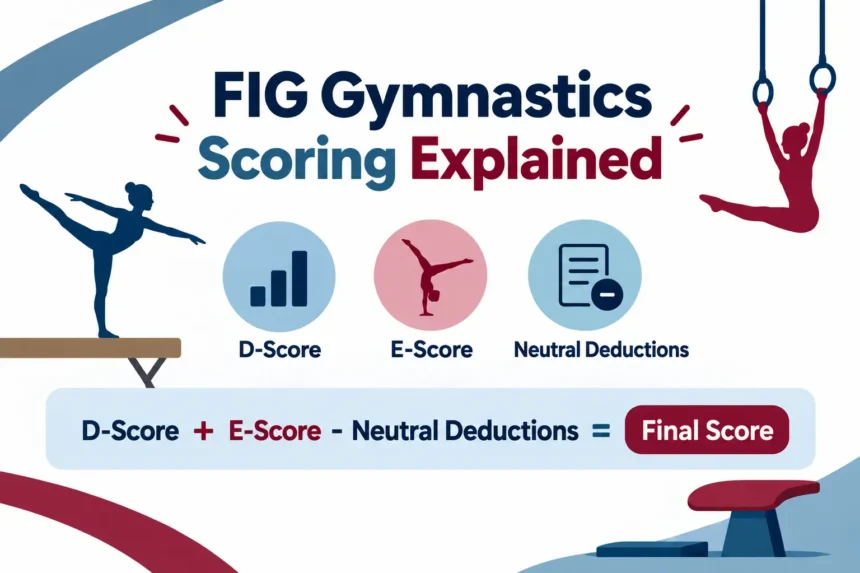
A gymnast performs a difficult routine and scores 14.200. Another gymnast performs something that looks simpler and earns 14.400. Why does the easier routine score higher?
Contents
In elite gymnastics, judges look at two things separately: how difficult the routine is and how well the gymnast performs it. A harder routine earns more difficulty points, but mistakes can take away that advantage.
These two parts are called the D-Score and E-Score. Together with any separate bonuses and penalties, they produce the final score. The explanation below follows the 2025–2028 FIG Code of Points for senior women’s and men’s artistic gymnastics—the rules used at the Olympics and other major international competitions.
How Does FIG Gymnastics Scoring Work?
The difficulty part of the score is built by adding points. The execution part starts from 10.0, and judges take points off for mistakes. Separate penalties may also apply, such as going outside the floor boundary.
The final calculation is:
D-Score + E-Score + any separate bonus − Neutral Deductions = Final Score
If a separate bonus is awarded, include it once in the final calculation. Men’s results can show an eligible stick bonus in its own SB column; that bonus is added to D + E, then any separate penalties are subtracted.
Women’s qualifying two-vault bonus is added to the vault average. These are different from bonuses already included within the D-Score. See the official men’s results format and women’s vault guidance.
“Neutral deductions” is the term for those separate penalties. Here is a hypothetical example with no separate bonus:
| Part of the score | What it tells the viewer | Example |
|---|---|---|
| D-Score | The difficulty judges awarded for the routine | 5.800 |
| E-Score | How well the routine was performed | 8.300 |
| Neutral deduction | A separate penalty for a rule violation | −0.100 |
| Final score | The result after adding difficulty and execution, then subtracting the penalty | 14.000 |
Try these numbers in the gymnastics score calculator. Choose FIG / international, then use “Try an example” to load 5.800 difficulty, 8.300 execution and a 0.100 separate penalty.
Only the execution part starts from 10.0. The difficulty points are added separately, which is why final scores such as 14.000 or 15.000 are possible. This is the basic structure set out in the FIG Women’s Code of Points.
Who Decides the Scores?
Different groups of judges have different jobs.
The difficulty judges, called the D-Jury, identify the skills and decide what difficulty points the gymnast has earned. The execution judges, called the E-Jury, look for mistakes in technique, body position and control. They also assess artistry where the rules require it.
Each execution judge records deductions independently. Their marks are then combined under the judging rules to produce one E-Score. They are not all added together.
Other officials may check whether the gymnast steps outside a boundary or goes over a time limit.
What Goes Into the D-Score?
The D-Score, or Difficulty Score, reflects what the gymnast successfully performs and receives credit for. Judges score the routine they see, rather than the routine the gymnast planned to do.
For example, a gymnast may intend to connect two skills but pause between them. The skills might still count individually, while the planned connection earns no extra points.
Apart from vault, the D-Score can include the values of individual skills, credit for required movements, connections and bonuses allowed on that event.
Individual Skills and Connections
Each recognized skill has a difficulty rating. An A-rated skill is worth 0.10, a B is worth 0.20, a C is worth 0.30, and the values continue upward.
A routine includes more than a collection of difficult skills, though. Judges also check whether it contains the types of movements required for that event.
Some combinations earn extra points when the gymnast moves from one skill into the next in the required way. This extra credit is called Connection Value. Performing the skills separately may earn their individual values without earning the connection points.
Other bonuses are available under specific event rules. Some are included within difficulty, while others are added separately to the final calculation. They are awarded only when their conditions are met.
How Women’s and Men’s Difficulty Differ
Women’s artistic gymnastics is often shortened to WAG, while men’s artistic gymnastics is called MAG. Both use a D-Score, but they build it in slightly different ways.
On uneven bars, beam and floor, women must include certain types of movements. These are called Composition Requirements.
For example, women’s floor routines need both forward and backward flips without hand support, performed within qualifying tumbling sequences. The technical name for a flip without hand support is a salto.
Men must show skills from specified groups of movements. These categories are called Element Groups. How much group credit a gymnast earns depends on the event and its rules, including the difficulty of the skill where required.
| Part of difficulty | Women’s gymnastics | Men’s gymnastics |
|---|---|---|
| Number of individual skills counted | Up to 8 on uneven bars, beam and floor | 8 on events other than vault, including the final skill (dismount) |
| Required types of movements | Composition Requirements | Element Group requirements |
| Events with connection credit | Uneven bars, beam and floor | Floor and horizontal bar |
| Vault difficulty | A listed value for the vault performed | A listed value for the vault performed |
Judges do not simply add up every skill in a routine. They select the counting skills using the event’s rules.
Restrictions on skill types and repetition still apply, so adding more movements does not always raise the D-Score. The FIG Men’s Code explains the men’s selection rules.
For a closer look at the numbers, see how FIG difficulty is calculated.
Why Vault Works Differently
On vault, the difficulty value belongs to the whole vault. Judges do not build it by adding together eight separate skills.
The gymnast then receives an E-Score for how well the vault was performed. Penalties can also apply. In men’s gymnastics, a vault that meets the rules for a controlled landing without a step or hop can earn a landing bonus.
One vault provides the score used for team and all-around competition. Gymnasts trying to qualify for the vault final perform two vaults, and the final also requires two. Those vaults must meet specific requirements, and their scores are averaged under the event rules.
What Does the E-Score Measure?
The E-Score, or Execution Score, measures how well the gymnast performs the routine.
It starts from 10.0. Judges then take points off for mistakes. For example, if the deductions used to calculate the E-Score total 1.70, the result is:
10.00 − 1.70 = 8.30 E-Score
Some mistakes are easy to see, such as a wobble on beam, bent knees or a step on landing. Others are less obvious, such as a handstand that does not reach the required position, a turn that finishes short or a skill that lacks height.
How Much Do Mistakes Cost?
The general FIG deduction scale is:
| Size of mistake | Typical deduction |
|---|---|
| Small error | 0.10 |
| Medium error | 0.30 |
| Large error | 0.50 |
| Fall | 1.00 |
The exact deduction depends on the mistake. Some errors have a fixed deduction, while others have a range based on how large the error is.
A gymnast can finish without falling and still lose a substantial amount from the E-Score. Bent knees on several skills, small balance adjustments and landing steps all add up.
On women’s beam and floor, judges also assess how the routine is presented and put together. Artistry and composition deductions can cover posture, rhythm and how smoothly movements fit together.
On floor, judges also look at how the movements relate to the music. The FIG WAG Help Desk illustrates these judging points.
Can a Fall Lower Both Scores?
Yes. A fall receives a 1.00 execution deduction, and the same incident may also cost difficulty points.
For example, a fall might prevent a planned connection from being completed. A skill might also receive a lower value, or no value, if the gymnast does not perform enough of it to meet the rules.
However, falling does not automatically remove the skill’s difficulty value. Judges separately decide whether the skill deserves credit and what execution deductions apply.
For examples of mistakes on each event, see the FIG E-Score breakdown.
What Are Neutral Deductions?
Not every penalty comes out of the E-Score. Some rule violations are deducted separately after difficulty and execution have been added together. These are called neutral deductions.
Common examples include going outside the floor boundary or exceeding a routine’s time limit. Other penalties can apply for breaking competition procedures or performing too few skills.
A gymnast can also lose points in more than one way during the same mistake:
| What happens | Where points may be lost |
|---|---|
| A planned skill or connection does not receive credit | D-Score |
| The gymnast bends the knees or takes a landing step | E-Score |
| The gymnast steps outside the floor boundary | A separate penalty from the combined score |
For example, a large step that carries a gymnast outside the floor area can receive an execution deduction for the step and a separate boundary penalty.
The detailed values are explained in out-of-bounds and other neutral deductions.
How to Compare Two FIG Scores
Looking at the D-Score and E-Score together helps explain why one routine beats another.
Consider these two examples on the same event, with no separate bonuses or neutral penalties:
| Gymnast | D-Score | E-Score | Final score |
|---|---|---|---|
| Gymnast A | 6.400 | 7.800 | 14.200 |
| Gymnast B | 5.900 | 8.500 | 14.400 |
Gymnast A earns 0.50 more for difficulty. Gymnast B earns 0.70 more for execution, enough to finish 0.20 ahead.
The harder routine offers a scoring advantage, but that advantage can disappear if it comes with too many mistakes. Coaches therefore consider what a gymnast can perform consistently, as well as how difficult the routine could be.
What Counts as a Good Score?
A good score depends on the event and the level of competition. The same number does not carry exactly the same weight on vault, beam, rings or another event because their difficulty and execution rules differ.
The fairest comparison is between routines on the same event, at the same competition level, under the same rules. The separate D-Score and E-Score then show whether the result came mainly from difficulty, clean execution or a balance of both.
Why Scores From Different Years Can Be Misleading
FIG updates its rulebook in cycles. Skill values, connections and bonuses can change, so an older score may have been calculated differently.
For 2025–2028, senior men’s routines on events other than vault moved from ten counting skills to eight. Women continued to count up to eight on uneven bars, beam and floor.
A lower difficulty score under a new rulebook does not automatically show that a gymnast has become less skilled. The calculation itself may have changed. FIG publishes its current Codes and updates on the official rules page.
Frequently Asked Questions
Is there a maximum FIG gymnastics score?
There is no fixed maximum final score that applies to every routine. The E-Score can reach 10.0, and difficulty is added separately. However, limits on counting skills and bonuses prevent gymnasts from increasing their scores simply by making routines longer.
Do the Olympics use FIG scoring?
Yes. Olympic artistic gymnastics uses the FIG rules for difficulty, execution and penalties. The D-Score and E-Score work in the same basic way as at other major international competitions.
Why do gymnastics scores have three decimal places?
Judges’ marks are combined, and averaging can produce numbers between whole tenths. That is why a scoreboard may show a score such as 14.233. It does not mean a judge deducted 0.001 for a tiny mistake.
Does NCAA gymnastics use the same system?
NCAA women’s gymnastics uses a different system built around a maximum starting score of 10.0, called the Start Value. NCAA men’s gymnastics follows the men’s FIG system with college-specific changes. The NCAA rules page lists both sets of modifications.
How is an all-around score calculated?
The gymnast’s final scores from every event are added together: four events for women and six for men. Team scoring uses the lineup and counting rules of the particular competition.
Final Takeaway
FIG scoring separates what a gymnast performs from how well it is performed. Difficulty points build the D-Score, mistakes lower the E-Score, and separate penalties may reduce the final total.
The strongest result comes from combining enough difficulty with a clean, controlled performance. Watching both parts of the score makes the result much easier to understand.
For more scoring topics, from Start Values to score reviews, browse the Scoring Map.