Gymnastics Hair Accessories: What’s Allowed at Meets and How to Wear Them Safely
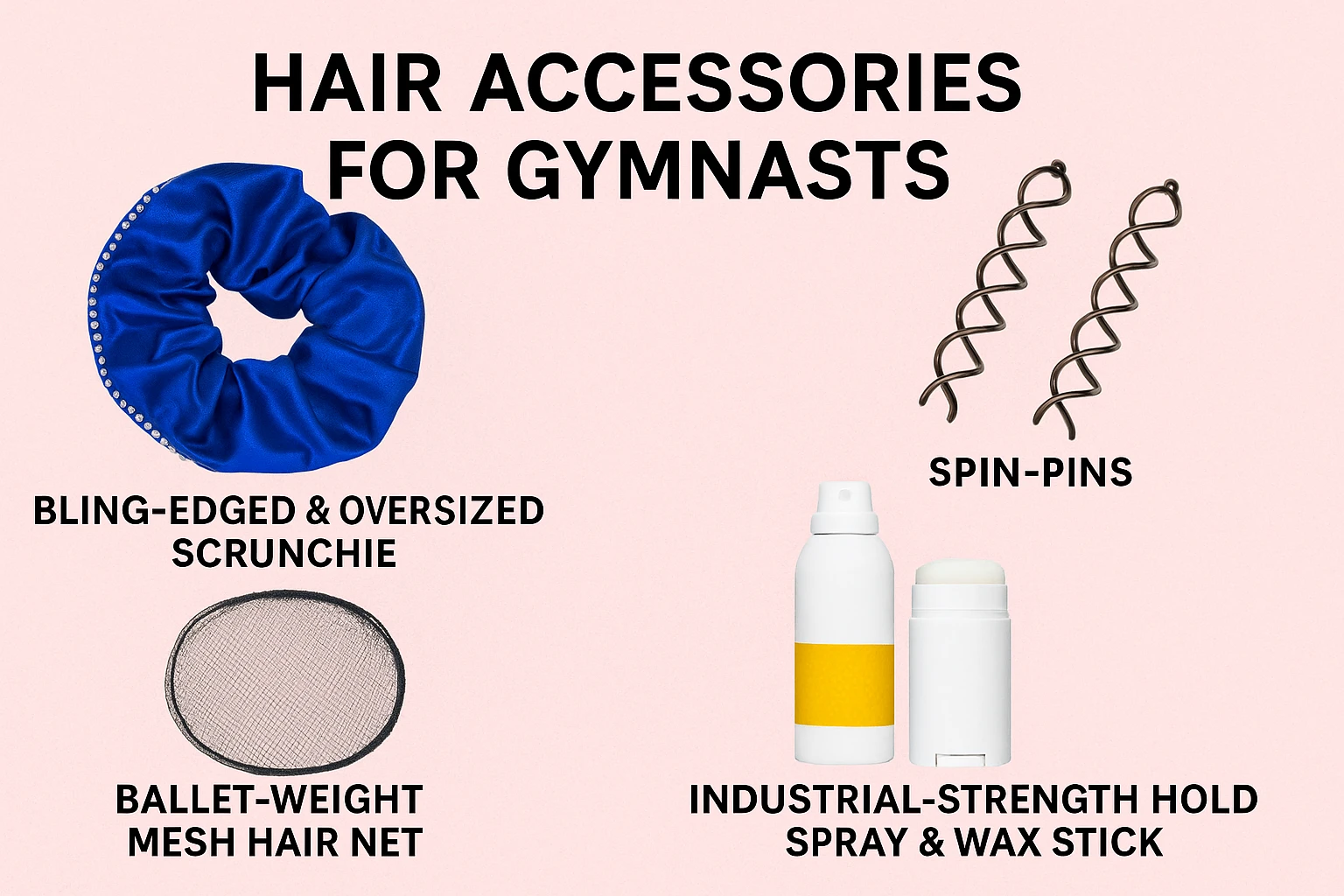
Bows, scrunchies, hair nets and sparkly clips are part of meet day for a lot of gymnasts. Parents often wonder whether they’re actually allowed, and whether a bow that falls off costs points.
Contents
The short answer: none of the main women’s rulebooks bans plain hair ties, scrunchies, bows or hair nets, and none lists a deduction for wearing one. The rules that matter are about keeping hair out of the gymnast’s eyes, about jewelry and, in some programs, about head coverings. Decorative pieces that look like jewelry are where problems can start.
This guide covers women’s competition in elite gymnastics (FIG), USA Gymnastics’ Development Program and Xcel, and NCAA college gymnastics. For the hair itself, see our guide to how hair must be worn at meets in each program.
Hair Accessories at a Glance
| Accessory | What the rulebooks say | What to check before a meet |
|---|---|---|
| Hair ties and elastics | Not mentioned | Soft, snag-free ties without metal joins; never tight enough to hurt |
| Scrunchies | Not mentioned | Worn over a secure base tie, not instead of one |
| Bows and ribbons | Not mentioned | Fixed firmly, with tails short enough not to swing into the face |
| Hair nets | Not mentioned | Covers the whole bun; a colour close to the hair |
| Bobby pins, U-pins and spiral pins | Not mentioned | As few as needed, with none digging into the scalp |
| Clips, barrettes and headbands | Not mentioned | Small and flat; ask the coach about large or rigid pieces |
| Rhinestone, crystal or metal hair pieces | Not defined, but every program limits jewelry | Ask the coach first; if in doubt, leave it out |
| Head coverings | Allowed by FIG, Xcel and the USA Gymnastics Development Program, with conditions; not mentioned in the USA Gymnastics Rules & Policies or the NCAA rules | See the program sections below |
“Not mentioned” means the item doesn’t appear in any of the attire rules covered below. It doesn’t mean every club or team allows it. Clubs and college teams can set their own expectations, such as a matching team bow.
What Each Program’s Rules Say
Every program sets its own attire rules and penalty, so check the one your gymnast competes in. The penalties below are for incorrect attire, which includes jewelry; our guide to attire deductions in each program covers leotards and the rest of the dress code.
FIG: elite and Olympic women
The World Gymnastics (formerly FIG) Women’s Code of Points 2025–2028 doesn’t mention hair or hair accessories. Its attire rules (Section 2.3.2, p. 9) say gymnasts must not wear jewelry such as bracelets or necklaces, apart from small stud earrings. They also allow a head covering, as long as it follows FIG’s current rules for competition clothing.
Incorrect attire, including jewelry, costs 0.30 from the final score. The chair of the Superior Jury takes it once per competition session when the judges report it, and there is no warning first (Section 2.4, p. 10, and the penalty table on p. 37).
USA Gymnastics Development Program (Levels 1–10)
USA Gymnastics’ 2026–2027 Rules & Policies, which govern both Development Program and Xcel meets, ask gymnasts to keep their hair secured away from the face so it doesn’t block their view of the apparatus (Chapter 2). Stud earrings are allowed in any part of the ear, and other piercings must be removed. No hair accessory is named, either as allowed or as banned.
The Development Program’s own rulebooks, the compulsory rules for Levels 1–5 and the 2026–2030 Optional Code for Levels 6–10 (p. 18), repeat the hair rule in their attire lists. Both also accept a head covering, as long as it is attached to the leotard or unitard, fits snugly over the head and isn’t a safety hazard. Neither names any hair accessory.
Incorrect attire, including jewelry, costs 0.20 after a warning. The Chief Judge takes it only once. At Levels 6–10, the USA Gymnastics 2026–2030 Women’s Development Program Optional Code applies it to the first event the gymnast competes if the problem isn’t fixed, with no further penalty after that (p. 18). The compulsory rules for Levels 1–5 also take it once.
Xcel
The hair rule above applies at Xcel meets too. The Xcel Code of Points lists hair that isn’t secured away from the face as incorrect attire, and allows no jewelry apart from stud earrings and medical bracelets (revised pages, August 2026, page G/J-21). Its attire regulations also say (Xcel Code, August 2025, pages G/J-23 and G/J-24, not changed in 2026):
- a head covering is acceptable if it is attached to the leotard or unitard and fits snugly over the head, so it isn’t a safety hazard;
- the 0.20 deduction comes off the first event competed after the warning, and is taken one time only.
NCAA women’s gymnastics
The NCAA’s 2026–27 Women’s Gymnastics Rules Modifications don’t mention hair at all. Gymnasts may wear only stud piercings, meaning jewelry that sits directly on the ear or body without dangling, and no other jewelry. After a warning, each occurrence costs 0.2 from the gymnast’s score (Section 1.11).
Teammates must also wear matching uniforms (Section 1.10), but the document doesn’t say whether hair accessories count as part of the uniform. Where the NCAA document is silent, college meets follow USA Gymnastics Level 10 rules (Section 1.2).
Does a Rhinestone Clip Count as Jewelry?
None of these rulebooks says. They don’t define whether a crystal-studded bow, a rhinestone barrette or a metal hair slide is jewelry. Because every program restricts jewelry, a hair piece that looks like jewelry is exactly the kind of thing a meet official may question.
The safest approach is to ask the coach well before the meet, and to choose fabric bows, scrunchies or plain clips if there’s any doubt. In Development Program, Xcel and NCAA meets, a warning comes before any deduction, so a gymnast normally has the chance to take the piece out. FIG has no warning step.
What If a Hair Accessory Falls Off?
No rulebook lists a deduction for a bow, clip or pin that comes loose during a routine. What the judges score is the routine itself, so a pause or an extra movement to fix hair is what can cost points, not the accessory. That’s our reading of the rules rather than a written rule.
The usual advice is to keep going and fix hair between events. If pins or a clip fell onto the floor or beam, tell the coach afterwards so they can be picked up.
How to Wear Hair Accessories Safely
Start with a secure, comfortable base
An accessory should decorate a style that already holds, not be the thing holding it. Build a ponytail, braid or bun that stays put on its own first; our guide to practice hairstyles that stay put without pulling compares the options.
Secure doesn’t mean tight. The American Academy of Dermatology warns that hairstyles that pull can lead to hair loss, and says a style that feels painful is too tight. It suggests loosening braids around the hairline and changing styles regularly so the hair can recover. If you notice broken hairs around the forehead or a receding hairline, the AAD advises seeing a dermatologist.
Choose fewer, softer pieces
- Ties: choose soft, fabric-covered elastics without metal joins. If a tie catches or snaps hairs when it comes out, replace it.
- Pins: use only as many as the bun needs, and slide them in so the ends sit inside the bun rather than against the scalp. A hair net can hold loose ends with fewer pins.
- Scrunchies and bows: slip them over the base tie once the style is finished, and check that bow tails can’t flick into the eyes.
- Clips and headbands: small, flat pieces are easiest to wear. Ask the coach about anything large or rigid before using it in training or at a meet.
Use styling products with care
Gel, wax and hairspray are optional. Keep sprays away from the eyes and follow the label. Leotard maker GK Elite warns that the alcohol in aerosol products such as hairspray can affect delicate fabrics, and recommends covering the garment before spraying. Doing hair before putting on the competition leotard avoids the problem.
Test the full look in practice
Wear the exact meet set-up, accessories included, for a normal coached practice. That shows whether anything slips, pokes or blocks vision while there’s still time to change it. There’s no need to try gymnastics skills at home to test a hairstyle.
Head coverings
FIG, Xcel and the USA Gymnastics Development Program allow head coverings under the conditions above. The USA Gymnastics Rules & Policies and the NCAA rules don’t mention them, so ask the club, meet director or team well before competition. Whatever the program, the AAD’s advice applies: pull the hair back loosely beneath the covering.
Pack a small meet-day kit
Spare ties, a few pins, a hair net and a small brush cover most problems. Keep them in a pouch the gymnast can find quickly, and make repairs between events rather than mid-routine.
Common Questions
Can gymnasts wear bows at meets?
Yes, in general. No FIG, USA Gymnastics, Xcel or NCAA rule bans a plain hair bow, and none lists a deduction for wearing one. A bow decorated with rhinestones or metal could be treated as jewelry, so check with the coach first.
Are scrunchies allowed in gymnastics competitions?
No rulebook mentions scrunchies, so nothing bans them. Wear one over a secure hair tie rather than relying on it to hold the hair.
Is there a deduction if hair falls in a gymnast’s face?
USA Gymnastics requires hair to be secured away from the face, but it doesn’t list a separate deduction for hair. The real cost is practical: hair in the eyes affects the gymnast’s view of the apparatus, and stopping to move it is part of the routine the judges see.
Can gymnasts wear a hijab or other head covering?
FIG allows a head covering under its competition clothing rules. Xcel and the USA Gymnastics Development Program accept one if it is attached to the leotard or unitard and fits snugly. The USA Gymnastics Rules & Policies and the NCAA rules don’t mention head coverings, so ask the club or meet director well in advance.
Wrapping Up
Plain hair ties, scrunchies, bows, nets and pins are allowed at gymnastics meets in the sense that matters: no major program bans them or deducts for them. What the rules do care about is hair kept out of the gymnast’s eyes and jewelry kept to studs, so treat sparkly, metal or rhinestone hair pieces with caution. Build a secure, comfortable style first, add accessories on top, and test the whole look in practice before meet day.