Gymnastics Hair Rules: Secure Styles, Accessories and Meet-Day Checks
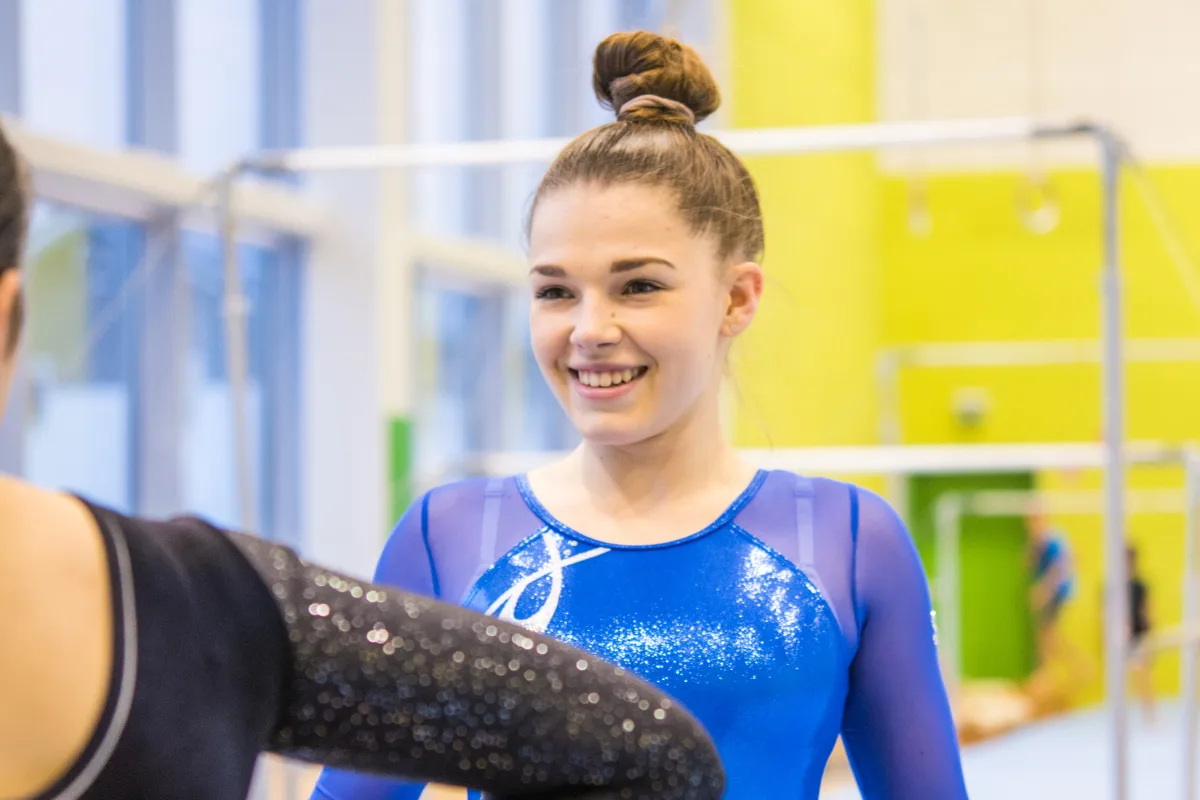
A useful gymnastics hairstyle stays secure, keeps the gymnast’s view clear and remains comfortable through the session. The competition requirements depend on the program. There is no single universal list declaring every clip, ribbon, bow or scrunchie allowed or banned across all artistic gymnastics.
Contents
- What USA Gymnastics actually says about hair
- Start with the program, then ask about the accessory
- Choosing ties, clips and decorations
- Jewelry rules are not identical across programs
- Hair, artistry and deductions are different issues
- Secure should not mean painfully tight
- Head coverings need an informed discussion
- A practical meet-day routine
This guide focuses on women’s artistic gymnastics and separates published rules from practical preparation. Check the applicable season and program before copying a hairstyle or accessory seen in a college meet or international broadcast.
What USA Gymnastics actually says about hair
The 2026–2027 USA Gymnastics women’s Rules and Policies require hair to be secured away from the face so it does not obscure the gymnast’s view of the apparatus. The document also addresses a well-groomed appearance and clean attire.
That requirement describes a functional outcome. It does not say that every gymnast must wear a bun, that every ponytail must be at the same height or that a particular braid pattern is compulsory.
A team may request a shared style or matching scrunchie. That is a team preference unless a relevant competition rule makes it a requirement. Ask the coach which instruction comes from the rulebook and which comes from the club’s meet-day plan.
Start with the program, then ask about the accessory
| Competition setting | Rules to check | What not to assume |
|---|---|---|
| USAG women’s Development Program or Xcel | Current women’s Rules and Policies plus the applicable program Code | A college appearance proves an item is allowed here |
| FIG women’s artistic competition | Current women’s Code and competition-clothing rules | Every USAG domestic detail applies internationally |
| NCAA women’s competition | Current NCAA modifications and their underlying USAG rules | College gymnastics simply copies the FIG Code |
| Recreational class or club display | The facility’s requirements for that activity | A meet deduction automatically governs a class |
For men’s artistic gymnastics or another governing organization, use that program’s documents. A women’s rule should not be presented as a universal rule for every gymnast.
Choosing ties, clips and decorations
A plain tie or scrunchie can be a straightforward starting option. Small clips or pins may help keep shorter sections in place. The useful checks are whether the item stays put, has an exposed sharp part, presses painfully or can interfere with movement.
Those are practical considerations, not a claim that every product in one category has official approval. A soft-looking decoration can still be loose, and a familiar accessory can behave differently when attached to a different hairstyle.
If an item has a rigid projection, dangling component or substantial weight, show the coach the actual item. A photo or general name such as “sparkly clip” may leave out the feature that matters. Obtain an answer before the gymnast begins warmup.
Jewelry rules are not identical across programs
The USAG women’s Rules and Policies allow stud earrings in any part of the ear and require other piercings to be removed. The FIG women’s Code permits small stud-type pierced earrings while prohibiting other jewelry such as bracelets and necklaces.
The 2026–2027 NCAA women’s modifications use different wording: stud piercings are permitted, with no other jewelry. The document defines the stud style and provides its own warning and deduction procedure.
These differences are why “only one pair of earrings is allowed everywhere” is unreliable advice. Jewelry added to a hairstyle also deserves a specific check; calling an object a hair decoration does not establish that it falls outside the applicable jewelry rule.
A coach should resolve an uncertain item with the meet officials using the actual program’s requirements. Do not wait until the gymnast is about to salute.
Hair, artistry and deductions are different issues
A secure hairstyle is not an artistry skill. In the FIG women’s Code, artistry addresses how a routine is composed and performed. It should not be summarized as a judge deducting points because a hairstyle is insufficiently fashionable or glamorous.
Likewise, do not attach a generic 0.20 “hair penalty” to every loose strand. The USAG attire provisions, NCAA jewelry provisions and other behavioral rules have their own wording and procedures. A numerical deduction needs the correct rule and context.
Our artistry guide explains the performance questions separately. Hair preparation supports an unobstructed, comfortable routine; it does not replace work on rhythm, movement quality or execution.
Secure should not mean painfully tight
The American Academy of Dermatology warns that repeated pulling from tight hairstyles can cause traction-related hair loss. Pain, scalp stinging, broken hairs and changes around the hairline are reasons to reassess the style rather than simply tighten it again.
Choose an arrangement suited to the gymnast’s hair length, texture and comfort. Braids, locs, curls, short cuts and head coverings may need different practical solutions. The aim is to meet the activity’s requirements without treating one hair texture or appearance as the standard everyone must copy.
If a style hurts, change it. Persistent scalp symptoms or hair loss warrant advice from a healthcare professional. A hairstyle that lasts through a meet is not a success if maintaining it causes pain.
Head coverings need an informed discussion
The FIG women’s Code expressly allows a head covering subject to its current competition-clothing rules. That is more useful than a blanket claim that head coverings are forbidden in artistic gymnastics.
Discuss the intended covering with the coach early enough to check the relevant program, fit and secure arrangement. Questions should concern the actual requirements and how the gymnast moves, rather than assumptions based on another athlete’s clothing.
For broader clothing choices, our beginner gymnastics clothing guide provides a separate starting point. Hair and clothing should be considered together when they affect comfort or movement.
A practical meet-day routine
- Confirm the requirements. Ask which program and season apply, and clarify any team styling request.
- Try the arrangement in an ordinary supervised practice. Notice whether it slips, blocks vision or feels uncomfortable during familiar activity.
- Adjust the setup. Fix the source of slipping instead of adding excessive tension or more decorations.
- Pack a small backup kit. Bring familiar ties and any approved items needed to repair the style.
- Check before warmup. Ensure the gymnast can see clearly, move comfortably and report any problem.
If an accessory loosens during activity, tell the coach and follow the situation’s instructions. Do not encourage a gymnast to continue a dangerous movement simply to avoid interrupting a routine.
The best choice is a manageable style the gymnast has already tested, with uncertain accessories settled in advance. A clear rule check and a comfortable fit are more useful than an elaborate appearance or an unsupported list of supposedly universal bans.