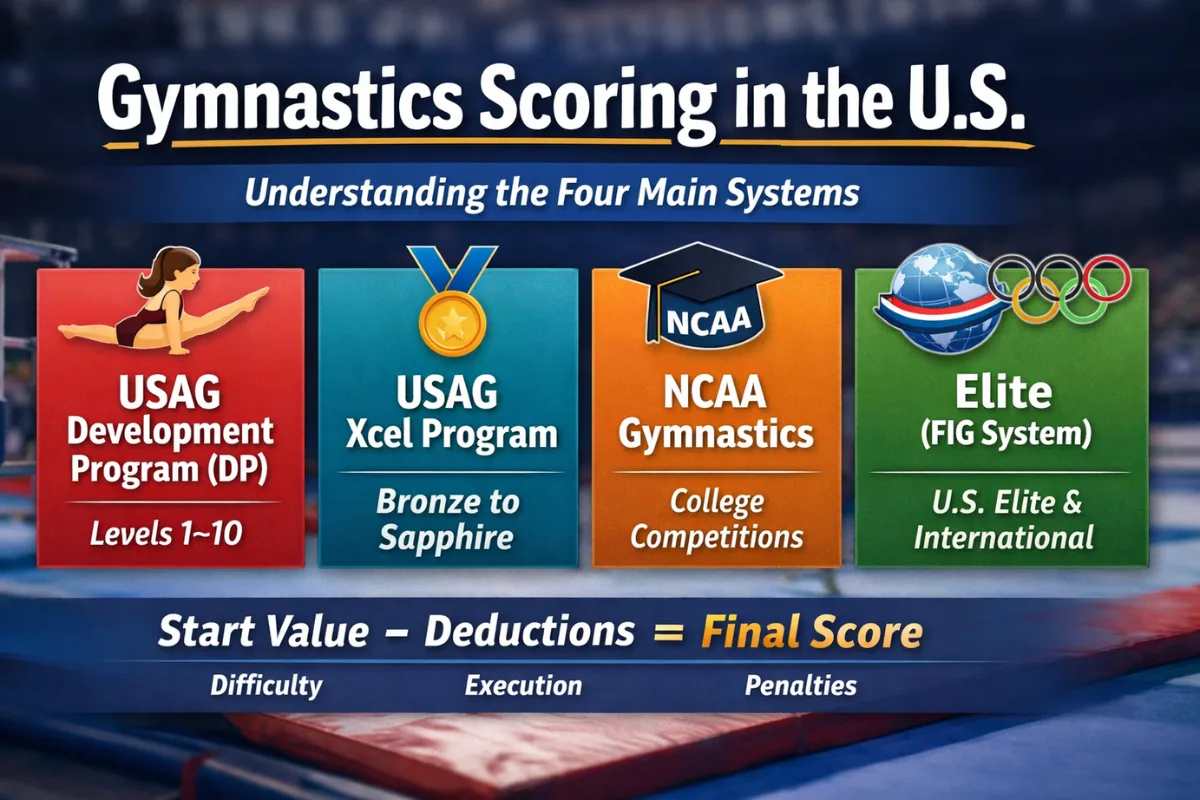
A college gymnast might score 9.850, while an elite gymnast receives 14.100. Both numbers can represent strong performances because the competitions use different scoring systems.
In women’s artistic gymnastics, the USA Gymnastics Development Program, Xcel and NCAA use versions of a 10.0-based system. FIG elite gymnastics adds separate difficulty and execution scores, allowing the final score to exceed 10.
This guide compares those four common systems, with a brief explanation of men’s scoring below. They are different competition programs and rule sets, rather than four stages every gymnast must complete. Both the Development Program and Xcel belong to USA Gymnastics.
Updated September 14, 2026. The NCAA women’s section covers the published rules for the 2026–27 season.
| Competition program | Who competes | Basic scoring approach | Individual scoring ceiling |
|---|---|---|---|
| Women’s Development Program | Club gymnasts in Levels 1–10 | Deductions come off the routine or vault’s starting value | Generally 10.0; qualifying Level 10 performances have a separate bonus |
| Xcel | Club gymnasts in Bronze through Sapphire | Start Value minus deductions | 10.0 |
| NCAA women | College gymnasts | Start Value minus deductions, using NCAA modifications | 10.0 |
| FIG elite | Elite gymnasts, including Olympic competitors | Difficulty plus execution, with applicable bonuses and separate penalties | Open-ended |
The program determines which rules apply. The same skill, landing error or routine combination does not necessarily receive the same value in every system.
Start Value and D-Score: The Main Difference
In a 10.0-based system, the judges establish the score available before performance deductions. This is called the Start Value, often shortened to SV.
The basic calculation is:
Start Value − deductions = final score
A routine does not automatically earn a 10.0 Start Value. Required skills, permitted difficulty and other routine-building rules can affect the starting number.
For example, suppose two routines receive the same total deductions:
| Hypothetical routine | Start Value | Deductions | Final score |
|---|---|---|---|
| A | 10.00 | 0.65 | 9.35 |
| B | 9.50 | 0.65 | 8.85 |
Routine B scores lower because it begins with less scoring potential. Its lower result does not, by itself, show that it was performed less cleanly.
FIG elite scoring separates those ideas differently. The D-Score measures the difficulty points judges award, while the E-Score measures execution and begins from 10.0. Judges add them together before applying any separate penalties or applicable final-score bonuses.
A 5.8 D-Score is therefore only one part of an elite score. It cannot be compared directly with a domestic 9.5 Start Value.
USAG Development Program Scoring
The Women’s Development Program, or DP, has ten levels. USA Gymnastics groups them into three stages:
| Stage | Levels | Routine structure |
|---|---|---|
| Developmental | 1–3 | Foundational skills and prescribed material |
| Compulsory | 4–5 | Standardized routines for each level |
| Optional | 6–10 | Individually constructed routines following level-specific rules |
This structure is described in the official Women’s Development Program overview.
Compulsory routines
At the compulsory levels, gymnasts at the same level perform the prescribed routines. Judges evaluate how accurately the gymnast follows the routine as well as technique, body position, rhythm and landing control.
Two gymnasts can therefore perform the same sequence and receive different scores. Small form errors, omitted movements or changes to the prescribed routine can all affect the result.
Optional routines: Levels 6–10
Optional gymnasts choose their skills within the rules for their level. On Bars, Beam and Floor, the Start Value depends on having enough skills of the required difficulty and including required types of gymnastics.
The difficulty classifications are called Value Parts. The required types of skills or combinations are called Special Requirements.
Under the 2026–2030 optional rules, Levels 8–10 also use Composition Credit, which rewards specified routine construction. Levels 9–10 use additional bonus for eligible difficult skills and connections. These components appear in the official Levels 6–8 and Levels 9–10 reference sheets.
A Level 10 routine has much more demanding requirements than a Level 6 routine, even when both earn a 10.0 Start Value. Matching Start Values do not make their difficulty equivalent.
Level 10 also has a qualifying extra 0.10 bonus outside the normal Start Value. Bars, Beam and Floor have specific conditions, while Vault has its own eligibility rules.
This is why describing every DP final score as strictly capped at 10.0 would miss an exception. See the Level 10 routine bonus provision and vault bonus rules.
For the full calculation, see how Start Value works in USAG Levels 6–10.
Xcel Gymnastics Scoring
Xcel is another USA Gymnastics program, with six divisions: Bronze, Silver, Gold, Platinum, Diamond and Sapphire. Its Code of Points has been extended through July 2028. Official Xcel program information.
Xcel routines are built around each division’s requirements. Gymnasts can choose different skills to meet those requirements, so routines do not have to look alike to receive the same Start Value.
On Bars, Beam and Floor, Bronze through Diamond begin from 10.0 before Start Value reductions. Judges reduce that value for issues such as missing required skills or performing restricted elements.
Sapphire is different: its base is 9.60, with up to 0.40 bonus available from qualifying difficulty and connections. A routine that earns the full bonus and satisfies the other rules can reach 10.0. Vault uses its own assigned values. Current Xcel Start Value rules.
Xcel and optional DP both allow individual routine construction. The important scoring difference is the set of requirements and restrictions the gymnast must satisfy. A combination that works in one program does not automatically earn the same credit in the other.
For the division-specific calculation, see how Xcel Start Values are calculated.
NCAA Women’s Gymnastics Scoring
NCAA women also use a 10.0-based system. Their rules use USAG Level 10 as a foundation, with NCAA modifications taking priority when the two differ.
For 2026–27, Bars, Beam and Floor reach a full Start Value through:
9.20 base + 0.60 bonus + 0.20 Composition Credit = 10.00
That formula assumes the required routine content receives credit. Judges then subtract performance and other applicable deductions.
Vault has an assigned Start Value, and the separate USAG Level 10 extra 0.10 bonus does not apply in NCAA competition. These provisions appear in Sections 1–2 of the 2026–27 NCAA women’s rules.
Individual scores and team totals
NCAA women’s teams can compete six gymnasts per event, with the highest five scores counting. This is commonly called “6 up, 5 count.”
Five perfect scores produce a 50.000 event total. Across four events, the theoretical team maximum is 200.000. An individual competing all four events can score a maximum 40.000 all-around. NCAA score-computing rules, Section 8.
For routine requirements, judging and team examples, see the NCAA women’s scoring guide.
Elite Gymnastics Scoring: The FIG System
Elite optional competitions in the United States use the international FIG scoring framework, with applicable domestic modifications. Olympic and World Championship routines follow the international Codes of Points.
U.S. elite qualification also includes compulsory tests, which follow rules separate from optional competition. USA Gymnastics Elite Program 101.
For a standard elite routine, the basic calculation is:
D-Score + E-Score − separate penalties = final score
The D-Score adds the difficulty points judges award for the skills and other required or rewarded parts of the routine. The E-Score starts from 10.0 and falls as judges deduct for execution errors. Some violations, such as going out of bounds, create separate penalties.
For example, a hypothetical women’s routine could receive:
| Score component | Points |
|---|---|
| D-Score | 5.800 |
| E-Score | 8.300 |
| Separate penalty | −0.100 |
| Final score | 14.000 |
The 10.0 figure limits execution before deductions; it does not cap the entire final score. This structure is explained in the 2025–2028 FIG women’s Code.
Women’s and men’s elite gymnastics share the difficulty-plus-execution approach, but their routine requirements differ. Women use Composition Requirements on Bars, Beam and Floor. Men use Element Groups on non-vault events.
Applicable bonuses also need attention. For example, men can receive a separate 0.10 stick bonus for qualifying landings. When it applies, that bonus is added to the D-Score and E-Score total before separate penalties are subtracted. FIG men’s Code, Article 7.2.
For the complete overview, see how FIG gymnastics scoring works.
Frequently Asked Questions
Does NCAA men’s gymnastics use the women’s 10.0 system?
No. NCAA men use the international men’s Code as their foundation, with NCAA modifications. Their open-ended difficulty-and-execution structure differs from NCAA women’s Start Value system. The 2026–27 NCAA men’s rules establish that framework.
Why is Vault scored differently?
A vault is assigned a value as a complete skill. Beginner programs can also assign values to prescribed vault progressions. In women’s DP, Xcel and NCAA, the assigned number is a Start Value. In FIG, it is the vault’s Difficulty Value, to which execution is added. The gymnast does not build the vault’s value by collecting several routine requirements and connections.
Can the same gymnast receive different scores in NCAA and elite competition?
Yes. The competitions value difficulty and calculate deductions under different rules. The gymnast may also change the routine to suit each system. An NCAA 9.850 and an elite 14.100 are not directly comparable measures of performance.
Does a harder routine always receive a higher score?
No. Additional difficulty helps only as permitted by the scoring rules, and execution losses can outweigh its benefit. Once an NCAA or Xcel routine reaches a 10.0 Start Value, adding another difficult skill does not automatically increase that maximum.
Following a Gymnastics Meet
Before comparing scores, identify the program, level or division, and whether the number belongs to one routine, an all-around performance or a team. Then check whether the judges start from an assigned value or add separate difficulty and execution scores.