NCAA Women’s Gymnastics Scoring: Individual and Team Scores
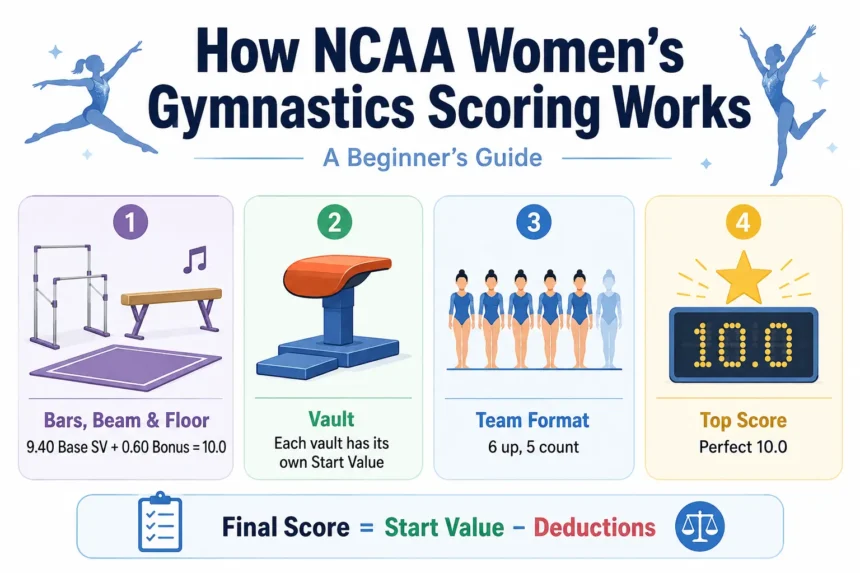
A college gymnast finishes a routine and receives 9.875. Later, the team’s score reaches 197.450. Those numbers describe different things: the first is one gymnast’s performance, while the second combines the team’s counting scores across four events.
Contents
- NCAA Women’s Gymnastics Scoring at a Glance
- How an Individual Routine Gets Its Score
- Special Requirements, Bonus and Composition Credit
- How Vault Scoring Is Different
- Where NCAA Gymnasts Lose Points
- How Multiple Judges Produce One Score
- How NCAA Team Scoring Works
- NCAA Women’s Scoring vs. FIG Elite Scoring
- Frequently Asked Questions
- A Quick Summary
NCAA women’s gymnastics uses the familiar 10.0 scoring system. Judges determine how much a routine is worth before mistakes, then subtract deductions for how it was performed. A routine does not automatically begin from 10.0.
For the 2026–27 season, Uneven Bars, Balance Beam and Floor Exercise build toward 10.0 through required skills, bonus and Composition Credit. Vault has a separate chart of assigned values. Once the individual scores are calculated, the team usually counts its best five scores from six gymnasts on each event.
NCAA Women’s Gymnastics Scoring at a Glance
| Scoring feature | How it works |
|---|---|
| Events | Vault, Uneven Bars, Balance Beam and Floor Exercise |
| Maximum individual routine score | 10.000 |
| Individual scoring method | Start Value minus deductions |
| Fall deduction | 0.50 |
| Team lineup | Up to six gymnasts on each event |
| Counting scores | The five highest scores on each event |
| Maximum team score | 200.000 across four events |
| Maximum individual all-around score | 40.000 across four events |
The distinction between an individual score and a team total explains much of a college gymnastics scoreboard. The underlying rules are set out in the 2026–27 NCAA Women’s Gymnastics Rules Modifications.
How an Individual Routine Gets Its Score
Before judges subtract performance mistakes, they establish the routine’s Start Value, often shortened to SV. This is the highest score available to that routine before deductions.
The basic calculation is:
Start Value − Deductions = Final Score
For example, a routine with a 10.0 Start Value and 0.15 in deductions receives:
10.00 − 0.15 = 9.850
If the same amount is deducted from a routine with a 9.90 Start Value, the result is 9.750. The final score therefore depends on both the routine’s starting value and the mistakes judges identify.
Try the NCAA women’s score calculator with a 10.00 starting score and 0.15 total deductions. Choose NCAA / college and Women, then change a number to see how it affects the result.
The Start Value is based on what judges count during the performance. A gymnast may plan a 10.0 routine but receive less if a skill or connection does not earn the expected credit.
How Bars, Beam and Floor Reach 10.0
For 2026–27, the scoring structure is:
9.20 base + up to 0.60 bonus + up to 0.20 Composition Credit = 10.00 Start Value
The base assumes the required routine content is present. Judges check the required number and difficulty of recognized skills, known as Value Parts, as well as the event’s Special Requirements. Missing required content can lower the Start Value further.
The main change from the previous season is the separate Composition Credit component. The former 9.40 base plus bonus structure has become a 9.20 base with up to 0.20 Composition Credit added separately. The maximum routine score remains 10.0. NCAA Rules Overview, Section 1.5.
Special Requirements, Bonus and Composition Credit
These three terms describe different ways the routine’s content affects its Start Value.
| Component | The question it answers |
|---|---|
| Special Requirements | Does the routine include the required types of gymnastics? |
| Bonus | Does it contain qualifying difficult skills or combinations? |
| Composition Credit | Does it meet the additional difficulty conditions specified for that event? |
Special Requirements: The Content the Routine Must Include
Each event has a list of required features. A routine might need an acrobatic series, a turning skill or a dismount of sufficient difficulty.
Each missing NCAA Special Requirement costs 0.20 from Start Value. If a routine otherwise reaches 10.0 but misses one requirement, its Start Value becomes 9.80 before performance deductions.
Bars has four Special Requirements; Beam and Floor each have five. The table below summarizes their focus rather than every technical condition:
| Event | Required content includes | Composition Credit focuses on |
|---|---|---|
| Uneven Bars | Changes between the bars, two different flight skills, a turning element and a qualifying dismount | Release difficulty and dismount difficulty |
| Balance Beam | An acrobatic series, a dance or mixed series, a split leap or jump, a full turn and a qualifying dismount | Dance difficulty and acrobatic difficulty |
| Floor Exercise | Required flips and combinations, sufficient difficulty in the final tumbling, a dance passage and passes on two different diagonals | Dance difficulty and acrobatic difficulty |
A flight skill includes a moment when the gymnast is airborne without support from the apparatus. An acrobatic series connects acrobatic skills, such as handsprings or flips. A dismount is the skill used to leave the apparatus and land.
The exact difficulty and connection conditions matter. For example, NCAA Bars requires two different flight elements, one at least D and the other at least C, excluding the dismount. Simply performing two releases does not automatically satisfy that requirement. NCAA event rules, Sections 3–5.
Bonus: Difficult Skills and Qualifying Connections
NCAA routines can earn up to 0.60 bonus from two sources:
- Difficulty Value Bonus, or DV Bonus, rewards qualifying difficult individual skills.
- Connection Value, or CV, rewards qualifying combinations of skills.
Connection rules vary by event. Floor can also award bonus for certain combinations in which handsprings connect the flips. These are called indirect connections.
To earn the full 0.60, a routine needs at least 0.10 DV Bonus and 0.10 CV. The remaining 0.40 can come from either source. For example, 0.20 DV Bonus + 0.40 CV can provide the full 0.60.
The skills must receive the required credit and satisfy the bonus conditions, including being performed without a fall or spotting assistance. Adding a difficult skill to the planned routine does not guarantee its bonus in competition.
The guide to difficulty and connection bonus across gymnastics programs explains how NCAA’s rules compare with USAG, Xcel and FIG.
Composition Credit: Another Part of Reaching 10.0
Composition Credit, or CC, can add up to 0.20 on Bars, Beam and Floor. Each event divides that credit into two parts worth 0.10 each.
On Bars, the two parts concern release difficulty and dismount difficulty. On Beam and Floor, they concern dance and acrobatics. These are specific content conditions, rather than a general judgment about whether the routine looks impressive.
Suppose a routine has all required content and earns the full bonus, but only half of the available Composition Credit:
9.20 base + 0.60 bonus + 0.10 CC = 9.90 Start Value
Even with no execution deductions, that routine cannot receive 10.0.
A skill can sometimes contribute to both bonus and Composition Credit when the rules allow it. However, extra bonus beyond the amount that can count does not replace missing CC. The explanation of the NCAA’s event-specific Composition Credit rules covers this component in more detail.
How Vault Scoring Is Different
Vault does not use the 9.20 base plus routine bonus and Composition Credit formula. Each recognized vault already has a predetermined Start Value in the NCAA vault chart.
Two familiar examples are:
| Vault | NCAA women’s Start Value |
|---|---|
| Yurchenko full | 9.95 |
| Yurchenko 1½ | 10.00 |
A Yurchenko entry uses a round-off onto the springboard followed by a back handspring onto the table. The full and 1½ versions then perform a backward flip in a stretched position with different amounts of twisting.
A Yurchenko full cannot score 10.000 because its Start Value is 9.95. However, it can beat a 10.0 vault if the harder vault receives larger deductions.
NCAA women perform one executed vault, and that score counts. The additional vault bonus available in the USAG Development Program at Level 10 does not apply in NCAA competition. NCAA Section 2 and Appendix I.
The complete explanation of vault scoring in NCAA, USAG, Xcel and FIG covers values, attempts, landings and program differences.
Where NCAA Gymnasts Lose Points
Most visible deductions concern execution: how well the gymnast performs. Judges watch the entire routine, including body positions, control, height, turns and landings.
The most noticeable errors differ by event:
| Event | Common visible mistakes |
|---|---|
| Vault | Bent arms on the table, separated legs, insufficient flight and landing movement |
| Uneven Bars | Short handstands, bent knees, leg separation, interrupted swing and an uncontrolled dismount |
| Balance Beam | Balance checks, incomplete positions, pauses and landing errors |
| Floor Exercise | Poor tumbling shape, incomplete dance positions, insufficient height and landing movement |
A gymnast can complete every major skill and still lose several tenths through smaller errors. One skill may also receive deductions for more than one distinct fault.
How Much Does a Fall Cost?
The standard NCAA fall deduction is 0.50. In a simplified example, a gymnast with a 10.0 Start Value who falls and loses another 0.10 elsewhere receives:
10.00 − 0.50 − 0.10 = 9.400
This example assumes the fall does not also change the Start Value. In an actual routine, the same mistake can remove bonus or other credit, creating an additional loss.
Vault also has special rules for unsuccessful attempts. A vault that doesn’t land on the soles of the feet first costs 1.00, and that figure already includes the fall. It is not 1.00 plus the ordinary 0.50 fall deduction.
Why Gymnasts Hold Their Finish
On Vault, Bars and Beam, the gymnast must hold a finishing position with straight legs and raised arms for one second. Failing to show that finish costs 0.05.
The finish should face the landing direction and remain still. If the gymnast falls on landing, the separate hold deduction is not added. This explains the brief, deliberate pause before many college gymnasts turn to celebrate. NCAA Section 1.5.b.
Structure Deductions: How the Routine Is Put Together
NCAA also lists event-specific Structure Deductions. These address the choice and arrangement of movements rather than errors such as bent knees or a landing hop.
Examples include certain extra transitions on Bars, missing directional variety in Beam acrobatics, and insufficient use of the Floor area. A routine can have a 10.0 Start Value and still receive a Structure Deduction.
For 2026–27, the NCAA document lists its own Composition Credit, Special Requirements and Structure Deductions. Only those listed provisions apply to collegiate competition; another program’s composition rules should not simply be added. NCAA Sections 1.1, 3.3, 4.3 and 5.4.
How Multiple Judges Produce One Score
Each judge evaluates the routine independently. Their marks are then combined according to the size of the panel.
| Number of judges | How the gymnast’s score is calculated |
|---|---|
| 2 | Average both scores |
| 4 | Remove the highest and lowest scores; average the remaining two |
| 6 | Remove the highest and lowest scores; average the remaining four |
For example, two judges might award 9.90 and 9.85:
(9.90 + 9.85) ÷ 2 = 9.875
That averaging explains why a scoreboard can display a number such as 9.875 even though neither judge individually gave that mark.
NCAA also sets limits on the difference between counting judges’ scores. When those marks fall outside the permitted range, the judging panel follows the required conference procedure. NCAA Sections 1.8 and 8.2.
How NCAA Team Scoring Works
A team may put up to six gymnasts in its lineup for each event, but only the five highest scores count. This is commonly called “6 up, 5 count.”
The lowest score is removed separately on each event. It is not one dropped score for the entire meet.
Example: Calculating a Beam Total
Consider these hypothetical scores:
| Gymnast | Beam score | Included in the event total? |
|---|---|---|
| 1 | 9.925 | Yes |
| 2 | 9.900 | Yes |
| 3 | 9.875 | Yes |
| 4 | 9.850 | Yes |
| 5 | 9.825 | Yes |
| 6 | 9.400 | No—lowest score |
| Beam total | 49.375 | Sum of the five counting scores |
The 9.400 does not enter this total. One fall score can therefore be dropped when the other five performances score higher. If two gymnasts fall in a six-person lineup, at least one of those scores must count.
With only five competing gymnasts on an event, all five scores count. Exhibition routines are separate from the competitive lineup and cannot replace a low counting score.
Adding the Four Events
The team’s meet total is the sum of its Vault, Bars, Beam and Floor totals:
| Event | Hypothetical team total |
|---|---|
| Vault | 49.250 |
| Uneven Bars | 49.400 |
| Balance Beam | 49.375 |
| Floor Exercise | 49.450 |
| Meet total | 197.475 |
Certain rule violations can also produce a team neutral deduction, which is applied separately to the team score. The example above assumes none. NCAA explains team scoring in Section 8.2 and team neutral deductions in Section 1.13 of its rules modifications.
Five perfect 10s would produce 50.000 on one event. Across all four events, the theoretical maximum is 200.000.
With no team penalties, a total of 198.000 represents an average of 9.900 across the 20 counting routines. This makes a large team total easier to interpret: it is built from many individual performances close to 10.0.
How the Individual All-Around Score Works
An all-around gymnast competes on all four events. Her own Vault, Bars, Beam and Floor scores are added together, giving a maximum of 40.000.
The team’s dropped-score rule does not remove an event from her individual all-around result. A score can be dropped from the team total and still count toward that gymnast’s all-around score.
NCAA Women’s Scoring vs. FIG Elite Scoring
NCAA women and international elite gymnastics use different scoring scales.
NCAA women build toward a maximum routine score of 10.000, then lose points for deductions. FIG separates the D-Score, which measures difficulty, from the E-Score, which measures execution and begins from 10.0.
The FIG formula is:
D-Score + E-Score − Separate Penalties = Final Score
A FIG final score can exceed 10 because difficulty is added separately. A college score of 9.950 and an Olympic score of 14.500 therefore cannot be compared as though they were measured on the same scale. The international framework is set out in the FIG women’s Code of Points.
The guide to how FIG gymnastics scoring works explains that system. NCAA men also use a different structure from the women’s 10.0 system covered here.
Frequently Asked Questions
Can an NCAA Woman Score More Than 10.0?
No. The maximum individual routine score is 10.000. The larger numbers shown for teams and all-around gymnasts are totals from several performances.
Does a 10.0 Start Value Mean the Routine Was Perfect?
No. It means the gymnast received the full starting value. Execution and other applicable deductions can still lower the final score.
Can a Fall Lower the Start Value Too?
Yes. A fall costs 0.50 in execution and may also remove bonus or other credit. Some Composition Credit can remain if the skill receives Value Part credit and the specific CC conditions are met, so a fall does not automatically erase every kind of difficulty credit.
Does Every Gymnast Have to Compete on All Four Events?
No. A gymnast may compete on one, two, three or all four events. Teams select an event lineup, while gymnasts competing on all four also receive an all-around total.
A Quick Summary
NCAA women’s scoring starts with each routine’s value, subtracts deductions and combines the judges’ marks into an individual score. Teams then count their best five scores on each of four events. Understanding those steps makes it easier to follow both a gymnast’s 9.875 and a team’s total near 198.