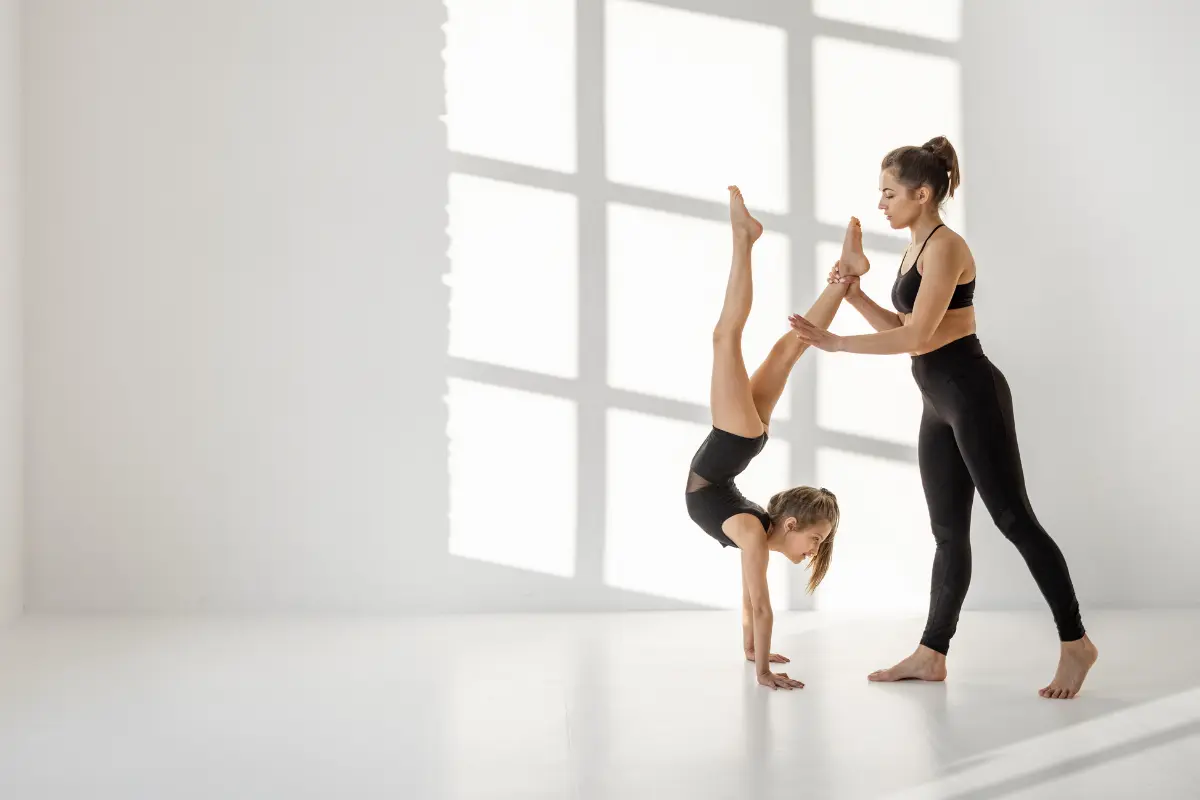
A gymnast changes the difficulty of a movement by changing body shape, support and timing. Tucking during a somersault, extending into a lever and adjusting a handstand all illustrate biomechanics: the study of forces and motion in living bodies.
- Start with the movement, not the silhouette
- Rotation: why a tuck can turn faster
- A faster rotation does not create more flight time
- Leverage: why moving mass outward changes a hold
- Balance: support and control matter together
- Landings: changing momentum takes force over time
- What body-proportion research can—and cannot—add
- Use mechanics to ask better coaching questions
Limb length and body proportions matter, but they are only part of the explanation. The same gymnast can make a task mechanically easier or harder without changing height at all. Understanding those changes is more useful than dividing athletes into naturally “good” and “bad” gymnastics body types.
Start with the movement, not the silhouette
A useful analysis identifies the task, the contact points and the phase of movement. A gymnast supported on the hands is in a different situation from the same gymnast in flight. Forces from the floor or apparatus can change motion during contact; those contacts are absent during a free-flight phase.
Body proportions affect where different segments are located, but a standing-height measurement does not describe the whole system. Two athletes of equal height can have different arm spans, leg lengths and mass distributions.
Our body-type research guide explains why measurements observed in elite groups cannot, by themselves, predict another athlete’s performance. Mechanics becomes more informative when the actual movement is examined.
Rotation: why a tuck can turn faster
Mass located farther from an axis resists changes in rotation more strongly. That distribution is described by moment of inertia. Pulling the limbs closer to the relevant axis can reduce it.
When external torque is negligible, angular momentum is conserved. In a simplified somersault model, reducing moment of inertia increases rotation speed. OpenStax’s angular-momentum explanation describes that relationship.
As a hypothetical calculation, if the moment of inertia were halved while angular momentum stayed constant, angular speed would double. This is a mathematical illustration, not a measured ratio between every gymnast’s tuck and layout positions.
Opening out increases moment of inertia and can slow rotation. It does not erase the need for an appropriate takeoff or give the gymnast unlimited control. The available flight time and the movement’s timing still matter.
A faster rotation does not create more flight time
Rotating and traveling through space are related parts of a skill, but they are not the same motion. Changing from a layout to a tuck does not supply another push from the floor once the gymnast is airborne.
The flight of the body’s center of mass depends on the takeoff conditions and external forces. A change in body shape alters how the segments move around that center. It should not be described as a way to manufacture extra airtime.
This distinction helps explain why a gymnast cannot solve every under-rotation simply by tucking harder. A coach needs to consider the whole sequence, including the entry, contact phase, takeoff and opening for landing.
Leverage: why moving mass outward changes a hold
A force creates a turning effect about a point when its line of action is offset from that point. This turning effect is torque. The relevant distance is the perpendicular moment arm, not automatically the full length of an arm or leg.
In a simple example, a 100-newton force acting with a 0.2-meter moment arm creates 20 newton-meters of torque. At 0.4 meters, it creates 40 newton-meters. These invented values illustrate the torque relationship; they are not estimates of a gymnast’s shoulder load.
A tucked lever can bring body mass closer to the support than a straight-body version. That is one reason changing shape can alter difficulty substantially. It also explains why an exercise progression may change leverage instead of adding weight.
Real joint loading is more complicated than a single rigid bar. Multiple segments, muscles and contact forces contribute. A simple model can explain a trend without being precise enough to prescribe a safe load or diagnose pain.
Balance: support and control matter together
For a stationary balance, the gymnast must manage the relationship between the body’s mass and its support. The support region is formed by the contact with the surface, such as the hands in a handstand or the feet on beam.
However, a moving gymnast is not a motionless object. Stepping, accelerating and changing body shape involve momentum and active corrections. A still photograph cannot show all the information needed to explain whether a position is recoverable.
Our center-of-gravity and balance guide explores the distinction. A lower body position can affect stability in a simplified model, but being shorter does not guarantee better balance or a stuck landing.
Landings: changing momentum takes force over time
Landing changes the gymnast’s downward and sometimes horizontal motion. Impulse describes the effect of force acting over time. For the same change in momentum, spreading the change across more time reduces the required average net force.
The impulse–momentum relationship helps explain why stopping distance, body movement and the landing surface matter. It does not give a universal knee angle or prove that one landing posture is safe in every situation.
In practice, direction, rotation, alignment, surface properties and the athlete’s preparation interact. Landing technique should be taught in an appropriate environment. A physics explanation is not a substitute for coaching or a reason to test a difficult landing alone.
What body-proportion research can—and cannot—add
A 2019 study of 53 male artistic gymnasts examined body measurements and fitness in relation to age category and preferred event. Such research can identify associations within a sample. It cannot show that a child with a particular limb ratio must specialize on a certain apparatus.
Event selection, experience and maturation can affect which athletes appear in a group. A measured association also does not reveal which training change would improve a particular individual. That requires additional assessment and evidence.
So no single torso proportion is ideal, and long legs don’t make every gymnast better at a given hold. What matters is the geometry and forces of the specific skill.
Use mechanics to ask better coaching questions
Ask what changed: the takeoff, body shape, support, assistance or timing? A change in one of those can explain why a skill feels different. The conditioning and strength guide discusses how a coach can then choose relevant preparation.
Biomechanics describes demands and possibilities. It is most useful when combined with the gymnast’s actual movement, preparation and response, rather than treated as a verdict based on height or appearance.