Gymnastics Conditioning: Exercises, Strength Training and a Weekly Plan
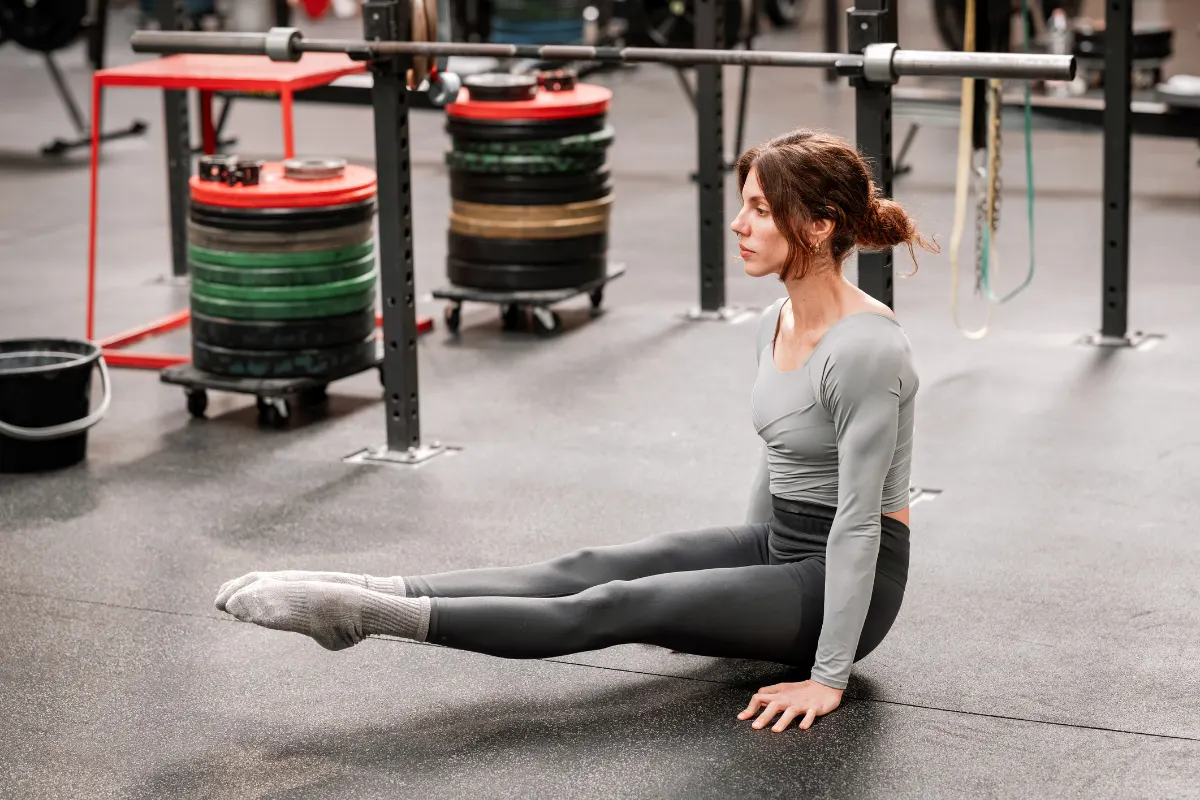
Gymnastics conditioning is the strength, power, endurance and flexibility work that prepares a gymnast’s body for skills. Most of it uses body weight, such as hollow holds, push-ups, pull-ups, leg lifts, squats and jumps, and it is usually part of practice, planned by the coach around the skills the gymnast is learning.
Contents
Strength training is one part of conditioning, not a separate program. This guide lists the main exercises with easier versions and quality checks, explains how gymnasts train leg strength and power, and shows how a training week fits together with rest days. Young gymnasts should follow their coach’s plan rather than add workouts on their own.
Gymnastics Conditioning at a Glance
| What it builds | Why gymnasts need it | Typical exercises |
|---|---|---|
| Core strength | Holding tight hollow and arched shapes in handstands, swings and landings | Hollow hold, arch hold, leg lifts |
| Upper-body strength | Supporting and pulling body weight on bars, beam and floor | Push-ups, support holds, pull-ups, rope climbs |
| Leg strength and power | Running, taking off, jumping and landing | Squats, lunges, calf raises, jumps |
| Muscular endurance | Keeping good form late in a routine or a practice | Holds and short circuits done in good shape |
| Flexibility and active control | Reaching and holding splits, bridges and open shoulders | Stretching and active leg lifts |
USA Gymnastics’ TOPS program, which screens 8- to 10-year-old girls for the elite path, tests these same qualities: a handstand hold, leg lifts at the stall bars, casts on the bar, straddle presses to handstand, a rope climb with the legs held in a pike, and five flexibility shapes (both front splits, a straddle split, a pike stretch and a bridge). Few gymnasts need TOPS-level numbers, but the list shows what gymnastics strength is for: controlling your own body in straight, tight shapes.
How Strength Training Fits Into Conditioning
The National Strength and Conditioning Association (NSCA) describes resistance training as a form of conditioning that can use body weight, elastic bands, medicine balls or weights. For gymnasts, body weight is usually the main load. A push-up, pull-up or support hold can be demanding strength work, and changing the body angle makes the same exercise easier or harder without any added weight.
Some older and higher-level gymnasts also lift weights; our guide to weight training for gymnasts explains how they use them. For children, the NSCA sets no minimum age. It says a child who is ready for organized sport, generally around age 7 or 8, is ready for some kind of resistance training as long as they can follow instructions, and its guidelines start with qualified supervision, light loads and correct technique.
Conditioning supports skill practice but doesn’t replace it. A stronger pull-up won’t teach the timing of a kip, and repeating a skill that keeps failing won’t always build the strength it is missing. Coaches use conditioning to build the specific strength a skill needs, then return to the skill.
Conditioning Exercises for Gymnasts
These are the basics most gymnastics conditioning is built on. End each set when the shape breaks down rather than when a count or a timer runs out: a short hold in a tight hollow is worth more than a long one with the lower back peeling off the floor.
Core
| Exercise | What it builds | Easier version | Quality check |
|---|---|---|---|
| Hollow body hold | The tight, slightly rounded shape used in handstands, swings and landings | Knees bent, arms by the sides | Lower back stays pressed to the floor |
| Arch hold (superman) | Back and glute strength for the arched shape | Lift the arms or the legs, not both | Neck long, no pain in the lower back |
| Leg lifts (lying, at the stall bars or hanging) | Compression: lifting straight legs toward the body for kips, presses and pike shapes | Lying leg lifts, or bent knees | Legs straight and together, no swinging |
| Dead bug | Keeping the trunk still while the arms and legs move | Move one limb at a time | Lower back stays down; keep breathing |
| Bird dog | Trunk control on hands and knees | Reach one arm or one leg at a time | Hips stay level, no twisting |
| Glute bridge | Hip strength (not the gymnastics back bridge) | A smaller lift | Hips rise without arching the lower back |
Our guide to core exercises for gymnasts has more variations, including hanging leg raises.
Watch: where the hollow shape shows up in skills
The hollow hold is first in the table because the shape appears all over the sport. In this whiteboard talk a gymnastics coach draws it as one smooth, slightly curved line from the hands to the feet, with the ribs and hips drawn toward each other (from 0:39).
The coach then follows the shape through skills. In tumbling and vaulting (1:10) the gymnast passes quickly between a hollow and a slight arch each time the hands or feet meet the floor or the table. On bars (3:48) a giant swing moves through a hollow on the way down and again on the way up. The comparison with a Roman arch is the coach’s own way of picturing the pressure, not a physics lesson.
From 6:03 the talk turns to CrossFit training, and one remark there is worth keeping. In skills the body moves through the hollow and does not stay in it, so the coach treats the static hold as a strength exercise and not as a copy of the skill. That is the point made above: conditioning supports skill practice but does not replace it.
Watch: hollow and arch drills, from the floor to the bar
A physical therapist who works with gymnasts shows five drills for the first two shapes in the table, the hollow and the arch. The player skips the announcements at each end.
The first drill (1:00) is the simplest and needs only a stick held overhead. Lying on the back, the gymnast lifts just the shoulders, then just the legs, then both together, then holds. The same sequence follows lying on the front for the arch. The later drills add load or apparatus: hollow rocks with a weight (2:55), quick swings between arch and hollow while hanging from a bar (4:25), holds with the feet anchored on a springboard (5:40) and shape changes over two foam rollers (about 7:05).
The speaker gives sets, counts and days per week for each drill. Treat those as the speaker’s general guide. The cues are the part that transfers: move slowly, keep the ears covered by the arms, change shape with the whole body at once, and choose an easier version when the lower back arches or the breath is held.
Upper body
| Exercise | What it builds | Easier version | Quality check |
|---|---|---|---|
| Plank and support holds | Straight-arm support for handstands, beam and bars | Knees down, or shorter holds | Body in one line, shoulders pushing the floor away |
| Push-up | Pushing strength for handstands and the push in round-offs and handsprings | Hands on a stable raised surface, or knees down | Body stays in one straight line all the way down and up |
| Pull-up or chin-up | Pulling strength for bars and the rope | Jump up and lower slowly, or row under a low bar | No kicking or swinging |
| Rope climb | Pulling and grip strength | Climb with the legs helping | Gym only, over a mat, with a coach watching |
| Wall handstand hold | Shoulder strength and the straight upside-down line | Walk only partway up the wall | Arms straight, no arch; walk down before you tire |
For work on the bar itself, such as toes-to-bar leg lifts and hollow holds on the bar, see our bar conditioning drills. For the wall handstand, our guide to learning handstands at the wall builds it up in stages.
Leg Strength, Power and Landings
Gymnasts use their legs to sprint down the vault runway, take off for tumbling, leaps and jumps, and absorb landings. Leg conditioning mixes plain strength work with power (jumping) and landing practice.
| Exercise | What it builds | Easier version | Quality check |
|---|---|---|---|
| Squat | Leg strength for takeoffs and landings | A smaller range, or hold a support | Heels down, knees following the toes |
| Lunge or split squat | Single-leg strength and balance | A shorter step, holding a support | Front knee stays steady over the foot |
| Calf raise | Ankle strength for springing and landing | Both feet, one hand on a support | Smooth up and down, no bouncing |
| Jump with a stuck landing | Power and landing control | Small two-foot jumps in place | Quiet landing on bent knees, knees over toes, then hold still |
| Springs and short sprints | Quick, springy takeoffs and run speed | Fewer, smaller bounces | Light on the balls of the feet, on a sprung or padded surface |
Jumping drills are plyometrics: the muscles stretch as you land and shorten as you spring up again. The NSCA calls age-appropriate plyometric training a safe and worthwhile way for young athletes to condition when it is properly prescribed, and warns that problems come when the intensity, amount or frequency of jumping outruns what the athlete can handle. Start small, on mats, and add height only once landings are solid.
Landing practice also protects the knees. The American Academy of Pediatrics (AAP) says programs that teach proper landing and stopping and include hamstring strengthening should be part of every gymnast’s training and conditioning, to help prevent tears of the ACL, a key knee ligament. For heel pain from Sever’s disease, an inflamed growth plate in the heel bone, the AAP notes that conditioning in sneakers can cut down on barefoot impact. Our guide to ankle exercises for gymnasts covers the lower-leg side of landing preparation.
Building a Gymnastics Training Week
A gymnastics training program is built from practices that usually follow the same order: a warm-up, then skills while the gymnast is fresh, then a conditioning block, then stretching or an easy cool-down. Hard conditioning before skill work leaves gymnasts tired for the skills that need the most control. The NSCA’s youth guidelines follow the same pattern, starting each session with a 5- to 10-minute dynamic warm-up and ending with a lighter cool-down and stretching.
Across the week, these guidelines keep the load sensible:
| Part of the week | Guideline |
|---|---|
| Rest | 1 to 2 days of rest every week (AAP) |
| Total hours | As a general rule, no more hours of training a week than the child’s age in years (AAP) |
| Strength work | For young athletes starting resistance training, 2 to 3 sessions a week on nonconsecutive days (NSCA) |
| Time off | At least 2 to 3 months a year away from the sport, which can be split into 1-month breaks (AAP) |
| Growth spurts | Typically between 9 and 14 for girls and 11 and 16 for boys; training hours, repetitions or intensity may need adjusting, with enough rest days (USA Gymnastics) |
| Sleep | 8 to 10 hours a night (USA Gymnastics) |
Here is how that can look for a young gymnast who trains three days a week. It is an example, not a prescription: the club’s schedule and the coach’s plan come first.
| Day | Plan |
|---|---|
| Monday | Practice: warm-up, skills, conditioning (core and upper body), stretching |
| Tuesday | Rest or free play |
| Wednesday | Practice: warm-up, skills, conditioning (legs, jumps and landings), stretching |
| Thursday | Rest or free play |
| Friday | Practice: warm-up, skills, lighter mixed conditioning, stretching |
| Saturday | Another sport or free play |
| Sunday | Full rest |
Team gymnasts train on more days, so coaches spread the hard conditioning through the week and change its focus from day to day. The rest days and the AAP’s hours guideline still apply.
Conditioning at Home
Home conditioning helps when it repeats exercises the gymnast already does well in the gym, as part of the coach’s plan. Ask the coach what to do, how much and on which days before adding any: home work counts toward the weekly training load, and a rest day should stay a rest day.
The home-friendly basics are the floor exercises above: hollow and arch holds, dead bugs, bird dogs, glute bridges, plank holds, push-ups, squats, lunges and calf raises. A coach might assign, for example, one leg exercise, one push-up variation and one core exercise, done with good form. Leave bar work, rope climbs, flips and jumping on hard floors to the gym, where there are mats and a coach.
- Use a clear space with a soft, non-slip surface, away from furniture.
- Have an adult who knows the exercises supervise younger children.
- Write down what was done and tell the coach, including any soreness that lasts. The home basics log in My Gymnast keeps a dated record.
- Stop any exercise that hurts.
Stretching fits at the end of the session, as part of the cool-down. Our guide to flexibility in gymnastics explains how gymnasts train it safely.
Common Questions
How often should gymnasts do conditioning?
In a club, conditioning is built into practice, so the coach’s plan sets how often. For young athletes starting strength training, the NSCA suggests 2 to 3 sessions a week on nonconsecutive days, and the AAP advises 1 to 2 rest days every week.
Can kids do strength training for gymnastics?
Yes, with qualified supervision. The NSCA says a properly designed and supervised resistance training program is relatively safe for young people and can make them stronger. Children start with body weight or light loads and learn the technique first.
How many reps should a gymnast do?
The coach sets the amount for each gymnast. As a starting point for young beginners, the NSCA’s guidelines suggest 1 to 3 sets of 6 to 15 repetitions of each strength exercise with light loads, then a gradual increase. Holds and jumps are judged by quality: stop when the shape or the landing breaks down.
Is it normal to be sore after conditioning?
Some muscle tiredness after a new exercise is normal and eases as the body adapts. Joint pain is different: the AAP advises seeing a doctor if the wrists are swollen or painful the next day, or if low back pain lasts longer than two weeks.
Final Takeaway
Gymnastics conditioning builds the strength, power, endurance and flexibility a gymnast needs to control their body in skills. Most of it is bodyweight work: core holds and leg lifts, push-ups, pull-ups and support holds, squats, lunges, and jumps with good landings.
It works best inside the coach’s plan: after the warm-up and skills, spread through the week, with 1 to 2 rest days and quality ahead of repetitions. At home, stick to the floor basics the coach has assigned.
Main Sources
- National Strength and Conditioning Association (2009), “Youth Resistance Training: Updated Position Statement Paper”
- American Academy of Pediatrics (HealthyChildren.org): Burnout in Young Athletes: How to Keep the Fun in Sports
- American Academy of Pediatrics (HealthyChildren.org): Gymnastics: Keeping the Sport Safe & Fun for Kids
- USA Gymnastics TOPS Physical Abilities, updated 31 August 2026
- USA Gymnastics: The Impact of a Gymnast’s Growth Spurt