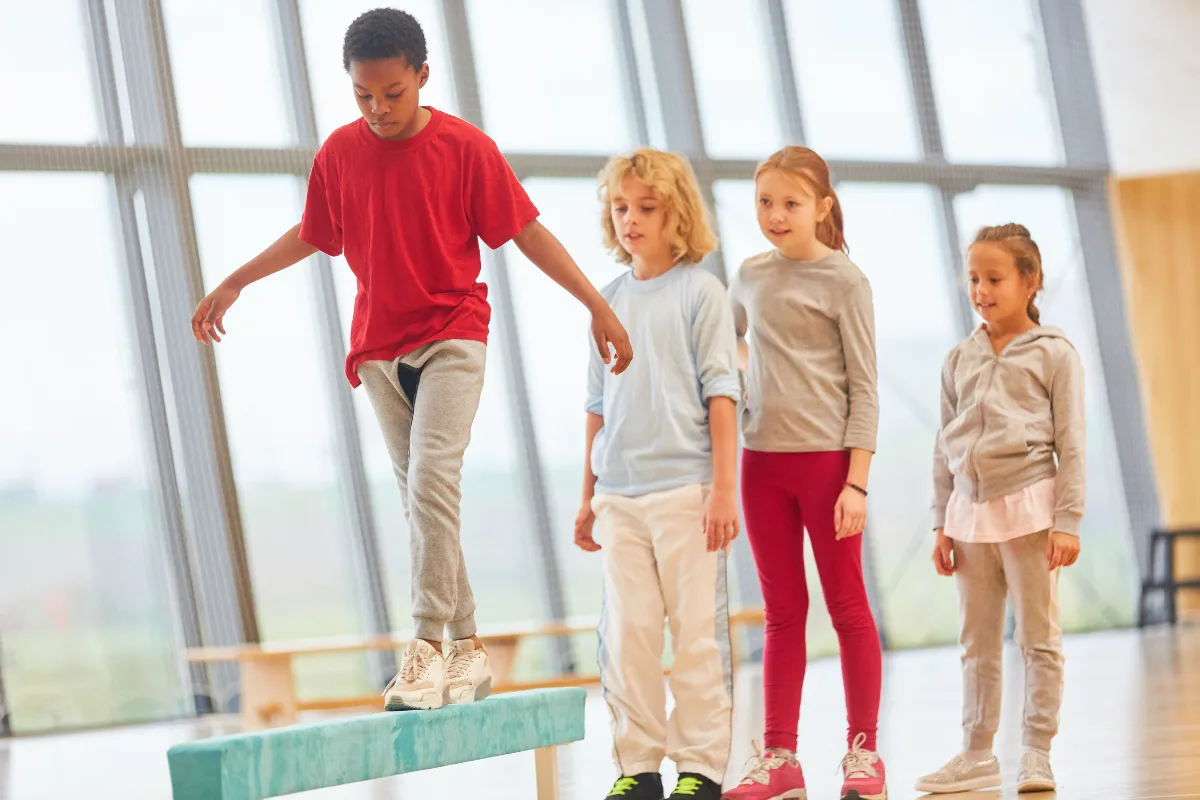
A low beam gives a gymnast a narrow surface to work on close to the floor. In an introductory class, it can help separate the challenge of placing the feet and controlling the body from the additional demands of a high beam.
Low beam is useful for both beginners and experienced gymnasts. Its role depends on the exercise: a newcomer may practice walking, while a more experienced athlete may use it to refine a familiar movement with a coach.
Not every low beam is the same
A foam floor beam, a padded training beam on low legs and an adjustable club beam can feel quite different. They may differ in width, firmness, height and intended use. A tape line is useful for orientation, but it cannot reproduce the raised edges or surface of a beam.
Manufacturers supply different products for different training tasks. For example, SPIETH’s training pad is a distinct piece of training equipment, not a claim that every low beam duplicates a competition beam. The equipment’s own instructions and the coach’s plan determine how it should be used.
Before practice, the coach checks the beam’s stability, its surface, the surrounding space and suitable matting. A portable beam should not slide, rock or be propped up to create a height it was not designed to provide.
The training pad in that example attaches over an existing beam; it is not a freestanding low beam. This illustrates why product names need checking. A family searching for a “beam mat” might find a beam-top cover, a floor balance strip or a landing mat. They serve different purposes and should not be treated as substitutes.
| Practice surface | What changes for the learner |
|---|---|
| A marked line on the floor | Provides a visible path without a raised edge to step from. |
| A soft floor beam | Adds a raised surface whose firmness and width depend on the product. |
| A low beam on designed supports | Provides a beam surface with an equipment-specific height and stability. |
| A pad attached to a beam | Changes the contact surface of the existing apparatus; it does not replace its supports or surrounding matting. |
What beginners can learn close to the floor
Introductory tasks may include stepping onto the beam, walking with control, pausing in a balanced position and stepping off as directed. These let the coach see how the gymnast places the feet, shifts weight and responds when balance changes.
The aim is not simply to reach the other end as fast as possible. A controlled pause can reveal more about balance than a hurried crossing. Likewise, repeatedly waving the arms or rushing through a difficult spot gives the coach useful information about what to simplify.
Instructions should match the exercise. Arm position, gaze and foot placement are not identical in every beam movement. A cue that helps a beginner walk may not be the cue used later for a turn, leap or acrobatic element.
A useful first observation is whether the gymnast understands the whole task, including where it ends. “Walk to this point, stop and step down as shown” is easier to review than an open-ended instruction to stay on as long as possible. The instructor can then identify which part needs attention.
Balance is not identical to stillness. Small adjustments can be part of controlling movement. The separate guide to beginner beam walking looks at foot placement, pace and how to interpret a wobble without treating every correction as failure.
Making practice useful without adding height
A coach can vary a simple task while keeping the same low setup. The gymnast might work on a clearer starting position, a controlled stop or joining two already learned movements. Progress can mean performing the task more consistently rather than making it immediately more difficult.
For example, a short walk followed by a planned pause asks the gymnast to control both movement and stillness. If that sequence becomes rushed, the coach can return to the pause on its own. This keeps the practice tied to an observable skill.
There is no universal “three good repetitions” rule that automatically clears a gymnast for a higher beam. The separate guide to moving from low beam to high beam explains how coaches consider that transition.
For example, consider a gymnast who crosses the beam comfortably but rushes when asked to stop halfway. The next learning task might be a controlled pause close to the starting point, rather than a longer crossing or a higher beam. This example separates the specific difficulty from the overall impression that the child can already “do beam.”
Likewise, a gymnast who understands a forward walk may be unfamiliar with a side-facing task. The coach can demonstrate the new orientation and its ending before linking it to other movements. Changing direction is a new learning demand even when the equipment remains in exactly the same place.
What low beam does not make automatic
Being near the floor does not remove the risks of falls, collisions or acrobatic skills. New flight elements, inversions and dismounts still need appropriate instruction and supervision. They should not be added because a basic walking exercise feels easy.
For practice outside class, families should first ask which activities the coach wants repeated and what equipment and space they require. USA Gymnastics treats equipment, supervision and athlete preparation as connected parts of risk management. Buying a low beam does not replace that preparation.
Parents observing a lesson can ask what the station is intended to develop and which cue the child is currently using. That gives a clearer picture of progress than comparing how high different children are working. The gymnast on the lowest setup may be practicing a new detail while another repeats a familiar exercise higher up.
The class also needs a clear turn-taking arrangement. Waiting gymnasts should know when the station is available and where to stand while another child completes the task. That organization helps the instructor observe the movement without avoidable interruptions.
Key Takeaway
Low beam is a place to develop controlled movement on a narrow surface. The most useful starting point is an appropriate setup and a simple task the gymnast understands. Height can come later, when the coach judges it appropriate for that particular skill.