Simone Biles’ Gymnastics Moves: Her Named Skills Explained
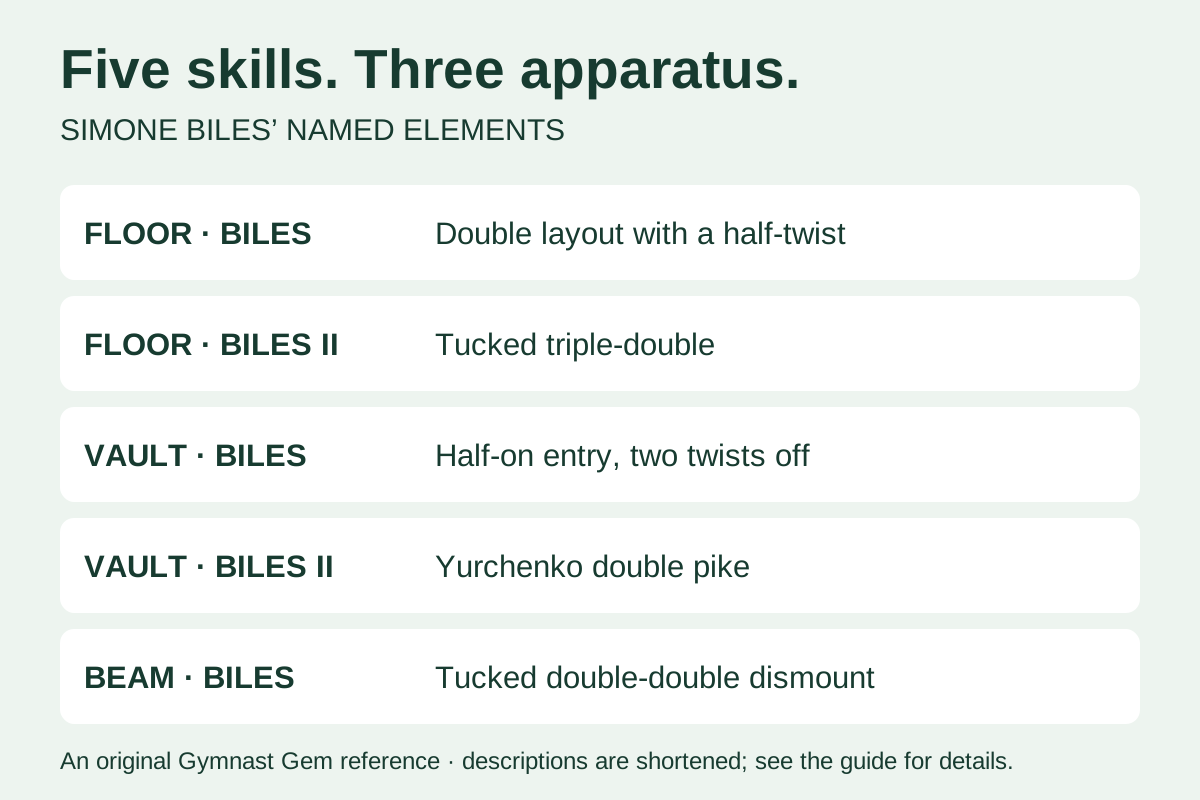
Five of Simone Biles’ gymnastics moves are named after her in the current women’s Code of Points: two vaults, two floor elements and one balance beam dismount. There is no Biles-named uneven-bars element in that list.
Contents
A named skill is more specific than a gymnast’s favorite or most recognizable move. It has an official entry in the rulebook. Another gymnast who performs that element uses the same name and difficulty value.
This guide is a directory of the five Biles skills. It explains their shapes, rotations and current values, with links to the specialist guides when you want a closer look.
Simone Biles’ Five Named Gymnastics Moves at a Glance
The values below come from the women’s 2025–2028 Code, checked on 2 November 2026. The year column identifies the skill’s World Championships debut, rather than the year of a particular Code edition.
| Event and name | What the skill is | Current value | Worlds debut |
|---|---|---|---|
| Floor: Biles, often called Biles I | Double backward somersault in layout with a half-twist. | G / 0.7 | 2013 |
| Vault: Biles, often called Biles I | Roundoff entry with a half-turn onto the table; forward layout somersault with two twists. | 6.0 | 2018 |
| Beam: Biles | Double backward somersault in tuck with two twists, as a dismount. | H / 0.8 | 2019 |
| Floor: Biles II | Double backward somersault in tuck with three twists. | J / 1.0 | 2019 |
| Vault: Biles II | Yurchenko entry into a double backward somersault in pike. | 6.4 | 2023 |
“Biles I” is a useful way to distinguish the first skill from the second on the same apparatus. The Code often labels the first simply “Biles.” The apparatus is essential: a floor Biles II and a vault Biles II are different movements.
The Two Floor Skills
Floor Biles: Double Layout With a Half-Twist
For the original floor Biles, the gymnast completes two backward somersaults in a stretched, or layout, position and adds a half-twist. It made its World Championships debut in Antwerp in 2013.
The current value is G, worth 0.7 toward the routine’s difficulty calculation when the skill is recognized and counted. The two somersaults and half-twist describe the airborne element; the roundoff and handspring that may lead into it are separate skills.
A layout does not mean standing upright in the air. It describes the extended body shape during rotation. Our guide to gymnastics body shapes compares it with a tuck and pike.
Floor Biles II: The Triple-Double
The floor Biles II combines three twists and two backward somersaults in tuck. That is why it is often called a triple-double: triple twist, double somersault. Its current value is J, or 1.0.
Biles performed it at the 2019 World Championships in Stuttgart. She also performed her new beam dismount at that competition, adding two named skills to her record.
Watch Team USA’s footage from the 2019 U.S. Championships. The opening tumbling pass is around 0:20–0:26. This is a domestic performance example from before Worlds, not the international naming performance. Look for the tucked shape and distinguish twisting from somersaulting rather than trying to count the entire run-up as part of the element.
Our flip-versus-twist guide explains the two rotation directions. For a direct comparison with the similarly named vault, see the two Biles II skills.
The Biles Beam Dismount
The beam Biles is a double backward somersault in tuck with two twists, performed off the beam as a dismount. It is commonly called a double-double: two twists and two somersaults.
It differs from the floor Biles II in both apparatus and twist count. The floor element has three twists; the beam dismount has two. Both use a tuck, but they are separate Code entries with separate values.
The beam skill made its Worlds debut in Stuttgart in 2019 and is currently rated H, or 0.8. That is an element value within a full beam difficulty score, not a maximum score for the routine.
It is also specifically a dismount. It should not be described as a flip that lands back on the narrow beam. The gymnast leaves the apparatus and finishes on the landing mats.
The Two Vaults
Vault Biles: Half-On Entry, Two Twists Off
The first Biles vault uses a roundoff entry and a half-turn onto the table, followed by a forward layout somersault with two twists. Its World Championships debut was in Doha in 2018. The current vault value is 6.0.
The half-turn onto the table and the two twists after it describe different phases. Combining those numbers into “a two-and-a-half-twisting vault” would hide the entry and create confusion with a different vault.
This vault shares its entry family with the Cheng. The Cheng has one and a half twists after the table; the Biles has two. For a current side-by-side value comparison, use the hardest vaults guide.
Vault Biles II: The Yurchenko Double Pike
The vault Biles II has a roundoff before the springboard, a backward handspring onto the table and two backward somersaults in pike after leaving it. It has no twist during the double-pike flight and is currently valued at 6.4.
In a pike, the hips fold and the legs stay straight. That separates this vault from the tucked triple-double on floor. The hand contacts also matter: roundoff hands on the runway or hand mat, feet on the board, then hands on the table.
Biles competed it domestically in 2021 and performed it at the World Championships in Antwerp in 2023. The detailed Yurchenko double pike guide covers that timeline, the vault’s recognition points and a real scoring example.
Why 6.4 and J Are Not Directly Comparable
Vault assigns a numerical difficulty value to the whole vault. Beam and floor assign letter values to individual elements, which contribute to a full routine’s difficulty score alongside the applicable requirements and connections.
That means a 6.4 vault is not “6.4 times harder” than a J-rated floor skill worth 1.0. The values occupy different roles in their scoring systems. Even the G and J values on floor do not represent a stopwatch, a percentage chance of success or a universal measure of physical effort.
Use the numbers to understand what the rules credit. Use the movement description to understand what you are watching. Our difficulty-value guide explains how element values contribute to a routine.
Does Every Biles Routine Include All Her Named Skills?
No. Having a skill named after a gymnast does not require that gymnast to perform it in every competition. The official name remains attached to the element regardless of a later routine choice.
Likewise, another gymnast does not receive a new named skill simply by performing a Biles element. Naming follows the rules for a submitted new element and its recognition at an eligible competition. Our guide to how gymnastics skills get named explains that process without mixing it into this five-skill directory.
Final Takeaway
Remember the five Biles skills by apparatus: two on floor, two on vault and one beam dismount. Then add the shape and rotations. The floor Biles II is a tucked triple-double; the vault Biles II is a double pike. Their shared name reflects the same gymnast, not the same movement or scoring scale.
Main Sources
- World Gymnastics, Women’s Code of Points 2025–2028: vault 5.34 and 4.61; beam 6.805; floor 5.703 and 5.1002.
- USA Gymnastics, 2018 Doha Worlds report: Biles’ first named vault.
- USA Gymnastics, Biles’ new skills at the 2019 World Championships.
- USA Gymnastics, 2023 Worlds qualification report: her fifth named skill.