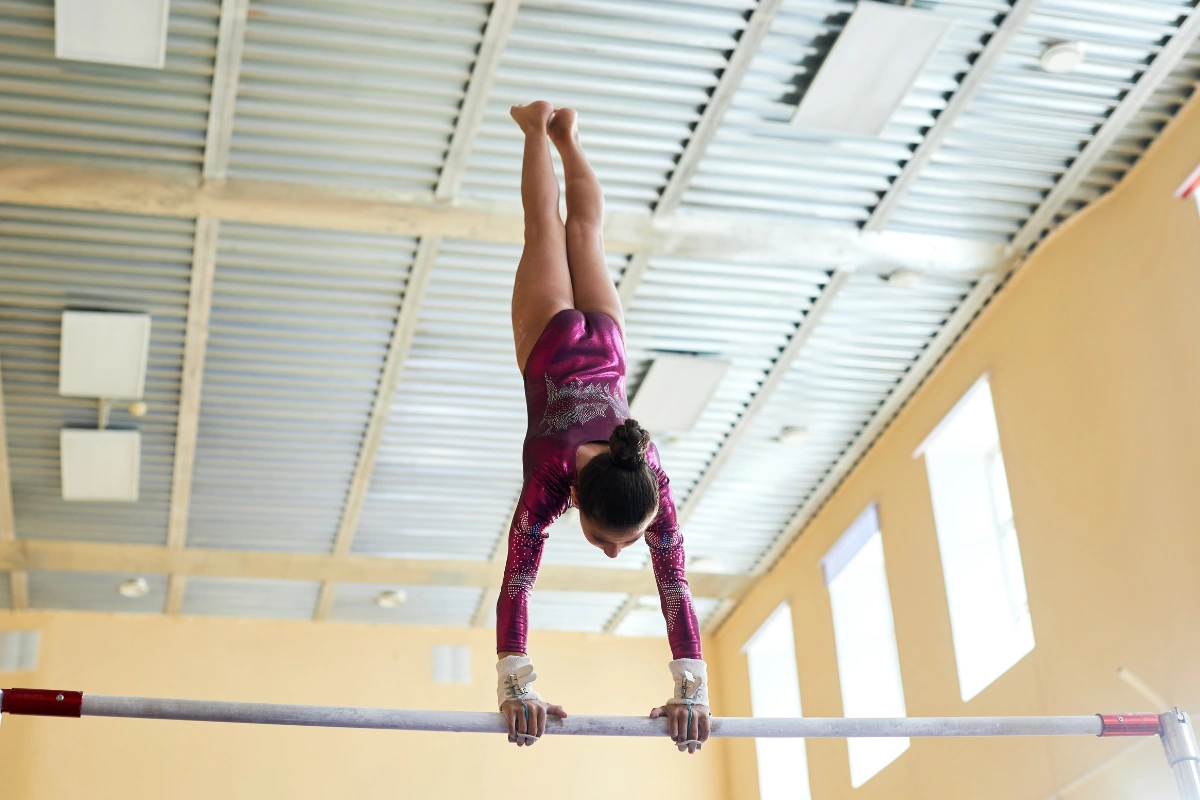
Bar circles are essential movements in gymnastics that involve rotating around the bar while maintaining control, fluidity, and body awareness.
In this guide, we’ll take you through the different types of bar circles, explain how to perform them and highlight which levels each skill is introduced.
What Is a Bar Circle?
A bar circle is a movement where the gymnast’s body rotates in a near-circular path around the bar. In this element, one hip (or occasionally the side of the torso) acts as the pivot point while the rest of the body swings around the bar. The movement closely resembles a segment of a circle, and the “circle” terminology describes the arc the body creates as it moves.
Below are some examples of “circles” commonly performed on gymnastics bars:
Beginner Circles
1. Mill Circle (Stride Circle)
The mill circle, also known as the stride circle, involves a forward rotation where the gymnast keeps one leg extended in front and the other behind in a scissored position. This movement is great for building foundational strength and body control while learning how to rotate efficiently around the bar.
How to Perform It:
- Start by hanging from the bar with your arms straight, ensuring your body is in a stable position.
- Swing your legs forward, keeping one leg extended in front and the other behind.
- Engage your core and shoulders to initiate the circle. As you rotate, maintain the scissored-leg position, keeping your legs straight and toes pointed.
- Complete the rotation smoothly and return to your starting position, ensuring balance and control.
Level:
Not part of the current USA Gymnastics Level 1–5 compulsory bars routines (2021–2029 cycle).
2. Back Hip Circle
Description:
The back hip circle begins in a front support position and involves a backward rotation around the bar. This movement teaches control over backward rotation and helps develop strength in the shoulders, arms, and core.
How to Perform It:
- Begin in a front support position, with your body aligned and arms straight.
- Lean your chest backward while keeping your arms extended. Engage your core to prepare for the rotation.
- Keep your body extended and your hips on the bar as you rotate backward around it.
- Finish the circle back in the front support position.
Level:
Part of the USA Gymnastics compulsory bars routines from Level 1 through Level 4.
3. Front Hip Circle
The front hip circle is a forward rotation. The gymnast leans forward and rotates around the bar, keeping their hips in contact with it. This circle helps develop control over the forward rotation and teaches awareness of the body’s position in space.
How to Perform It:
- Start in a front support position on the bar with your arms straight and your body stable.
- Lean forward while keeping your arms extended and your body engaged.
- Swing your legs over the bar, ensuring your hips stay in contact with the bar as you rotate.
- Complete the rotation smoothly and return to the front support position.
Level:
In the current USA Gymnastics compulsory routines, it appears in Level 3.
Intermediate Circles
4. Clear Hip Circle
The clear hip circle is a backward rotation where the gymnast’s hips stay off the bar, creating a “clear” space during the rotation. This skill is essential for building the power and technique needed for advanced bar elements.
How to Perform It:
- Start in the front support position with your arms straight and shoulders engaged.
- Begin the backward rotation by lifting your legs and pushing your hips away from the bar. Your hips should remain clear of the bar throughout the motion.
- Engage your core to maintain a hollow body shape as you complete the rotation.
- Finish the circle by returning to the front support position.
Level:
Typically seen in Level 5 and beyond.
5. Free Hip Circle
“Free hip circle” is another name for the clear hip circle described above. It’s the same skill, a backward circle with the hips clear of the bar, so the same steps and levels apply.
Advanced Circles
6. Stalder Circle
The stalder circle is a high-level skill where the gymnast rotates with legs straddled and hips clear of the bar. This movement demands flexibility, strength, and control, and is often used in elite-level routines.
How to Perform It:
- Start by gripping the bar and swinging your legs into a straddle position.
- Engage your core and lift your hips off the bar to begin the rotation, keeping your legs straddled.
- Keep your hips clear of the bar as you complete the circle, ensuring that your body remains controlled and smooth throughout.
- Return to a stable position after the circle.
Level:
A stalder circle is one of the choices in the Level 5 compulsory bars routine. In optional routines from Level 6, stalder elements count as clear circles, and they are used all the way to elite.
7. Giant Circle
The giant circle is a full rotation around the bar in a straight body position, starting and ending in a handstand. This move generates momentum, allowing gymnasts to connect it to other advanced elements, including dismounts.
How to Perform It:
- Begin in a handstand position on the bar, ensuring your body is straight and aligned.
- Push through your shoulders to initiate the rotation, using wrist shifts to control the motion.
- Keep your body tight and your legs together as you swing around the bar, maintaining control of the movement.
- Complete the circle by returning to the handstand position, ensuring stability and control.
Level:
Introduced in Level 7/8 and refined in higher levels.
| Move Name | Level | Description |
|---|---|---|
| Mill Circle | Not in Levels 1–5 compulsory bars | A forward rotation with scissored legs around the bar. |
| Back Hip Circle | Level 1-4 | A backward rotation from front support, with the body extended and the hips on the bar. |
| Front Hip Circle | Level 3 | A forward rotation with hips staying on the bar, ending back in front support. |
| Clear Hip Circle | Level 5+ | A backward rotation with hips clear of the bar, forming a “clear” space. |
| Free Hip Circle | Level 5+ | Another name for the clear hip circle. |
| Stalder Circle | Level 5 (one choice), then optionals | A straddle circle with hips clear of the bar, used for advanced transitions. |
| Giant Circle | Level 7-10 | A full rotation with straight arms and a body in a handstand position at the top. |
Incorporating Circles into Gymnastics Routines
- Levels 1–5: The back hip circle (Levels 1–4) and the front hip circle (Level 3) are foundational elements in compulsory routines, and Level 5 adds a clear circle (a clear hip circle, sole circle or stalder). They help gymnasts develop rotational skills and control.
- Levels 6–10: Clear circles, with the hips off the bar, become a requirement: one at Level 6 and two at Level 7. They’re integrated into optional routines, adding complexity and enabling gymnasts to link elements together seamlessly.
- Elite Levels: Advanced circles such as the stalder circle and giant circle are combined with release moves and intricate dismounts, pushing the limits of difficulty and performance.
In total, a gymnast performing routines in Levels 1–5 might encounter 2–3 different types of circles (the back hip circle, the front hip circle and, at Level 5, a clear circle), depending on their level. Higher levels build on clear circles such as the clear hip and stalder circles.
Through consistent practice, proper technique, and careful progression, gymnasts can enhance their fluidity, power, and precision, setting the stage for success on the bars.