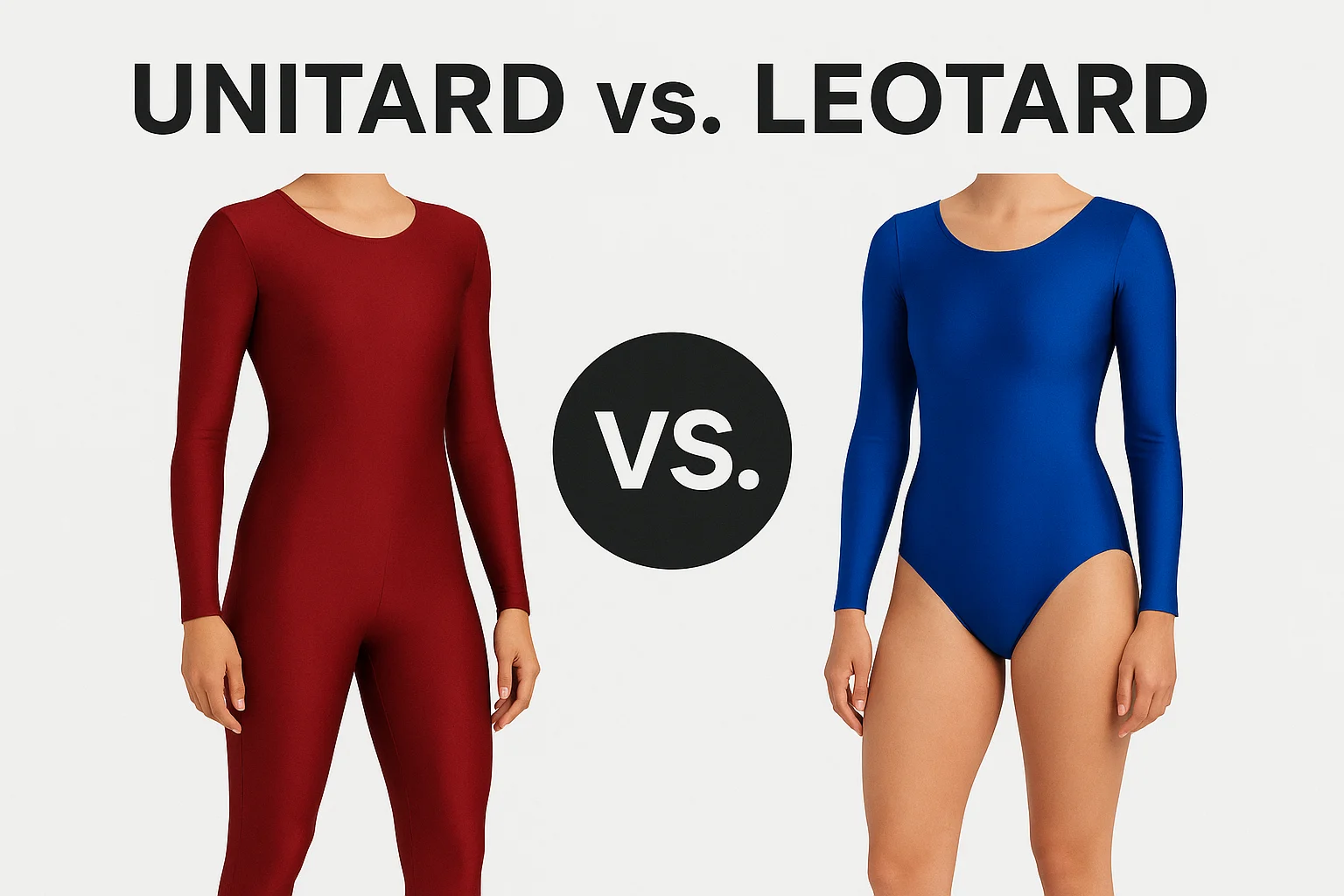
For many years, the high-cut leotard has been the traditional look of gymnastics. Now, the full-length unitard, offering more coverage and confidence, is giving gymnasts more choices than ever.
So, what’s the real difference? And which one should you (or your gymnast) choose? Let’s break it down.
First Things First: Are Both Legal?
Yes. Both leotards and unitards are fully legal in gymnastics competition, though the specifics vary slightly by governing body:
- FIG (International): Gymnasts may wear a leotard or a one-piece unitard. Unitards must cover from hip to ankle, and all garments must be non-transparent and of elegant design. Full-length leg coverings in the same colour as the leotard are also allowed.
- USA Gymnastics (Development & Xcel): USA Gymnastics has its own attire rules, separate from FIG’s. Athletes may wear a leotard or a unitard, and tights or shorts are allowed in set colours, such as the leotard’s colour or skin tone. Incorrect attire costs 0.20 after a warning.
- NCAA (College): Athletes must wear a one-piece leotard, but they may add school-issued shorts, tights, or leggings, effectively creating a unitard-like look. Uniformity across the team is required.
- Cultural Note: At the Tokyo 2020 Olympics, Germany’s women wore full-length unitards in qualification as a stand against the sexualisation of the sport and for athletes’ right to choose, as ESPN and CBS News reported at the time. Their outfits were within FIG rules.
✅ Bottom line: Unitards are allowed under FIG, USA Gymnastics and Xcel rules. In NCAA the base garment must be a leotard, but leggings can be added for the same look. The real deciding factors are comfort, gym policy, and team uniform rules.
What Exactly Is the Difference?
Both garments are stretchy, one-piece, and performance-ready. The main distinction is in the legs:
- Leotard: Covers the torso, may be sleeveless or long-sleeved, and leaves the legs bare. Hip cuts vary from moderate to high.
- Unitard: Covers the torso and extends down the legs, either capri or full-length. Sleeves are optional.
- NCAA Note: Pairing a leotard with matching leggings creates a unitard-like look, though the base garment is still considered a leotard.
👉 In short: Leotard = bare legs. Unitard = covered legs.
Pros and Cons in Real Life
Leotard (Classic Choice)
Pros
- Cooler and lighter for long practices or hot gyms.
- No fabric around hips or knees, so movement feels free.
- Biggest variety of styles and usually cheaper.
Cons
- Can ride up if the cut doesn’t fit well.
- Less coverage, which can make some gymnasts feel uncomfortable.
Unitard (Full- or Capri-Length)
Pros
- More coverage = more modesty and confidence.
- Extra fabric can feel cleaner on mats and equipment.
- Less chance of wardrobe issues during competitions.
Cons
- Warmer than a leotard, especially in hot gyms.
- Needs a good fit or fabric may bunch at the knees or ankles.
- Fewer ready-made options, and custom ones cost more.
Cost and Sizing Basics
Pricing
Prices vary widely by brand, fabric and decoration. Competition leotards with crystals or custom designs usually cost more than practice wear, so check current prices with your club’s supplier or a retailer before budgeting.
How Many to Buy
Beginners usually only need 1 competition suit and 2 practice outfits. Unitards may take longer to dry, so an extra one can help if you train often.
Comfort and Fit: How to Get It Right
Whether you choose a leotard or unitard, fit is everything. The wrong cut, fabric, or finish can turn a great outfit into a constant distraction.
- Fabric & Lining: Pick high-quality 4-way stretch. Matte or brushed interiors help reduce slipping. Heavy sweaters may prefer lighter-weight or mesh-panel designs—always non-transparent per rules.
- Leg Cut & Elasticity (Leotards): A slightly higher leg line often anchors more securely on the hip. Elastic should lie flat, not dig or gape.
- Inseam & Hem (Unitards/Leggings): Hems should sit smoothly at the ankle or calf, with no pooling. If you tape ankles, check that hems don’t interfere.
- Compression: Some gymnasts like a snug, compressive fit because it moves with the body. Choose what feels comfortable, and avoid anything so tight that it restricts squats or splits.
- Seams: Look for flatlock seams in high-motion areas (hips, inner thighs, behind the knee). Bulky seams = friction and distraction.
✅ Takeaway: Your attire should move with you, not against you. Comfort, secure fit, and freedom matter most.
So… Which Should You Choose?
- Choose a leotard if you want maximum airflow, endless style choices at lower cost, and you’ve found a leg cut that stays put without ride-up.
- Choose a unitard (or leo + leggings) if you value coverage and confidence, want to avoid mid-routine adjustments (especially on camera), or often compete in chilly venues.
👉 Either way: fit beats fashion. Always test your garment in full routines—vaults, bar dismounts, beam choreography, and tumbling passes—to ensure distraction-free performance. And double-check your program’s attire rules to avoid neutral deductions.
Frequently Asked Questions (FAQ)
Do unitards affect scoring?
No. Judges do not deduct for choosing a unitard over a leotard. Scores are only affected if the outfit breaks attire rules (e.g., transparency, neckline, or uniform mismatches).
Are there rules about colors and logos?
Yes. FIG regulates logos, advertising and national identification on competition wear, and USA Gymnastics men’s meets follow the FIG advertising rules. USA Gymnastics women’s rules allow only small manufacturer branding on tights and shorts. The FIG women’s Code also asks for attire of elegant design.
Can you wear leggings over a leotard?
Yes. In the USA Gymnastics Development Program, tights or shorts may be worn under or over the leotard in black, the leotard’s colour or skin tone. In NCAA, they must be part of the school’s official uniform and match any teammate wearing the same item.
What happens if a gymnast wears incorrect attire?
In USA Gymnastics women’s meets (Levels 1–10 and Xcel), incorrect attire costs 0.20 after a warning. If it isn’t corrected, the Chief Judge takes it only once, not on every routine. FIG elite uses 0.30, once per competition session.
Which is better for beginners: leotard or unitard?
It depends on comfort. Many beginners start with a leotard, but if a gymnast feels more confident and secure in a unitard (or leo + leggings), that choice can make learning skills less stressful.