Is the Straddle Press Handstand Harder? Here’s Why Everyone Tries It
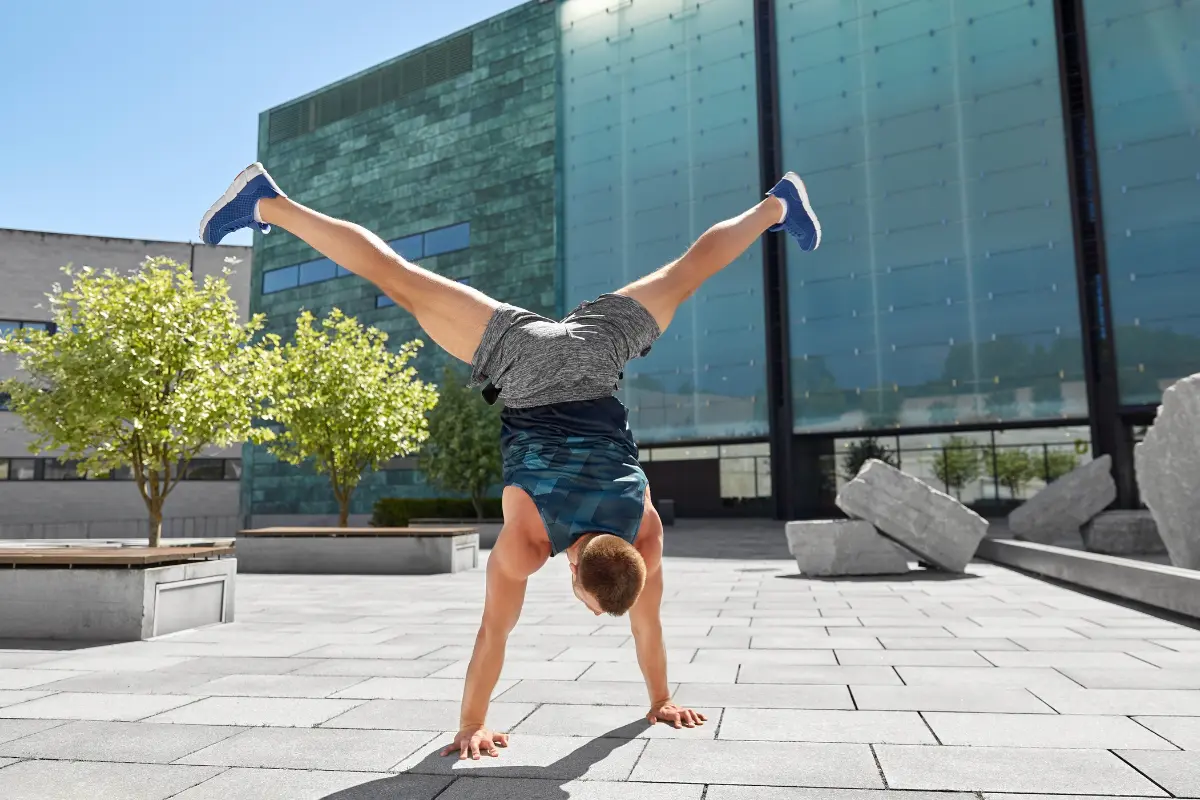
Yes, a straddle press handstand is harder than kicking up to a handstand, because you lift into it slowly with no kick or jump. Your shoulders have to lean forward and hold your weight while your hips rise over your hands, and you need the active flexibility to keep your wide legs folded close to your body until they leave the floor.
Contents
- What Is a Straddle Press Handstand?
- Why the Straddle Press Feels (and Is) Tougher
- So Why Do People Try the Straddle Press Handstand?
- Straddle Press to Handstand: A Step-by-Step Guide
- Step 1: Learn the Wall Press Setup
- Step 2: Practice the Freestanding Floor Prep
- Step 3: Work on the Straddle Hover
- Common Straddle Press Handstand Mistakes
- Final Takeaway
- Main Sources
That makes the press a strength-and-control skill that usually comes after a steady handstand. This guide explains what makes it hard, why gymnasts train it, how coaches choose preparations and the mistakes that hold most people back.
What Is a Straddle Press Handstand?
The straddle press handstand is a skill where you lift into a handstand from a wide-legged standing or sitting position (often a straddle), without jumping or using any momentum. It’s slow, controlled, and powered entirely by your body’s strength and flexibility.
Unlike the typical kick-up handstand, which uses leg swing and momentum to get upside down, the straddle press is about pure control and strength from the ground up.
The press can start standing, with your feet on the floor until they float off, or from a straddle L-sit, holding yourself up on your hands with your legs off the floor in a wide V. The L-sit version is harder because your arms carry all your weight from the start, and it is the one USA Gymnastics tests in its TOPS program, described below.
Why the Straddle Press Feels (and Is) Tougher
A kick-up handstand uses momentum to cheat gravity—you swing your legs, shift your weight, and ride the arc to balance. The straddle press, on the other hand, offers no such shortcut. Every inch of lift must come from raw strength and precise control.
A 2021 study of 59 trained male gymnasts, who pressed with their legs together in a pike rather than a straddle, found that the less-skilled gymnasts worked harder at the shoulders through the first half of the lift, while the more skilled ones folded tighter at the hips as their feet left the floor.
On top of that, the gymnast must fold the torso tightly between the legs—a movement known as pancake compression—while simultaneously allowing the hips to shift forward, clearing the feet from the ground. This dual action taxes:
- Active flexibility in the hamstrings and hip flexors
- Scapular and shoulder strength
- Core compression and balance
It’s not just a strength move—it’s a full-body coordination challenge. And that’s exactly what makes it so much harder than it looks.
Compression and Shoulder Control
Compression means pulling your legs toward your body with your own muscles. It is not the same as flexibility: a gymnast can sit comfortably in a wide straddle and still be unable to lift their legs in it without leaning back. Coaches check it with small seated leg lifts, raising both feet from a straddle sit, and with leg lifts on a bar or at the stall bars. A small, controlled lift tells a coach more than a big swinging one.
Shoulder control moves your weight from your feet to your hands. Your shoulders lean forward over your hands while your arms stay straight and push tall, and they have to hold that lean while your hips rise. Folding tighter at the hips seems to let the shoulders do less of the work, which is why coaches train the fold and the lean as separate pieces before putting them together.
Skill Comparison: Kick-Up vs. Straddle Press
| Feature | Kick-Up Handstand | Straddle Press Handstand |
|---|---|---|
| Entry Method | Uses momentum from leg swing | Slow strength-based lift |
| Control Needed | Moderate | Very high |
| Strength Requirement | Low to moderate | High |
| Flexibility Requirement | Basic | Advanced (especially hamstrings and hips) |
| Balance Demand | Begins once inverted | Required from the ground up |
| Usually Learned | Early, as the usual first entry | After a steady handstand |
So Why Do People Try the Straddle Press Handstand?
The straddle press handstand isn’t just a show-off move. It is a basic training skill: USA Gymnastics tests presses to handstand in TOPS, its physical-abilities testing for young gymnasts on the elite path, described below.
It is also slow and has no landing, so it trains shoulder and core strength without the impact of tumbling. Like any handstand work, it still loads the wrists, so build up gradually.
And let’s not forget the artistry. In artistic gymnastics, a press to handstand has a set difficulty value in the FIG Code of Points. Doing it smoothly earns no extra difficulty, but pauses and visible effort cost execution points—so control matters as much as strength.
Straddle Press to Handstand: A Step-by-Step Guide
The steps below set out a common progression for the straddle press to handstand.
How Coaches Choose Preparations
No single drill order suits everyone. Coaches watch where the press breaks down and train that part on its own: a gymnast who can’t lift their feet has a different problem from one who rises well but falls over at the top.
| What you see | What it usually points to | What coaches often use |
|---|---|---|
| The feet only leave the floor with a hop | The shoulders aren’t leaning far enough over the hands yet | Lean drills, or a press with the coach’s help |
| The legs swing away early, or the hips stall | Not enough active compression | Seated straddle leg lifts and leg lifts on a bar |
| The elbows bend | This version is too hard for straight-arm support right now | Support holds, or a variation the coach picks |
| The rise works but the finish falls over | The handstand balance itself | Handstand holds |
| The same help is needed week after week | The help may be doing the hardest part | Take away one kind of help at a time |
Raising the feet on a stable box and raising the hands on parallettes change different parts of the press, so the coach picks the one that fits the problem. Needing less help through the same controlled range is progress.
USA Gymnastics’ TOPS testing, which screens 8- to 10-year-old girls for the elite path, asks for five straddle presses in a row from a straddle L-sit and back down, on the floor, a beam or parallettes. Testers deduct for bent arms or legs, resting, and bouncing off the arms, the same faults coaches watch for in practice.
Step 1: Learn the Wall Press Setup
The first step is getting comfortable with the movement mechanics—and for that, the wall is your best friend.
Wall Setup Tips:
- Don’t place your hands too close or too far from the wall. Find a middle ground that feels secure.
- Start with your head and shoulders touching the wall. This gives you a physical reference point as you roll your back upward.
- Turn your elbow pits forward to lock out your arms and engage your shoulders properly.
This is where you’ll practice slowly rolling your back up the wall, lifting your legs into the straddle position. In the beginning, jumping is okay. The key is to use the wall to understand the feeling of the movement, especially how it should feel when descending back down.
Wall Drill Goal:
Control the descent. Even if you jump up at first, focus on slowly lowering your legs back down with control. This helps you build the strength and awareness needed for the full press later.
Step 2: Practice the Freestanding Floor Prep
Once you’re comfortable with the wall drill, it’s time to take it to the floor and begin training without support.
Start with Floor Positioning:
- Your hands should not be directly under your feet, nor should they be too far out.
- Find a middle point that allows you to comfortably lean forward and distribute weight evenly.
The Freestanding Prep Drill:
- Start in a deep straddle fold with hands on the floor.
- Round your back and shift your weight forward slightly.
- Rise up onto your toes and begin compressing your hips toward your chest.
- Don’t press into the handstand just yet. Instead, hold this prep position and then slowly lower your feet back to the floor.
The focus here is body position, not the full handstand. You’re training your body to recognize the right alignment and compression needed for a successful press.
Step 3: Work on the Straddle Hover
Once the floor prep feels solid, challenge yourself with a hover.
The Straddle Hover Drill:
- Enter the same straddle compression position from the prep drill.
- This time, actively try to hover your feet just slightly off the floor.
- Lock your arms, engage your core, and drive the hips upward.
- Hold the hover for a second or two before lowering back down with control.
No Jumping Allowed.
This is a strength and technique drill. You’re building the ability to lift your legs from the ground through compression, not momentum. Resist the urge to hop.
Once this hover becomes easier, you can try extending the straddle into a full press to handstand, or play with bringing your feet together once you’ve lifted partway up.
Common Straddle Press Handstand Mistakes
Here are ten common mistakes, how to spot them and what to do instead:
1 | Insufficient Active Hip Compression
The Mistake: The hips stay behind the hands, keeping the feet glued to the floor.
Spot It: The gymnast leans forward, but the heels never lift.
Fix It: Practice straddle leg lifts and pancake folds, and work toward lifting both heels off the floor with control, without leaning back.
2 | Not Leaning the Shoulders Forward Enough
The Mistake: Shoulders stack directly over wrists, leaving the center of gravity too far back.
Spot It: The press never lifts, even when everything looks “tight.”
Fix It: Practice wall-facing handstand leans, nose just off the wall. Learn to push tall and then lean forward.
3 | Opening the Hips Too Soon
The Mistake: The legs lift before the shoulders finish protracting, stalling the press.
Spot It: Hips start to rise, but the legs swing or drop midway.
Fix It: Train slow negatives: lower from a handstand to a toe tap as slowly as you can control. Lowering this way practices the same path in reverse.
4 | Bent or Buckling Elbows
The Mistake: Unlocked elbows shorten the lever and make the triceps work overtime.
Spot It: Arms shake or collapse during the press.
Fix It: Do straight-arm planche leans and scapular shrugs to build lockout strength and shoulder elevation.
5 | Using a Mini-Jump (Momentum Crutch)
The Mistake: A subtle hop helps lift the feet, but eliminates true strength development.
Spot It: Feet leave the floor before the shoulders pass the fingertips.
Fix It: Film from the side. Any toe-lift before your shoulder lean is visible? Restart the rep.
6 | Sagging Lumbar or Anterior Pelvic Tilt
The Mistake: The lower back overarches, breaking the line and stressing the lumbar spine.
Spot It: Visible arch or “banana” shape forms mid-press.
Fix It: Drill posterior pelvic tilt tuck-ups—focus on drawing ribs down and hips under as the legs lift.
7 | Wrist Pain from Poor Mobility or Angle
The Mistake: Limited wrist extension forces shoulder drop and wrist strain.
Spot It: Stiffness or mild discomfort in the wrists during the lean, with no sharp pain.
Fix It: Warm up the wrists before pressing and build up wrist stretches gradually; a coach may also adjust your hand position. Sharp wrist pain is different: stop, and if the wrist is still painful or swollen the next day, get it checked by a doctor or physical therapist. The American Academy of Pediatrics gives the same advice for gymnasts’ wrists.
8 | Uneven Weight Shift (Left/Right Bias)
The Mistake: One hand carries more load, twisting the press and causing imbalances.
Spot It: Body leans or rotates toward one side during lift.
Fix It: Mark a centerline and pause halfway. Check for even fingertip pressure under each hand.
9 | Holding the Breath
The Mistake: Holding the breath to force the press up.
Spot It: Rigid posture and sudden collapse midway up.
Fix It: Keep breathing steadily through the press. If you can’t, go back to an easier preparation for now.
10 | Skipping Eccentric Control on the Way Down
The Mistake: Only training the lift-up leaves a gap in strength and control.
Spot It: You can lift up, but collapse quickly when lowering.
Fix It: End each session with a few slow, controlled lowers, gently tapping toes before bending knees.
Quick Self-Assessment Checklist
- Shoulders over fingertips before feet lift? Yes/No
- Elbows locked and rotated forward? Yes/No
- Hips folded tight as the feet leave the floor? Yes/No
- Wrists comfortable during the lean? Yes/No
- Lowering controlled all the way down? Yes/No
If any answer is “No,” revisit the corresponding fix above before adding more volume.
Final Takeaway
Yes, the straddle press handstand is harder than a kick-up. With no kick or jump, your shoulders have to lean forward and carry your weight while your hips fold tight and rise over your hands.
Coaches build it in pieces: compression, the shoulder lean and a steady handstand, then slow lowers and assisted presses. Train the part where your press breaks down, keep your arms straight, and stop if your wrists hurt.
Main Sources
- USA Gymnastics TOPS Physical Abilities, updated 31 August 2026: presses to handstand and leg lifts
- Mizutori et al. (2021), “Kinematics and joints moments profile during straight arm press to handstand in male gymnasts,” PLOS ONE
- American Academy of Pediatrics (HealthyChildren.org): Gymnastics: Keeping the Sport Safe & Fun for Kids