How to Do an L-Sit and a V-Sit: Steps, Progression and Common Mistakes
An L-sit is a hold on straight arms. The hands press down on the floor, a pair of bars or the rings, the hips lift, and the legs stay straight out in front at hip height, so the body draws a capital L from the side. In a V-sit the legs lift higher and the L closes into a V.
Contents
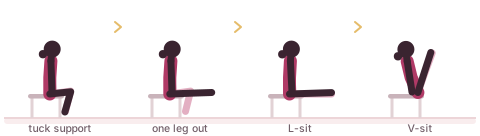
Both holds look still and simple, and both are harder than they look. Most people cannot lift two straight legs on the first try, so the L-sit is usually learned in smaller shapes: knees tucked, then one leg out, then both. The V-sit comes after the L-sit is steady.
This guide follows that order and explains what to check at each step.
The L-sit at a glance
| Question | Answer |
|---|---|
| What it is | A support hold on straight arms with both legs straight and level in front of the hips |
| Where gymnasts use it | Men’s floor, still rings and parallel bars, and as a starting position for presses to handstand |
| Value in the rules | A, the lowest value (0.1), in the men’s Code of Points; a V-sit is a B (0.2) |
| Hold time in competition | 2 seconds from a complete stop |
| Usual first step | Tuck support: knees bent, feet just off the floor |
| Equipment | None needed; low parallettes or two sturdy blocks give the hips more room |
What Is an L-Sit?
In an L-sit the arms are straight and vertical, the shoulders are pressed down away from the ears, and the torso stays upright. The legs are together, straight at the knees and held level, with the toes pointed. Nothing but the hands touches the support.
Two jobs happen at once. The arms and shoulders push down to hold the body up, which gymnasts call support. The hip and abdominal muscles pull the legs up toward the torso and keep them there, which coaches call compression. A gymnast can be strong enough for one and still be stopped by the other.
The men’s Code of Points, the rulebook World Gymnastics publishes for international competition, calls the L-sit and the V-sit basic support positions. It lists them on three apparatus.
| Position | Where the men’s Code lists it | Value |
|---|---|---|
| L-sit or straddle L-sit | Floor (lowered into from a handstand), rings, parallel bars | A (0.1) |
| V-sit | Floor, rings | B (0.2) |
| Manna, a V-sit with the legs horizontal | Floor | C (0.3) |
Each hold has to last two seconds, counted from the moment the gymnast is completely still. A shorter hold costs 0.3 in execution, and a position that never stops earns no difficulty credit. For a learner, the rule points at what to practice: a short, motionless L-sit on straight arms is the skill, and a longer one with bent elbows or sinking legs is something else.
The same standard applies to the other straight-arm strength holds in gymnastics. On rings, the L-sit is one of several static shapes; our guide to still rings positions shows it beside the support hold and the levers. A straddle L-sit is also where a press to handstand often starts.
How to Do an L-Sit, Step by Step
Start on the floor, or on low parallettes or two sturdy blocks if you have them. Raised hands leave more room under the hips and let the wrists stay straighter, so the first lift is easier to find. Warm up the wrists first; our guide to wrist preparation for gymnastics covers how.
- Set the hands. Sit tall with the legs straight and together. Place the hands flat beside the thighs, fingers pointing forward.
- Lock the elbows. Straighten the arms completely before anything leaves the floor. Bent elbows turn the hold into a different exercise.
- Push the shoulders down. Press the floor away until the shoulders drop from the ears and the hips rise. This small movement creates the lift.
- Lift the legs. Let the hips move slightly back between the hands, then pull the legs up to hip height with the knees straight and the toes pointed.
- Hold, then lower. Stay still for two seconds while breathing normally, and set the legs down under control.
If the legs will not leave the floor, that is normal at first. Keep steps 1 to 3, bend the knees for step 4 and work through the shapes in the progression below.
Watch: the L-sit on the floor
This short tutorial from STRIQfit shows the whole sequence on the floor, with each drill labeled on screen. The presenter begins with the shoulder push at 0:14, practicing it alone as a scapular lift, then adds the weight shift and the leg lift at 0:31.
Two parts are worth finding. At 1:09 the presenter shows easier versions for anyone who cannot lift both legs yet: one leg at a time, and the same lift with the upper back resting against a wall. At 1:21 the hands are set so the thumbs sit just under the thighs. That is the presenter’s own reference point for the distance, not a rule.
The presenter also says cramps in the thighs and hips are common in early attempts. Short holds with a rest between them are the usual answer.
L-Sit Progression: From Tuck to Full Hold
Each step keeps the same support and changes only how much leg the hips have to hold up. A useful test for moving on is the competition standard itself: a clean stop, two seconds and straight arms.
| Step | Shape | What to check |
|---|---|---|
| 1. Hip lift | Feet stay on the floor; the hips rise on locked arms | The shoulders move down and the elbows stay straight |
| 2. Tuck support | Knees bent, feet just clear of the floor | The hips hang between the hands without resting on the arms |
| 3. One leg out | One leg straight and level, the other tucked; change legs | The straight knee stays straight, and both sides get practice |
| 4. L-sit | Both legs straight and level | The legs are at hip height from the start of the hold to the end |
| 5. Straddle L-sit | Legs apart, hands between them | Same value as the L-sit in the Code, but a different balance; treat it as its own shape |
There is no official number of seconds for moving on. A few short holds in the correct shape are a better target than one long hold that sags. When the elbows bend or the legs drop, end the attempt.
Leg-lift drills build compression between attempts. The STRIQfit tutorial uses seated lifts: sit with the legs straight, put the hands on the floor beside the knees, or beside the thighs to make it easier, and raise both feet. More of this work is in our gymnastics core exercises.
Common L-Sit Mistakes
| What you see | Likely cause | What to try |
|---|---|---|
| Shoulders up by the ears, hips barely off the floor | The shoulders are not pushing down | Practice the hip lift alone with locked arms, or raise the hands on blocks |
| Elbows bend | The shape is too hard for straight-arm support today | Go back one step and keep the arms straight in every version |
| Knees bend, or the legs sink below level | Compression strength, sometimes tight hamstrings | One-leg holds and seated leg lifts; shorter attempts |
| Chest collapses and the body leans far back | The lean is doing work the hips cannot do yet | Sit tall first, then lift a smaller shape |
| Thigh or hip cramps | Common in early practice | Shorter holds, with a rest between attempts |
| Wrists ache on the floor | The wrists are bent back under load | Warm up, or use parallettes so the wrists stay straighter; stop if it is pain and not effort |
From L-Sit to V-Sit
A V-sit keeps the straight arms of the L-sit and raises the legs steeply, so the torso and legs form a narrow V. The Code’s own drawing shows the legs close to vertical. In the men’s Code it is worth one step more than the L-sit, a B, and the two-second rule is the same.
Three things have to grow for the legs to rise. The hips need more compression strength, because the legs are pulled much closer to the chest. The hamstrings need enough flexibility to allow that fold with straight knees. And the shoulders have to keep pushing down while the arms reach farther back behind the torso.
A coaching session on the SaturnoMovement channel shows how one coach sorts these out. The coach first asks the learner for an L-sit, a V-sit attempt and a shoulder check, then decides that for this learner the limit is the strength to pull the legs closer, not the arms. The work that follows is done with the hands on blocks: from an L-sit, draw the knees in, extend the legs upward and lower them slowly, for only two or three repetitions, with hamstring stretching between sets.
That session is one coach’s plan for one athlete. The reasoning carries over better than the numbers: find the part that is holding the legs down, and train that part.
Beyond the V-sit is the Manna, which the Code describes as a V-sit with the legs horizontal and values at C on floor. It is an advanced strength element. The Code also expects the two to look clearly different: a position halfway between a V-sit and a Manna is deducted and may not be credited as either.
The other classic straight-arm hold on the floor turns the body face down. Our planche progression covers it step by step.
Frequently Asked Questions
Is the L-sit a beginner skill?
In the rules it sits at the lowest value, but it is rarely easy for a beginner. It needs straight-arm support and enough compression to hold both legs level, and most people build up to it through the tuck and one-leg versions.
How long should you hold an L-sit?
Two seconds is the competition standard in the men’s Code of Points. No official training number exists beyond that; hold times in tutorials are the presenters’ own suggestions.
Is an L-sit easier on parallettes than on the floor?
Usually, yes. Raised hands give the hips and feet more clearance and keep the wrists straighter. On the floor there is no spare room, so the shoulders have to push the hips higher for the legs to clear.
What muscles does an L-sit work?
The triceps keep the elbows straight, and the muscles around the shoulder blades push the body up. The hip flexors and abdominal muscles hold the legs level, and the muscles on the front of the thighs keep the knees straight, which is where early cramps tend to show up.
Final Takeaway
An L-sit is a two-second hold on straight arms with the legs straight and level. Learn it in order: lift the hips, hold a tuck, extend one leg, then both.
The V-sit is the same support with the legs lifted higher, and it asks for more compression and more hamstring flexibility. Keep the arms straight in every version, and choose a smaller shape whenever the elbows bend or the legs sink.
Main Sources
- World Gymnastics: Men’s Artistic Gymnastics Code of Points 2025–2028 — the L-sit, V-sit and Manna on floor, rings and parallel bars, the two-second hold rule and the note on positions between a V-sit and a Manna.
- STRIQfit: The Perfect L-Sit Tutorial – Beginner Friendly — the floor sequence, the leg-lift drills and the easier versions.
- SaturnoMovement: L-Sit to V-Sit Tutorial — a coached session on what limits a V-sit.