In artistic gymnastics, men and women share some apparatuses, like vault and floor exercise, but they also compete on equipment unique to their gender.
Men have six events: floor, pommel horse, still rings, vault, parallel bars, and high bar. Women have four: vault, uneven bars, balance beam, and floor. That often leads to a common question: why don’t women compete on the pommel horse and rings?
Historical Roots of Apparatus Division
The story goes back to the early 19th century and Friedrich Ludwig Jahn, known as the “father of modern gymnastics.” Jahn’s Turnverein (gymnastics clubs) in Germany created apparatuses to train men in strength, discipline, and military readiness.
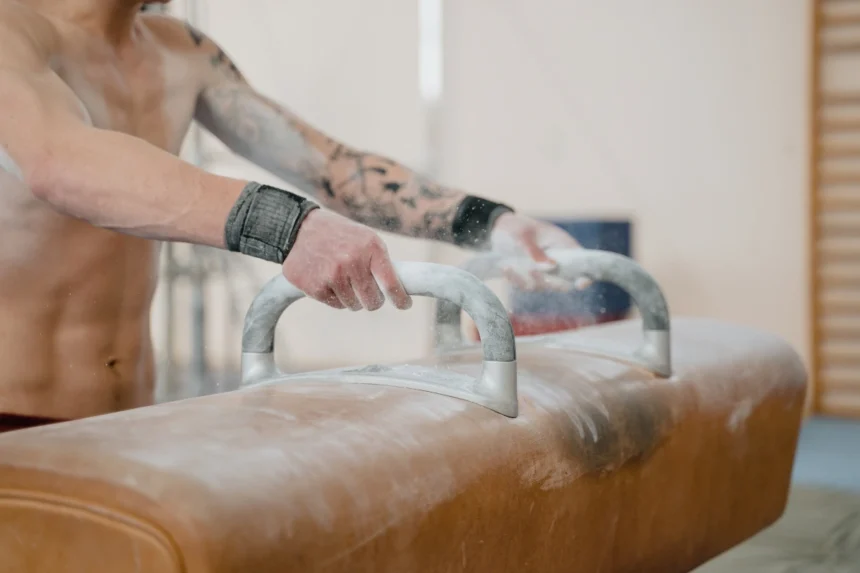
- Pommel horse grew out of the wooden horse soldiers once used to practice mounting and dismounting.
- Rings were designed to test upper-body power, grip, and control while suspended in the air.
When women joined competitive gymnastics in the early 20th century, their program was shaped by very different cultural expectations. Instead of military-style drills, women’s events were designed to highlight grace, artistry, flexibility, and dance-inspired movement.
Biomechanics and Skill Demands
Pommel horse and rings are among the most physically demanding apparatuses, but in very specific ways that matched the goals of men’s training.
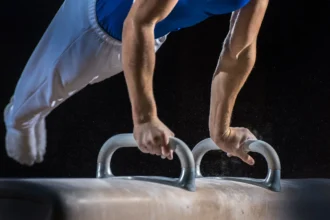
Pommel Horse:
Requires continuous circular hip motion, swing strength, and shoulder endurance. It’s not a skill set built around flexibility or balance, but rhythm and immense arm strength. Errors result in abrupt falls, making it one of the hardest men’s events to master.
Still Rings:
Known as the “crucifix event,” rings demand isometric strength holds (like the Iron Cross) and explosive swing-to-strength transitions. The apparatus is inherently unstable since the rings can move freely, so pure upper-body strength is critical.
While women absolutely can build the strength to attempt these skills, the women’s program evolved to focus on acrobatics, leaps, and balance artistry, keeping pommel horse and rings outside their competition pathway.
The Role of Tradition and Codification
By tBy the mid-20th century, the International Gymnastics Federation (FIG) formally separated men’s and women’s events. From then on:
- Men’s Artistic Gymnastics (MAG): Centered on strength, swing, and endurance apparatuses.
- Women’s Artistic Gymnastics (WAG): Highlighted artistry, dance, balance, and tumbling power.
Once this split was standardized, it became deeply rooted. The Olympic format reinforced it, and training systems followed. Girls were coached on WAG progressions, while boys focused on MAG. Reversing this today would mean redesigning progressions, certifications, and coach education worldwide.
Could Women Compete on Pommel Horse or Rings?
In theory, yes. Some women have trained on these apparatuses in open gyms or non-traditional programs, and the NAIGC (National Association of Intercollegiate Gymnastics Clubs) in the U.S. even allows mixed-gender competition. There, women sometimes perform on pommel horse or rings successfully.
But at the FIG and Olympic level, it’s highly unlikely. Adding new apparatuses would disrupt the balance of the women’s program, lengthen competitions, and run against decades of tradition.
Why Women Compete on Beam and Uneven Bars Instead
Instead of pommel horse and rings, women’s gymnastics introduced balance beam and uneven bars, two events that became defining features of the program.
- Balance Beam: A 10 cm wide surface where gymnasts combine posture, leaps, turns, and acrobatics. It emphasizes precision, control, and elegance, making it unique to women’s gymnastics.
- Uneven Bars: The women’s “swing event.” Instead of holding static strength positions like on rings, gymnasts perform flowing swings, high-flying transitions, and daring releases between two bars of different heights.
Together, these events gave women’s gymnastics its own identity, balancing the explosive power of vault and floor with artistry, rhythm, and creativity.
Common Myths
“Women don’t do rings because they aren’t strong enough.”
False. Female gymnasts train incredible upper-body strength every day, especially for uneven bars. Pull-ups, rope climbs, handstands, and casting drills all require serious muscle power. If rings were part of their events, training would simply shift to prepare for them—and women would be more than capable.
“Men skip beam and uneven bars for the same reason.”
Correct, but not because they can’t. The men’s program was designed differently. Their events emphasize strength and swing, while women’s emphasize artistry and balance. In a way, it’s a mirror image—neither side avoids certain apparatuses because of ability, but because of how the sport evolved.
In short: women could do rings and pommel horse, but the sport chose a different path that made men’s and women’s gymnastics distinct yet equally demanding.